
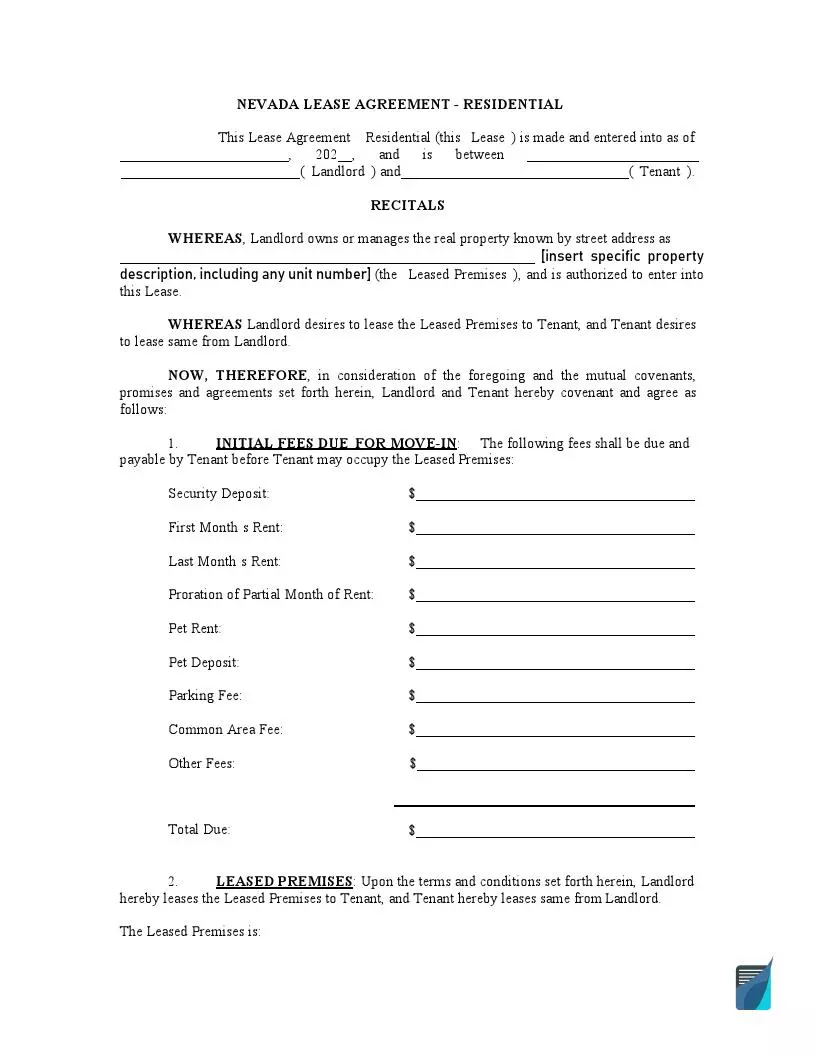
A Nevada lease agreement is a written contract between a landlord and a tenant that sets the rules for renting a property in the state. It names the parties, the property, the rent, and the move-in and move-out dates, and it becomes legally binding once both parties sign it. FormsPal offers eight versions of the Nevada lease agreement. They cover a standard rental, a room, a commercial space, a sublease, and a month-to-month tenancy, each with room for pet policies and other house rules.
Last Updated: September 2026. This guide is reviewed and updated regularly to reflect current Nevada law. If you notice an error or outdated information, please contact us.
Build Your Document
Answer a few simple questions to make your document in minutes
Save and Print
Save progress and finish on any device, download and print anytime
Sign and Use
Your valid, lawyer-approved document is ready
Nevada landlords and tenants should understand the legal rules behind a lease before signing one. FormsPal offers eight versions of the Nevada lease agreement, each built for a different way of renting. Below is the full list, followed by a closer look at the most common versions.
Room Rental Agreement. This version covers a rental property with more than one tenant. Renting a single room is a cheap, convenient option. It should list each tenant's duties, each tenant's share of the rent, any pet rules, and contact details for everyone involved.
Commercial Lease Agreement. This contract version is for business space, such as an office, a store, a parking lot, or a production space, instead of a home.
Month-to-Month Lease Agreement. This version renews each month as long as rent is paid. It is popular because it is flexible and carries little long-term risk.
Termination Lease Letter. This letter tells the other party that the lease is ending. It gives the landlord time to find a new tenant, and the tenant time to find a new place. Send it by mail or courier to keep a record of when it arrived.
Popular Local Rental Lease Agreement Forms
Nevada law sets rules for signing a lease, for the disclosures a landlord must make, and for how rent must be listed. These rules apply to every written Nevada lease.
Nevada also requires two disclosures. If the rental property is in foreclosure, the landlord must tell a prospective tenant in writing before they sign.[2.5] The lease must also list a phone number for someone who lives in the county, or within 60 miles, for the tenant to call in an emergency.[2.4]
Keep your free copy of the signed lease safe. It is the record both parties use if a question comes up about rent, deposits, or notice periods. Fill it in and make changes with our PDF editor before anyone signs.
Nevada sets minimum notice periods for ending or changing a periodic lease without cause. A landlord or tenant ending a week-to-week tenancy must give at least 7 days notice. Ending a month-to-month tenancy takes at least 30 days notice. A landlord raising the rent must warn the tenant at least 60 days ahead, or 30 days for a tenancy shorter than one month.[1]
| Tenancy or Change | Minimum Notice |
|---|---|
| Ending a week-to-week tenancy | At least 7 days |
| Ending a month-to-month tenancy | At least 30 days |
| Rent increase (tenancy of 1 month or longer) | At least 60 days |
| Rent increase (tenancy shorter than 1 month) | At least 30 days |
Counting the days on a notice period is easy to get wrong near a month's end. Use our deadline calculator to confirm the exact date a notice period runs out.
A Nevada security deposit is money the tenant pays upfront that the landlord holds during the tenancy to cover unpaid rent or property damage beyond normal wear and tear. Nevada law sets a deadline for returning the deposit and a cap on late fees, covered below.
After the tenancy ends, the landlord must give the tenant an itemized written accounting and return what remains of the deposit within 30 days.[2.3]
Nevada also limits late fees. A landlord who charges one cannot charge more than 5 percent of the periodic rent. For a tenancy longer than week-to-week, the landlord also cannot impose the fee until at least 3 calendar days after the rent due date.[2.2]
Common mistake: charging a late fee the day after rent is due. Nevada landlords must wait at least 3 calendar days before a late fee can apply, for any tenancy longer than week-to-week.
Nevada also caps the deposit. A landlord may not demand or receive a security deposit or a surety bond, or a combination of the two, including the last month's rent, whose total amount or value exceeds three months' periodic rent (NRS 118A.242(1)).[2.13]
| Document Name | Nevada Rental Lease Agreement Form |
| Other Names | NV Rental Lease, Nevada Residential Lease Agreement |
| Relevant Laws | Nevada Revised Statutes, Chapter 118A |
| Security Deposit Return | Thirty (30) days from end of tenancy |
| Avg. Time to Fill Out | 18 minutes |
| # of Fillable Fields | 119 |
| Available Formats | Adobe PDF |

Nevada gives both parties a chance to fix a violation before the lease can end over it. How long that window lasts depends on which party broke the lease and what kind of violation it was.
A landlord must safely store a tenant's left-behind property for 30 days after an eviction, a lockout, or the end of the rental period. The landlord may charge the tenant the actual cost of inventory, moving, and storage before releasing it. During the 5 days right after an eviction or lockout, the landlord must also let the tenant back in. The tenant may retrieve essential items such as medication, baby formula, basic clothing, and personal care items.[2.12]
A tenant protected under Nevada's domestic violence provisions may end the lease early by giving the landlord written notice. The lease ends at the close of the current rental period, or 30 days after the notice, whichever comes first.[2.7] If the rental property is sold, the new owner must notify the tenant of the change within 30 days of the sale.[2.8]
Nevada renters are protected by rules on late fees, deposits, notices, and disclosures under NRS Chapter 118A. A landlord must cap late fees at 5 percent of rent and wait at least 3 days after the due date to impose one.[2.2] The landlord must also return the security deposit within 30 days of the tenancy ending,[2.3] and give written notice before raising the rent or ending a periodic tenancy.[1]
See the sections above for the full list of rules and their citations.
A Nevada landlord has 30 days after the tenancy ends to give the tenant an itemized written accounting and return what remains of the security deposit.[2.3]
General information, not legal or tax advice.
Unless noted otherwise, the sources below are from the Nev. Rev. Stat..
Other Rental Lease Agreement Forms by State
