
A Nevada bill of sale is a written document that records the sale of a vehicle from a seller to a buyer. The Nevada DMV says a bill of sale must include the seller's name, the buyer's physical address, a complete description of the vehicle, and the date the buyer signed.[2] The Nevada DMV also publishes its own bill of sale, Form VP-104, and a certificate of title or other ownership documents must accompany it.[1] Our free form has a place for each item, and you can fill it in online or download it as a PDF.
Last Updated: October 2026. This guide is reviewed and updated regularly to reflect current Nevada law. If you notice an error or outdated information, please contact us.
Build Your Document
Answer a few simple questions to make your document in minutes
Save and Print
Save progress and finish on any device, download and print anytime
Sign and Use
Your valid, lawyer-approved document is ready
Our website offers several bill of sale templates for specific items you may want to buy or sell. You can edit each one to add your own conditions to the sale.
| Document Name | Nevada Vehicle Bill of Sale Form |
| Other Names | Nevada Car Bill of Sale, Nevada Automobile Bill of Sale |
| DMV | Nevada Department of Motor Vehicles |
| Bill of Sale Required? | No bill of sale is needed when a Nevada title is signed over. For an out-of-state title or no title, Nevada law requires a signed and acknowledged statement of sale, such as the DMV's Form VP-104.[4] |
| Avg. Time to Fill Out | 7 minutes |
The item you are selling decides which bill of sale you need. Pick the template that matches what you are buying or selling: a motor vehicle, a boat, a firearm, or a general item. Each card below shows what the template covers and lets you download it.
Nevada motor vehicle bill of sale records the change of vehicle ownership in a private sale. Use it for a car, a motorcycle, or any other vehicle you buy from a private seller.
| Alternative Name | Car Bill of Sale |
| Seller’s Signature | Signature line included |
| Buyer’s Signature | Signature line included |
| Notarization | Required when the vehicle has no Nevada title |
| Download | PDF Template |

Use a boat bill of sale to record the transfer of ownership when you buy or sell a watercraft. Boat sales are handled separately from road vehicle sales, so use the boat form for watercraft.
| Alternative Name | Vessel Bill of Sale |
| Seller’s Signature | Signature line included |
| Buyer’s Signature | Signature line included |
| Notarization | See the template |
| Download | PDF Template |

Nevada firearm bill of sale records a firearm transfer between two parties. Gun sales have their own rules, and our firearm page covers the details.
| Alternative Name | Gun Bill of Sale |
| Seller’s Signature | Signature line included |
| Buyer’s Signature | Signature line included |
| Notarization | See the template |
| Download | PDF Template |

Use a general bill of sale to record any sale between a buyer and a seller. A typical one lists both parties’ contact details, a description of the item, the price, and signatures.
| Alternative Name | Generic Bill of Sale |
| Seller’s Signature | Signature line included |
| Buyer’s Signature | Signature line included |
| Notarization | See the template |
| Download | PDF Template |
No bill of sale is needed when a Nevada title is signed over. For an out-of-state title or no title, Nevada law requires a signed and acknowledged statement of sale, such as the DMV's Form VP-104 (NRS 482.426).[4] If you use one, the Nevada DMV says it must include four things.[2] Our form covers each of them.
Signatures on the form must be originals, and photocopies are not acceptable. A certificate of title or other ownership documents must also accompany the bill of sale.[1]
Two more rules come from the Nevada DMV page on private party sales. If your vehicle is a 2011 model or newer, you must enter the current mileage in the odometer reading section of the title when you sell it. Any loan or lien on the vehicle must be satisfied before it can be sold.[3]
A sale submitted on a properly endorsed Nevada certificate of title requires no acknowledgment. If the sale goes to the DMV on anything else, such as a title from another state or no title document at all, the law calls for a statement. It describes the vehicle and names the buyer and seller. Both must sign it and acknowledge it, which means confirming the signatures in front of a notary or another official.[4]
Any such statement must be signed and acknowledged by the seller and the buyer.
Check the VIN on the form against the VIN on the title before anyone signs.
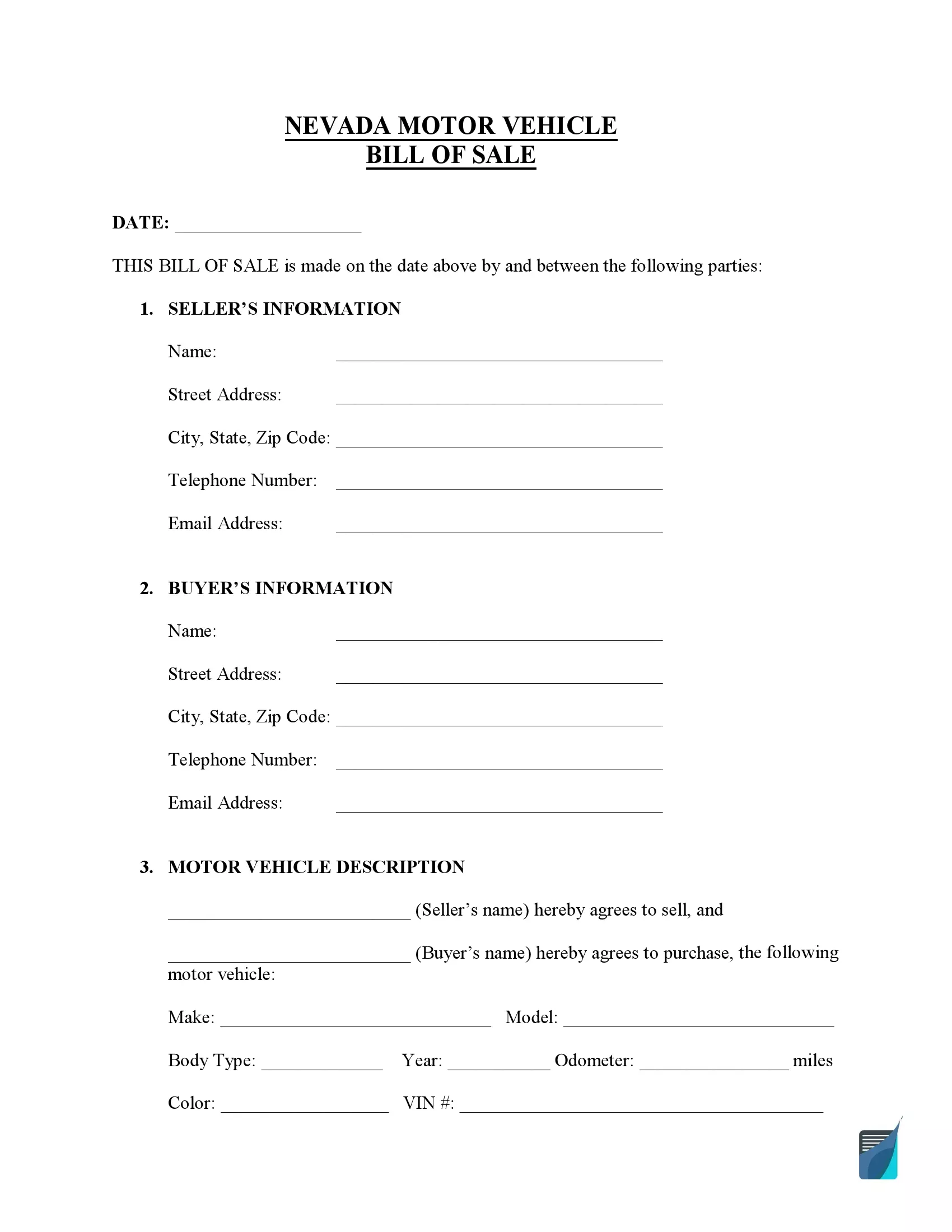
The Nevada vehicle bill of sale form has four pages. Fill it in order: the date, the seller, the buyer, the vehicle, the price and payment, and the signatures. You can complete the PDF with our online PDF editor and print it for signing, because signatures must be originals.[1]
Step 1. DATE
On page 1, write the date on the DATE line at the top of the form.
Step 2. Seller’s Information
Still on page 1, enter the seller’s details in section 1:

Step 3. Buyer’s Information
Section 2 asks for the same details about the buyer:

Step 4. Motor Vehicle Description
In section 3, write the seller’s name and the buyer’s name in the opening sentence. Then enter the vehicle details:

Step 5. Purchase date and total price
On page 2, section 4 starts with the purchase date. Enter it, then write the total price in U.S. dollars.

Step 6. How the price is paid
Check one box in section 4: paid all at once, trade-in, deposit, or gift. A trade-in asks for the buyer’s vehicle details. A deposit asks for the amount, the deposit date, and the date the balance is due.
Step 7. Payment type and taxes
Select cash, check (add the check number), cashier’s check, or money order. Then check whether taxes are included in the purchase price.
Step 8. Miscellaneous Provisions
On page 3, read section 5 before you sign. It has no blanks to fill in.
Step 9. Signatures
In section 6, the seller and the buyer each sign, print their names, and add the date. The form also has a line for a witness signature.

Step 10. Acknowledgment
Page 4 holds the acknowledgment. If you use it, sign in front of the notary.
After a private sale, buyers usually take the paperwork to the Nevada DMV to register the vehicle. The DMV says a certificate of title or other ownership documents must accompany the bill of sale.[1] Check the DMV’s vehicle registration page for current fees, deadlines, and any extra documents before you go. The DMV tells private-party buyers to register the vehicle at a DMV office within 30 days of the purchase.[3] Nevada law also requires the seller or buyer to submit the signed-over title, or the statement of sale, to the DMV within 10 days after the sale (NRS 482.426).[4]
Buyers commonly bring these documents:
If you have only a bill of sale and no title, read our guide on getting a vehicle title with a bill of sale.
Application for Vehicle Registration (Form VP-222) is submitted to the Department of Motor Vehicles.

Use this vehicle power of attorney when you need to give a short-term permit to another person to act on your behalf.

A bill of sale to use for a watercraft title transfer authorized by Nevada state.

Firearms Transaction Record (Form 4473) is required for any firearm transfers and purchases.

These answers cover two common questions about a private car sale in Nevada. The first is how to write a bill of sale for a car. The second is which paperwork a seller needs, based on the Nevada DMV forms and guides listed in the sources below.
Fill in the seller, buyer, vehicle, and price sections of the form in order, then sign it. If your vehicle is a 2011 model or newer, enter the current mileage in the odometer reading section of the title when you sell.[3] Signatures must be originals, and photocopies are not acceptable.[1]
Start with the bill of sale. Signatures must be originals, and a certificate of title or other ownership documents must accompany it.[1] If your vehicle is a 2011 model or newer, you must also enter the current mileage in the odometer reading section of the title when you sell.[3]

Other Nevada Forms
General information, not legal or tax advice.


