
A Nevada firearm bill of sale is a written record of a gun sale, trade or gift. It names the seller and the buyer, describes the firearm by make, model, caliber and serial number, and states the price and how it is paid. Nevada law bars an unlicensed person from selling a firearm to another unlicensed person unless a licensed dealer first runs a background check on the buyer.[2.1]
Last Updated: October 2026. This guide is reviewed and updated regularly to reflect current Nevada law. If you notice an error or outdated information, please contact us.
Build Your Document
Answer a few simple questions to make your document in minutes
Save and Print
Save progress and finish on any device, download and print anytime
Sign and Use
Your valid, lawyer-approved document is ready
Browse more Nevada bill of sale templates or read our general bill of sale guide.
Nevada and federal law each set rules for a firearm sale. Nevada Revised Statutes section 202.2547 requires a licensed dealer to run a background check before one unlicensed person sells a firearm to another.[2.1] Title 18 of the United States Code, section 922, bars selling a firearm to a prohibited person and sets minimum ages for sales by licensed dealers.[1] The rules below name their sources.
No state permit is needed to buy or possess a firearm in Nevada, but a private sale between unlicensed persons must go through a licensed dealer, who runs a background check on the buyer (NRS 202.2547).[2.3]
The dealer who runs that check must follow every federal and state requirement as though selling the firearm from the dealer's own inventory, including recordkeeping (NRS 202.2547). Under federal rules, that means the dealer records the transfer on ATF Form 4473 and runs the NICS check.[2.4]
Carrying a pistol, revolver or other firearm concealed on the person is unlawful without a permit issued under NRS 202.3653 to 202.369 (NRS 202.350). A Nevada resident applies to the sheriff of the county where he or she lives, and a non-resident may apply to the sheriff of any county (NRS 202.3657).[2.5]
Under 18 U.S.C. § 922(a)(1)(A), a person engaged in the business of dealing in firearms needs a federal firearms license. Occasional sales for a personal collection or hobby do not count as engaging in the business (18 U.S.C. § 921(a)(21)(C)).[1.1]
An unlicensed person shall not sell or transfer a firearm to another unlicensed person unless a licensed dealer first conducts a background check on the buyer or transferee in compliance with this section.
In plain words, the check comes first and a licensed dealer runs it. The check applies when both the seller and the buyer are unlicensed persons.[2.1]
A licensed dealer may charge a reasonable fee for conducting a background check and facilitating a firearm transfer between unlicensed persons under this section of the law.[2.2]
Federal law bars selling or otherwise disposing of a firearm or ammunition to anyone the seller knows, or has reasonable cause to believe, is in one of these groups:[1]
Federal law also limits what a licensed dealer may sell. A dealer may not sell a firearm or ammunition to anyone the dealer knows or has reasonable cause to believe is less than eighteen years of age. For a firearm other than a shotgun or rifle, the limit is less than twenty-one years of age.[1]
| Rule | What the law says | Source |
| Background check for a private sale | A licensed dealer first conducts a background check on the buyer when an unlicensed person sells or transfers a firearm to another unlicensed person. | [2.1] |
| Dealer fee | A licensed dealer may charge a reasonable fee for the check and for facilitating the transfer. | [2.2] |
| Prohibited persons | Unlawful when the seller knows or has reasonable cause to believe the buyer is in a barred group. The groups include people under indictment for or convicted of a crime punishable by more than one year, fugitives and unlawful drug users. | [1] |
| Minimum age for dealer sales | Less than eighteen years of age for any firearm. Less than twenty-one years of age for a firearm other than a shotgun or rifle. | [1] |
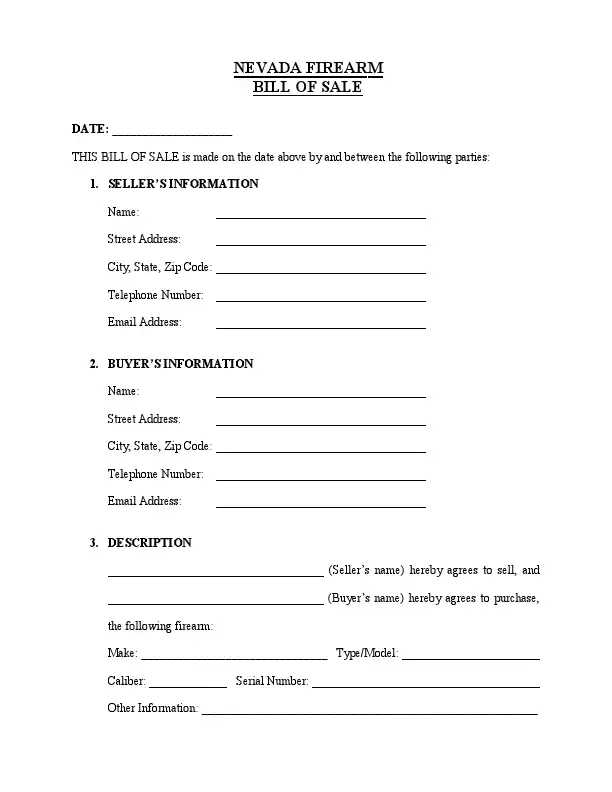
The FormsPal Nevada firearm bill of sale records who sold the firearm, who bought it, which firearm changed hands and on what terms. It also carries a statement from each side, signature lines with a witness line, and a notary acknowledgment page. A signed copy shows the date and the details of the sale.
For more on gun sale paperwork in general, read our firearm bill of sale guide.
Download the free Nevada firearm bill of sale as a PDF, or answer a few questions and create the form online with FormsPal. Fill it in on screen with our online PDF editor or print it and write in the details by hand. Both parties then sign the form and each keeps a copy for their records.
The steps below follow the FormsPal Nevada firearm bill of sale in order, from the date line on page 1 to the notary acknowledgment on page 5. Fill in every blank that applies before anyone signs.
Write the date of the bill of sale on the DATE line at the top.

Fill in the seller's name, street address, city, state and zip code, telephone number and email address.

Fill in the same details for the buyer.
Write the seller's name and the buyer's name in the opening lines. Then describe the firearm:

Enter the purchase date and the total price. Then check one way the price is paid:
Then check how the price is paid: cash, check (add the check number), cashier's check or money order.

Each side reads its own list of statements. The seller's list covers ownership and the condition of the firearm, and the buyer's list covers legal age and the other conditions the buyer confirms. Each party signs under their own list on page 3.
Read these terms together. The seller confirms ownership and that the information is true, and the firearm is sold as is, with no guarantees or warranties. This bill of sale is the only agreement between the two parties, so there is nothing to fill in here.

Enter the date on each date line. The seller and the buyer each sign and print their name. The form also has a line for a witness to sign and print a name.

The last page is a notary acknowledgment. When it is used, the signer appears before the notary, who fills in the county, the date and the names, then signs and seals it. Each party should keep a signed copy of the bill of sale. A separate Nevada notary acknowledgment form is also available.

This answer covers private gun sales in Nevada. It rests on the state and federal sources listed at the end of this page, and it does not replace advice from a licensed attorney about your own sale.
A private sale between two unlicensed people needs a background check first. Nevada law bars an unlicensed person from selling or transferring a firearm to another unlicensed person unless a licensed dealer first conducts a background check on the buyer.[2.1]
General information, not legal or tax advice.
These are the laws behind the numbered markers on this page. Each source opens on an official government website, so you can read the full text of the law yourself.
