
An employment verification letter confirms a person's job details, such as job title, dates of employment and pay. Hiring teams use it to check an applicant's work history, and lenders use it to see steady income before they approve a mortgage or a car loan. Use the free template below, or read on to see what to include, how to reply and how to fill out the form.
Last Updated: October 2026. This guide is reviewed and updated regularly to reflect current law. If you notice an error or outdated information, please contact us.
Build Your Document
Answer a few simple questions to make your document in minutes
Save and Print
Save progress and finish on any device, download and print anytime
Sign and Use
Your valid, lawyer-approved document is ready
An employment verification letter is used to confirm some information about the prospective candidate for a position. The details about a worker might include their job title and department, salary, employment dates, skills, qualifications, etc.
An employment verification letter enables a hiring company to get to know a potential applicant better and make a more informed decision regarding hiring him or her.
Employment verification letters might be also used by landlords or financial institutions if they want to learn more about an individual renting or acquiring a house.
The only formal requirement for an employment verification form is that the details provided in it should be truthful. Other than that, there are no formal requirements for writing such a letter. It means that it might contain various questions regarding a prospective employee. At the same time, the recipient company is not obliged to respond to such a request.
Even though it is not a formal requirement, there is an unwritten rule that companies do not give away information without the written consent of the employee in question accompanied by their signature.
If you are the one who wants to obtain information about the potential employee, you can turn to the company with a minimal set of questions. Here is an example of a request for verification of employment.
Dear Madam/Sir,
Jack Anderson has applied for the job position of Lead Software Engineer with Microsoft Inc., and he mentioned your company as part of his working experience. We would appreciate it if you could assist us in verifying some information that was listed on Jack Anderson’s CV by answering the following questions:
Thank you in advance for a swift response! Please do not hesitate to contact us in case you have any questions.
Faithfully,
Sarah Parkinson
Human Resources Manager
Microsoft Inc.
Email: sarahparkinson@gmail.com
Telephone number: 860-224-9797
However, if you want to learn more about the personality and skills of the potentials employee, you can extend the list of questions. But note that some businesses won’t provide a broader scope of information in order to protect themselves from possible lawsuits from their current or former employee. This is why those companies will provide only easy-to-verify details such as job title, employment dates, and annual salary.
But you can take a chance and still ask them more questions, for example:
In your employment verification letter, add a line above the list of questions with the name of the employee and the words “…hereby permits this information to be shared” . Leave a spot underneath the statement where the applicant can sign and date. This way, you show that the information you ask for is approved by your current or former employee, and you increase your chances to get more info about the applicant.
There are a lot of employment verification letter samples on the net, but if you want to get a customized employment letter template, use our online document builder. It will help you get a proper form in less than five minutes!
Replying to a verification request takes a little care, because your answer goes into someone else's hiring or lending decision. Check your company's own process first, then share only facts that can be verified, such as dates of employment, job title and pay. These three tips show how.
The policy in regards to the release of information at your company might require you to fill out your own employment verification forms, not the ones mailed or faxed over. The corporate policy may also restrict you from disclosing certain information. In some cases, such policies might prohibit you from replying to an employment verification letter at all. This should be figured out before you start responding.
One of the easiest ways to get involved in a lawsuit is to send your current or former employee’s resignation letter, copies of any personal records, or other documents to the requesting company.
Yes, along with standard questions, you might be asked to provide your company’s opinion on the employee in question. No, you shouldn’t do that even if you are asked to. The thing is that negligent answers might get your company into legal trouble.
When responding to the proof of employment letter, try to avoid showing any opinions, and provide only verifiable information such as working periods, salary/wages, etc. Do not put in any information beyond what the employee requests.
The sample letter further down this page shows how these recommendations look in a real reply.
A short reply that sticks to the facts often covers these points:
The job details part of the Employer template, which you can download below, works like this.
In this section, an employer should specify the title of the employee, what working day they have/had (full or part-time), the amount of salary and how often they are/were getting paid, and whether there are/were any bonuses. Along with that, the contacts of the employee have to be added should the requesting company need any further information.
If you want to check whether the letter of verification is legitimate or not, there are certain steps you can take before hiring an individual/approving a home mortgage or a car loan.
Alternatively, if the person is self-employed or has been getting payments in cash, you can ask them to see the forms they used to pay federal taxes for the past several years.
Several groups ask for proof of a job, and each one looks for slightly different details. Knowing who is asking helps you decide what to include in your request or your reply, and how much detail suits the situation.
If you are the one asking, say why you need the letter and who should receive it. If you are the one replying, check that the person asking is the one named in the request before you share anything.
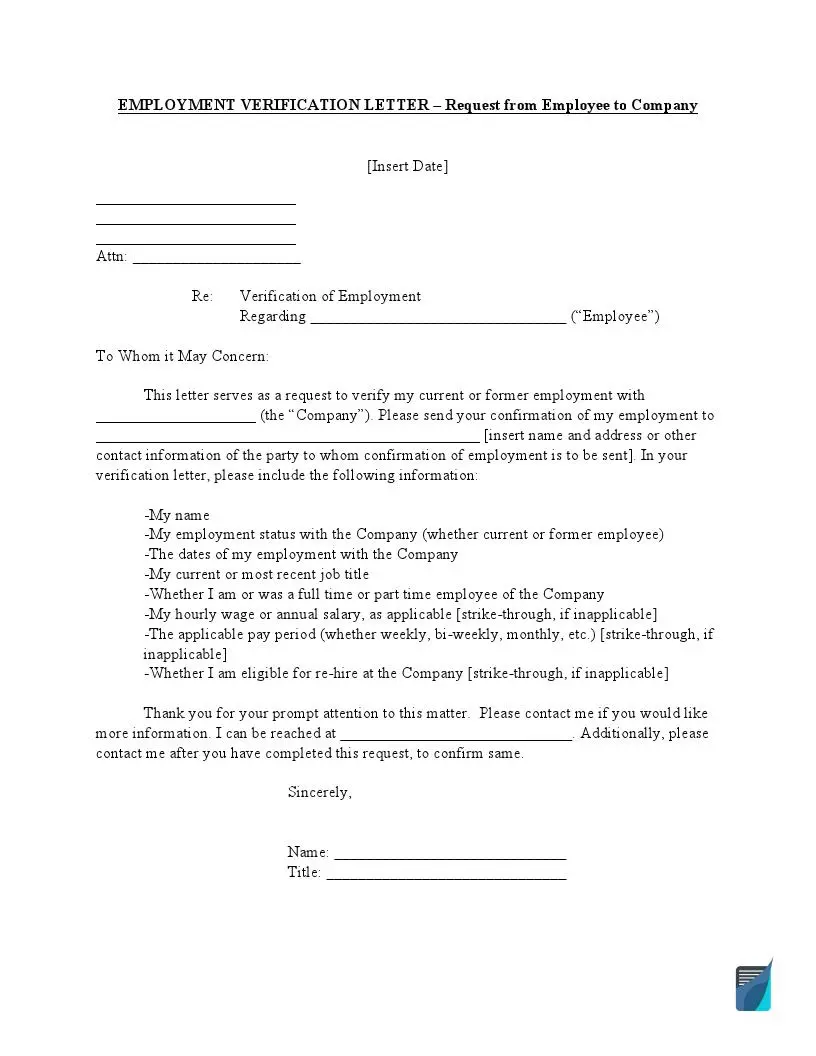
FormsPal offers two Employment Verification Letter templates, and they do different jobs. One is the request that an employee sends to a company. The other is the reply that a company sends back with the job details.
| Employee template | Employer template | |
|---|---|---|
| Who fills it out | The current or former employee | The company or its HR team |
| Purpose | Ask the company to confirm job details | Confirm the job title, hours and pay |
| Main fields | Date, Attn, Regarding, company, recipient, contact details, name and title | Job title, part or full time, hours per week, hourly or salaried, pay frequency and pay rate |
| Best used when | You need proof of employment for a loan, a rental or a new job | You received a request and want to reply in writing |
Not sure which one fits? Start with the Employee template if you need a letter, and with the Employer template if you are the one writing it.
The steps below follow the FormsPal Employment Verification Letter template from the Employee download above, the request an employee sends to a company. You can fill in the downloaded PDF in the PDF editor. The Employer download is the reply letter, with lines for the job title, hours and pay instead of a request list.
The screenshots under each step show the FormsPal Employment Verification Letter template filled with sample entries in blue, so you can see where each answer goes. The names, addresses, dates and amounts are examples only.





Once the template is filled in, a few practical steps turn it into a finished letter. Go through them in order, and keep a copy of everything you send so you can see later what was shared.
This sample is a reply from an employer, written on the same lines as the Employer template. It confirms the job title, the dates of employment and the annual salary, and it gives a phone number for follow-up questions. All names and numbers are made up.
Sheila Woods
Human Resources Manager
M&Ms Corporation
38 Jefferson Avenue
Los Angeles, CA 90003
December 1, 2020
Sarah Parkinson
Human Resources Manager
Microsoft Inc.
52 Aspen Street
Los Angeles, CA 90019
Dear Ms. Parkinson,
This letter is to verify that Jack Anderson was employed at M&Ms Corporation as a Lead Software Engineer from January 5, 2020, to November 1, 2020, with an annual salary of $200,000.
For any additional information regarding Jack, please do not hesitate to contact me at 567-444-1289.
Sincerely,
Sheila Woods
A typical letter confirms the employee's job title, the dates of employment and the pay. Some also state the work schedule, such as full time or part time. The Employer template on this page has lines for each of these details.
Download the free Employee or Employer PDF template from this page. You can also answer a few questions in the online builder at the top of the page and create your own letter in minutes.
Yes, it is legal as no business is obliged by US laws to give a response to such a letter. The only exception is when the request comes from a federal or state agency.
If you get an employment verification request, don’t put it off, as complying with such requests is in everyone’s best interests.
Once again, there is no such requirement in states or federal laws. That means that the company that got an employment verification request might respond within any timeframe.
However, responding within reasonable periods is a common courtesy.
As we have previously mentioned, many businesses would provide only easily checkable details in their response.
Some companies might go further and respond to some of the questions on the list. For example, the question “Would you rehire…?” can result in a cautious response “If qualified.” But such an answer might not reflect a full picture of the potential employee. It might imply that they were fired because of their incompetence. It might also imply that their previous employer will hire them as long as they still qualify for the job.
For the requesting company, this answer might be less than professional, but it would be a wise choice to prevent yourself from any legal issues.
An employment verification letter might be considered a regular business letter for a responding company, but for the employee in question, it might be of much more importance. The response might affect a candidate’s housing, insurance, or future career. This is why the answer should be professional:
General information, not legal or tax advice.

