
Updated:
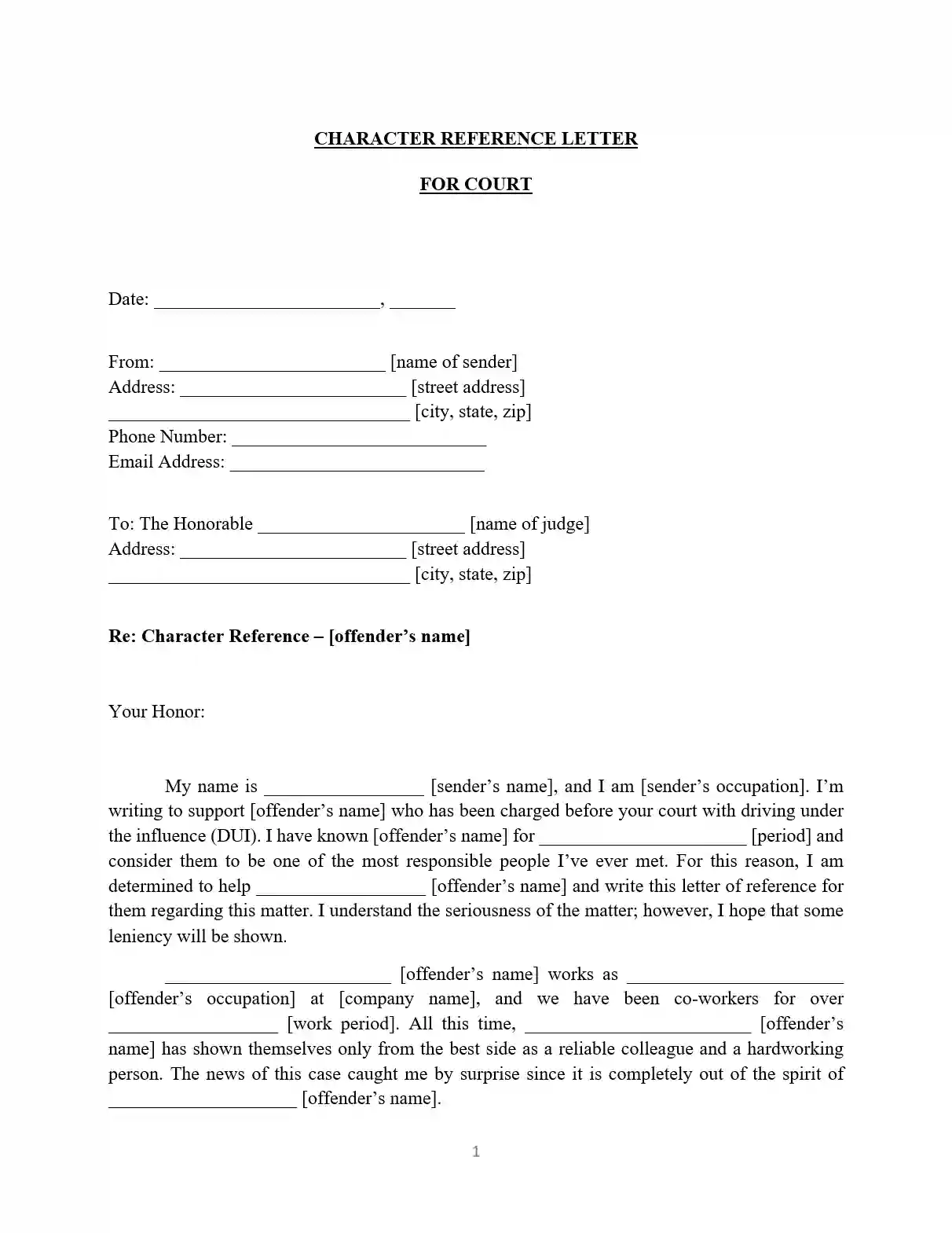
A character letter for court is a signed letter to a judge. This character reference letter gives the court a firsthand view from a friend, relative, coworker or neighbor. Use this page’s builder and sample letters for criminal, custody and DUI cases.
Build Your Document
Answer a few simple questions to make your document in minutes
Save and Print
Save progress and finish on any device, download and print anytime
Sign and Use
Your valid, lawyer-approved document is ready
A character letter for court, also called a character reference letter or a letter of support, is a personal statement to a judge about a person’s character, written by someone who knows them. It is a type of letter of recommendation, written for a judge instead of an employer or a school.
The writer describes what they have seen of the person at home, at work and in the community. The letter does not argue the facts of the case. It is a plain letter and not a court form, so the wording is the writer’s own.
A character letter is a written statement handed in on paper, while a character witness speaks in the courtroom and answers questions there. Whether a case calls for letters, live witnesses or both is a question for the lawyer handling it.
A character letter fits when someone wants to describe a person in their own words, while another document fits when the lawyer needs sworn facts or live answers. These are the usual alternatives:
A character reference letter is most often used at criminal sentencing, in child custody disputes and in DUI cases, where a judge decides something that shapes the person’s future. The letter gives a view of the person that the case papers do not show.
At criminal sentencing, a character letter shows the judge who the person is apart from the offense, and whether the conduct looks unusual for them. In federal cases, 18 U.S.C. § 3553(a)(1) tells the court to consider “the history and characteristics of the defendant,” along with other factors, in choosing a sentence.
18 U.S.C. § 3661 adds that no limitation shall be placed on information about the “background, character, and conduct” of a convicted person that a federal court may receive and consider for sentencing. Those sections cover federal courts. In a state case, ask the lawyer how that court treats character letters.
In a child custody case, a character letter describes how a parent cares for the child, based on what the writer has seen the parent and child do together. The most useful writer knows the family and has watched them over time. Concrete details help most: school drop-offs, medical visits, homework routines and how the parent handles a hard day.
Ask the lawyer whether a letter fits this custody case or whether the court expects a sworn statement instead. Our character letter for child custody page goes further.
In a DUI case, a character reference letter shows the person’s reliability at work and at home, along with any steps they have already taken, such as a responsible drinking program. The writer treats the offense as serious and does not explain it away.
For a letter in an immigration matter, see the character letter for immigration page.
A useful character letter gives a judge firsthand, specific and honest detail from someone who understands why the person is in court. These qualities make a letter easier to trust:
Excessive and unnatural praise can make the whole letter look unreliable. A plain account of what the writer has seen carries more weight than a list of compliments, as this made-up pair of examples shows:
Too general: “Alex is a wonderful person and would never hurt anyone.”
Specific: “When my mother was ill last winter, Alex drove her to treatment every week for months without being asked.”
The best writer of a character reference letter knows the person well and can describe their character from direct experience. Whether that is a friend, an employer or a coach depends on the type of case.
| Writer | What they can speak to | Fits best when |
|---|---|---|
| Friend or neighbor | Everyday conduct and how the person treats others | Any case, when they have known the person for a long time |
| Parent, sibling or other family member | Family role, growth and support at home | Sentencing or custody, with the relationship stated openly |
| Employer or coworker | Work ethic, reliability and diligence | DUI and other criminal cases |
| Teacher or coach | Conduct around children and how a parent shows up | Child custody |
| Faith leader or volunteer coordinator | Service and standing in the community | Sentencing |
| AA sponsor | Effort in recovery that the person agrees to share | DUI, after the person agrees to what is disclosed |
| Substance use counselor | Effort in treatment that the person consents to share | DUI, after the consent described below this table |
A counselor at a federally assisted substance use program generally needs the person’s signed written consent under 42 C.F.R. § 2.31 before disclosing records of that treatment, and should confirm with the program what it may share.
When several people write references, each writer can describe a different side of the person’s life. You do not need a lot of letters: a few specific ones say more than a thick stack that repeats itself.
A mother, father, son or other relative writing a character letter does best by stating the relationship openly and resting the letter on what they have seen themselves. A judge will expect a relative to be loyal, so events matter more than feelings.
A parent writing for a son can describe a job he kept through a hard time or the care he gives a younger sibling. A relative writing for a good mother can describe her school runs, medical visits and everyday routines with her children.
To ask someone for a character letter, choose a person who knows you well, explain the case plainly and ask them to write only what is true. Give them the judge’s name, the case number and the date the lawyer needs the letter.
You can also ask your lawyer to speak to the writer, explain the case and show how the letter can help. Let the writer decide what to say. A letter they would be comfortable standing behind is the only kind worth handing in.
A character reference letter for court follows a plain business letter format, with the writer’s details, the date, the case reference, a greeting to the judge, the body and a signature. This table shows what goes in each part:
| Part | What to write |
|---|---|
| Heading | Your full name and address in the upper left corner of the page |
| Date | The full date you write the letter |
| Case reference | The case number or the person’s name, so the letter can be matched to the case |
| Greeting | A formal greeting to the judge, such as “To: The Honorable Judge” and the judge’s name |
| Introduction | Who you are, your occupation, how you know the person and for how long |
| Body | What you know about the case, the person’s qualities, your examples and any changes since the incident |
| Closing | A short respectful ending with your phone number or email |
| Signature | Your signature with your printed name below it |
Tip: Write in your own words and keep a signed copy of the letter for your records. A plain, truthful letter reads better than a polished one.
To write a character letter for court, introduce yourself, show that you understand the case, describe the person with real examples and close with respect. Keep the letter short and clear, and use only the parts below that are true for you.
Open the character letter by giving your name and occupation, then say how you know the person, how long you have known them and how close you are. Skip the history of every meeting. The judge only needs enough to see why your view counts.
State that you know why the person is before the court, because a character letter from someone unaware of the case tells a judge very little. A short line is enough, such as saying you understand the charge and take it seriously. Do not retell the facts of the case.
Describe the qualities you have seen yourself and attach a real example to each, since an example shows the judge more than an adjective does. An employer can describe the person’s work ethic and diligence. A neighbor can describe how they help others or give time to charity.
Mention hard life circumstances only when you know about them firsthand and the person agrees to have them shared, such as a death in the family or a loss of income. Background helps a judge see the whole picture. Present it as context and never as an excuse.
Explain how the case has affected the person and what they have done since, as long as you have seen it yourself. That part is not needed in every letter. In a DUI case, it could be attending a responsible drinking program. In a custody case, it could be parenting classes or visits to a counselor.
Check with the lawyer before you repeat anything the person has said about the offense. The letter can show remorse you have seen without saying what happened.
Close the letter by saying you understand the seriousness of the matter, thanking the judge for reading it and giving your contact details. Then add your signature and printed name. Include a phone number or email so the lawyer can reach you with questions.
The basic guidelines for a character reference letter are to stick to what you know firsthand, keep a calm and respectful tone, and give a few clear examples of the person’s good character.
A strong character reference letter includes truthful detail that a judge can picture, in language plain enough to follow easily:
Leave out of the letter anything that argues the case for the court, attacks someone else or claims more than you know, because these points weaken the rest:
After you sign a character letter, give it to the person you wrote it for or to their lawyer, and keep a copy for yourself. Go through this short checklist:
Ask the lawyer before you send anything straight to the judge. A person without a lawyer can ask the clerk’s office how this court takes character letters and by what date. Tell the person when the letter is done, and answer quickly if the lawyer asks you to change a detail, as long as the change stays true.
These sample character letters for court are starting points for a general reference, a child custody case and a DUI case. Replace each blank with the real names, dates and details, then adjust the wording so it sounds like you and matches what you know about the person.
The samples are written by a friend, neighbor or coworker. If your relationship with the person is different, change the details so they explain how you really know them.
A family member can adapt any of these samples by naming the relationship in the opening line. Delete every line that is not true for you.
This general character reference letter suits a friend or neighbor writing for a person who faces a criminal charge or sentencing.
Character Reference Letter
From _______________
____________________
____________________
(Write your full name and address)
______________, 20___
(Write the current date here)
Re:_________________
(Write the case number or the name of the accused person)
To: The Honorable Judge ______________ (insert the name of the Judge),
My name is __________________ (your full name), and I am a ______________ (your profession or occupation). I have known __________________ (the person’s full name) as a good friend for over __________________ years (how many years you have known each other). __________________ (the person’s name) was my neighbor for some time before we became close friends, and our families often spend time together.
I am writing this letter of reference because I know why __________________ (the person’s name) is before the court, and I understand the seriousness of this matter. I ask the court to consider what I have seen of their character.
__________________ (the person’s name) is reliable and honest. My spouse and I have left our children in their care many times without any doubt, and they have never accepted money for it.
They also volunteer at __________________ (the organization’s name). When someone asks for help, __________________ (the person’s name) comes without expecting a reward.
In addition to our friendship, __________________ (the person’s name) is a respected member of our neighborhood. I was surprised to hear about this case, because it does not match the person I know. __________________ (the person’s name) has told me they accept responsibility for their actions. (Keep this sentence only if it is true and the lawyer agrees.)
I hope the court will take this letter into account. Despite this case, I continue to consider __________________ (the person’s name) a worthy member of our community.
Sincerely,
__________________
(Affix your signature)
__________________
(Print your name)
This character letter for child custody suits a friend or coworker who has watched a parent and child together over time.
Character Letter for Child Custody
From _______________
____________________
____________________
(Write your full name and address)
______________, 20___
(Write the current date here)
Re:_________________
(Write the case number or the names of the parents)
To: The Honorable Judge ______________ (insert the name of the Judge),
My name is __________________ (your full name), and I am a ______________ (your profession or occupation). I have known __________________ (the parent’s full name) as a good friend for over __________________ years (number of years). We met at my previous place of work, and our families have been close since then. I am writing this letter in support of __________________ (the parent’s name) in the custody case about their child, __________________ (the child’s name).
__________________ (the parent’s name) is kind, patient and honest. Children feel at ease around them, and my family is always happy to spend time with them.
During these years, I have watched __________________ (the child’s name) grow up and have seen how the two of them relate to each other. __________________ (the parent’s name) moves personal plans aside to attend the child’s concert or to drive __________________ (the child’s name) to a competition in another town. From what I have seen, this is one of the most caring and supportive parents I know.
I hope this letter helps the court understand the care I have seen __________________ (the parent’s name) give __________________ (the child’s name).
Sincerely,
__________________
(Append your signature)
__________________
(Print your name)
This character reference letter for a DUI case suits a coworker or close friend who knows about the steps the person has taken since.
Character Reference Letter
From _______________
____________________
____________________
(Write your full name and address)
______________, 20___
(Put the current date here)
Re:_________________
(Write the case number or the name of the accused person)
To: The Honorable Judge ______________ (insert the name of the Judge),
I am writing on behalf of __________________ (the person’s full name). We have been coworkers and close friends for over __________________ years (how many years you have known each other). In that time, I have known them as a reliable colleague and a loving and caring spouse and parent. The news of this case surprised me, because it does not match the person I know.
Recently, __________________ (the person’s name) has faced a series of setbacks: their father, to whom they were close, died, and they also lost a large amount of money. (Describe only what is true and what the person agrees to share.) As a good friend, I saw how hard this was on them. I do not offer this as an excuse.
__________________ (the person’s name) has already started attending a responsible drinking program. (Name the program only if this is true.) From what I have seen, they take this seriously.
I am fully aware of the dangers of drunk driving and consider it a serious matter. I hope the court will take note of what I have seen of __________________ (the person’s name) as a colleague and a friend.
Sincerely,
__________________
(Put your signature)
__________________
(Print your name)
A good character reference letter is short, specific and easy to read, and these answers settle the practical questions writers ask most often.
A single page is a good length for a character reference letter, since a short letter with a few real examples is easier to read. Focus on how the person treats family, coworkers and neighbors.
Address the character letter to the judge handling the case, and write the judge’s name after “The Honorable Judge.” If you do not know the name, ask the lawyer on the case or check the case paperwork.
Many writers simply say whether they know about the charges and then turn to what they have seen of the person’s character. Specific examples of kindness and responsibility tend to influence a reader more than general praise. Ask the lawyer on the case whether other references are being gathered, so the letters do not repeat each other.
How a letter reaches the judge matters, so give it to the lawyer on the case rather than sending it to the judge directly. Under Canon 3A(4) of the Code of Conduct for United States Judges, a federal judge generally should not consider communications about a pending or impending matter made outside the presence of the parties or their lawyers, with listed exceptions. In federal sentencing, 18 U.S.C. § 3661 places no limitation on the character information a federal court may receive and consider. Both of those cover federal courts only, and state rules can differ, so in a state case ask the lawyer or the clerk’s office how that court treats letters. A short and specific letter is also easier for a busy reader to finish.
You can turn down a request to write a character letter, since a letter is a personal favor and you should only sign what you honestly believe. Being called to testify is a separate question: if you receive a subpoena, ask a lawyer what it means for you.
Ask the lawyer or the court clerk whether this court wants a notarized or sworn statement before you pay for a notary. For federal matters, 28 U.S.C. § 1746 lets a dated, signed declaration under penalty of perjury stand in where a sworn written statement is required or permitted, except for a deposition, an oath of office or an oath required before a specified official other than a notary public.
Yes, use the Create My Document button at the top of this page to answer a few simple questions, then save, print and sign the character reference letter. You can also download the Word file and fill it in yourself.
General information, not legal or tax advice.
