
Updated:
A gift affidavit is a sworn statement that an item was a gift. The donor signs it to confirm the recipient owes nothing in return for the money, car or property. The affidavit serves families, especially for cash gifts to relatives and gifted cars.
Key facts

Build Your Document
Answer a few simple questions to make your document in minutes
Save and Print
Save progress and finish on any device, download and print anytime
Sign and Use
Your valid, lawyer-approved document is ready
An affidavit for a cash gift to a relative puts the amount, the date and the no-repayment promise in writing, signed by the relative who gave the money. The statement turns a bank transfer or a check into a gift with a clear paper trail. It answers the most common question about family money: was it a gift or a loan?
A cash gift affidavit needs five details to read clearly. Each one goes into the asset blank or the gift sentence of the form.
Example wording, with made-up names and amounts: “I was the owner of $12,000 in cash, held in my checking account. On May 2, 2026, for the love and affection I bear for my daughter, Jane Doe, I gave her this sum by check as her sole property. I expect no repayment of any part of it.”
A mortgage lender may ask for a signed gift letter when gift money goes toward a down payment. Many lenders use their own gift letter form, so the borrower asks the lender which form it accepts before the donor signs. The affidavit then serves as a second, sworn account of the same gift for the family's own papers.
A gift affidavit is useful whenever someone may later ask whether a valuable item was a gift. Costly items such as motor vehicles, art objects and jewelry are the usual cases. The document is especially relevant for cars, since a gifted vehicle still goes through a title transfer.
The affidavit fits these situations:
Everyday presents, such as a birthday gift from a friend, rarely call for one. The affidavit earns its place when the value is high or the item is unusual to give away, such as a car or an early painting.
The FormsPal form fits on one page and follows the order of a sworn statement: place, donor, asset, gift and signature. Each part answers one question about the gift.
The asset blank holds one plain description of the gift with its value. A good description lets a stranger pick the item out: a make, a model, a serial number or, for money, the amount and the account it came from. The value is the donor's best figure for what the item was worth on the day of the gift.
The gift sentence says the donor gave the asset “for the love and affection” they bear for the donee. The same printed sentence adds “and other good and valuable consideration”, a stock phrase that recites something of value given in return. The IRS treats as a gift a transfer where full consideration is not received in return (IRS, Frequently asked questions on gift taxes), so a donor who received nothing can strike that phrase or check it with a lawyer. The printed lines about age, sound mind and personal knowledge do not by themselves make the page sworn, since an affidavit is a written or printed statement made under oath (U.S. Courts, Glossary of Legal Terms).
Tip: Write the names of the donor and the donee the same way everywhere they appear, and check them against each person’s ID before you print.
The affidavit has three parts to fill in, in the order they appear on the page. The steps below follow the FormsPal template from top to bottom.
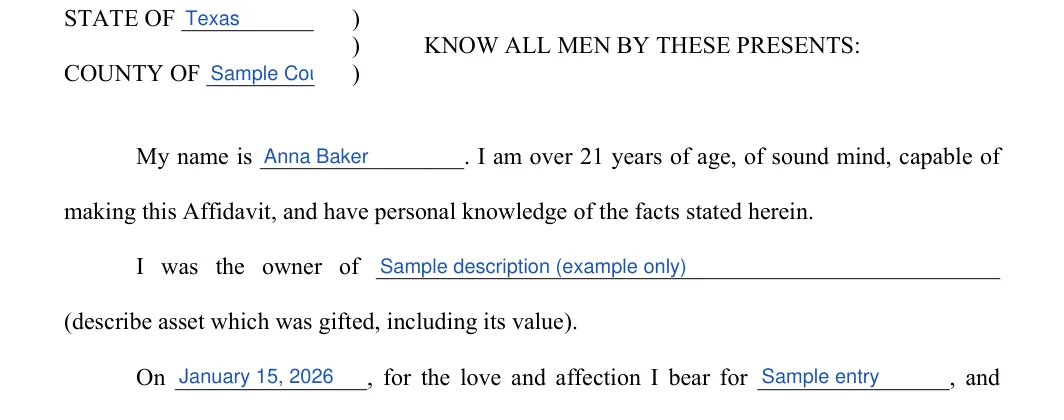
The screenshots under each step show the FormsPal Gift Affidavit template filled with sample entries in blue, so you can see where each answer goes. The names, addresses, dates and amounts are examples only.
Under the AFFIDAVIT OF GIFT heading, enter the state where you are signing in the STATE OF blank.


Enter the county in the COUNTY OF blank and write your name in the first sentence. The sentences about your age, sound mind and personal knowledge are already printed on the template.
In the blank after “I was the owner of,” describe the asset you gave away and include its value. Then enter the date of the gift and the name of the person receiving it in the sentence that begins with the date.
What you might write in the document is: “On [Date of making a gift] for the love and affection I bear for [name of the donee] and other good and valuable consideration, I gave to him/her, as his/her sole property, the aforementioned asset.”

The closing sentence about your intent to make a gift is already printed. Enter the date in the Dated blank, sign on the signature line and print your name beneath it.


The signed affidavit does its job only when the right people can see it. These steps keep it ready for use.
A gift affidavit for a car names the vehicle by year, make, model and VIN and says the donor gave it with no payment in return. The affidavit records the gift itself; it does not transfer the title. The title transfer goes through the motor vehicle agency where the car is titled, and its paperwork differs from one state to another, Florida and Pennsylvania included.
Searches for a “car gift letter for a family member” look for the same thing in looser form. The affidavit is the sworn version: the donor states the gift under their signature rather than in a simple letter.
A gift affidavit is a sworn statement, while a gift letter is a plain signed letter. Both say a transfer was a gift and name the donor, the donee and the item or amount. The affidavit adds the donor's statement of age, sound mind and personal knowledge, which makes it the more formal of the two.
A mortgage lender usually asks for a gift letter, often on its own form. For a car, a costly item or any office that asks for a sworn account, the affidavit is the closer fit. FormsPal also has a gift letter template, and more sworn forms sit under affidavit forms.
The affidavit describes a gift, and the IRS treats as a gift any transfer to an individual where full consideration is not received in return (IRS, Frequently asked questions on gift taxes). The general rule is that any gift is a taxable gift, with several exceptions (IRS, Frequently asked questions on gift taxes). An affidavit does not decide whether tax is due; the value and the kind of gift do.
The IRS FAQ lists these gifts as generally not taxable gifts:
The donor is generally responsible for paying the gift tax, according to the IRS FAQ on gift taxes; under special arrangements the donee may agree to pay it instead (IRS, Frequently asked questions on gift taxes). Making a gift does not ordinarily affect the donor's federal income tax (IRS, Frequently asked questions on gift taxes). The IRS gift tax return is Form 709 (IRS, Frequently asked questions on gift taxes). A tax professional can say whether a particular gift calls for one.
Most weak affidavits fail on a vague asset description or mismatched names. These habits keep the finished page clear.
A gift affidavit is a sworn written statement by the person who gave a gift. It names the donor, the recipient and the item, and says the item was given as a gift.
The donor signs it. The FormsPal template speaks in the donor's words, from the description of the asset to the closing sentence about the intent to make a gift.
An affidavit is a statement made under oath (U.S. Courts, Glossary of Legal Terms), so the donor normally signs it under oath before a notary or another officer who administers oaths. The FormsPal template ends with the date, the donor's signature and printed name, with no block for the oath officer, so one is added below the signature. The office that receives the affidavit can confirm what it accepts.
The FormsPal template is a general form with blanks for the state and county where you sign. An agency in your state may publish its own gift form, for example for vehicle transfers, so check with the office that will receive it.
Yes, the asset blank can describe more than one item. List each item with its own value, so every part of the gift is easy to identify.
A gift affidavit becomes a sworn statement once the donor signs it under oath, since an affidavit is a written or printed statement made under oath (U.S. Courts, Glossary of Legal Terms). Signed without an oath, the template reads as a signed gift statement rather than an affidavit. A qualified lawyer can answer questions about your own circumstances.
General information, not legal or tax advice.
