A Nevada small estate affidavit is a sworn written statement that a person with a right to succeed to a dead person's property signs to collect that property without waiting for probate. Nevada's small estate law, Nev. Rev. Stat. § 146.080, limits the value of the property to $150,000 for a surviving spouse and $25,000 for any other claimant.[1.4] It also requires a wait of at least 40 days after the death,[1.1] no real property in the estate,[1.2] and no pending or granted petition for a personal representative.[1.3]
Last Updated: October 2026. This guide is reviewed and updated regularly to reflect current Nevada law. If you notice an error or outdated information, please contact us.
Create a free high quality Nevada Small Estate Affidavit online now!
Build Your Document
Answer a few simple questions to make your document in minutes
Save and Print
Save progress and finish on any device, download and print anytime
Sign and Use
Your valid, lawyer-approved document is ready
... or download your Nevada Small Estate Affidavit Form as a PDF file
Nevada Revised Statutes § 146.080 sets four conditions for using a small estate affidavit. The estate must stay under a value limit, at least 40 days must have passed since the death, the property must include no real property, and no petition for a personal representative may be pending or granted. The sections below take each condition in turn.
Value limit: the gross value of the decedent's property in Nevada must not exceed the applicable amount.[1.2] That amount is $150,000 if the claimant is the surviving spouse and $25,000 for any other claimant.[1.4]
What the value leaves out: amounts owed to the decedent for service in the armed forces, and the value of any motor vehicles registered to the decedent.[1.2]
Waiting period: at least 40 days must have passed since the death. The person claiming does not need letters of administration or a probated will, and the affidavit can be used whether the decedent died with a valid will or without one.[1.1]
No real property: the property must not include any real property, any interest in real property, or any mortgage or lien on it.[1.2]
No personal representative: no petition for the appointment of a personal representative may be pending or have been granted in any jurisdiction.[1.3]
On the form you swear that you have the right, under NRS 146.080, to succeed to the decedent's property. You also swear that you are personally entitled to full payment or delivery of the property claimed, or that you claim it on behalf of and with the written authority of all other successors who have an interest in it.[1.1]
The statute defines the value limit in one sentence. Here is its wording:
As used in this section, “applicable amount” means: (a) If the claimant is the surviving spouse of the decedent, $150,000. (b) For any other claimant, $25,000.
The form prints both value limits as check boxes: $150,000.00 if you are the surviving spouse and $25,000.00 if you are not. Check the one box that fits you before you sign.
This page covers Nevada only. For how the document works in other states, see our general small estate affidavit page.
The affidavit must also state that all debts of the decedent, including funeral and burial expenses, have been paid or provided for (Nev. Rev. Stat. § 146.080(2)(f)). The statute does not require the person claiming to have paid them personally.[1.5]
Nevada Small Estate Affidavit Laws Details
Max. Estate
$150,000 (surviving spouse) and $25,000 (any other claimant)[1.4]
Other Nevada Forms
Consider our tool to customize any template on FormsPal to your requirements. Here is a number of some other widely-used Nevada documents we provide.
Create a free high quality Nevada Small Estate Affidavit online now!
Filling Out the Nevada Small Estate Affidavit Form
The PDF on this page is the Affidavit of Entitlement for Estates Pursuant to NRS 146.080 from the State of Nevada Self-Help Center (selfhelp.nvcourts.gov). The form prints no form number or revision date. It is one page, and the 7 steps below follow its order. Its first paragraph is printed for Clark County: it says the decedent left "an estate in the County of Clark, State of Nevada". If the property is in another Nevada county, ask the person or company holding the property, or that county's self-help center, which form to use. The statewide self-help site sends Clark County and Washoe County filers to those counties' own self-help sites, and Washoe County publishes its own version of the affidavit. The PDF is fillable, so you can type the answers on screen, or print it and write them by hand.
The screenshots under each step show the Affidavit of Entitlement, the official Nevada form, filled with sample entries in blue, so you can see where each answer goes. The names, addresses, dates and amounts are examples only.
State and county (top of the form). Enter the state and county where you will sign the affidavit in front of a notary on the STATE OF and COUNTY OF lines.Step 1: sample entries, not a real document.
Your name and the decedent's death (first paragraph). Write your name after "I, (your name)". Your address goes at the bottom of the form, under your signature. Then write the decedent's name, the county and state where the death happened, the day and month of death and the last two digits of the year (the form prints the "20"), and the state where the decedent lived at the time of death. The paragraph ends with two printed statements: the decedent left "an estate in the County of Clark, State of Nevada", and the estate did not include real property or a lien on it. The Clark County words are printed, not a blank to fill in. If the property is in another Nevada county, ask the person or company holding the property, or that county's self-help center, which form to use before you go on.Step 2: sample entries, not a real document.
Your value limit (check one box). Check the first box if you are the decedent's surviving spouse. It states that the gross value of the estate is not over $150,000.00. Check the second box if you are not the surviving spouse but have a right to succeed to the property, or are a beneficiary under the decedent's will. It states that the gross value is not over $25,000.00. Both boxes leave out amounts owed to the decedent for service in the Armed Forces of the United States and the value of motor vehicles registered to the decedent. Check only one box.Step 3: sample entries, not a real document.
The property you claim. On the line after "Decedent's estate consists of the following", list each asset you need transferred, such as a bank account, stock certificate, insurance proceeds or a payroll check, and the portion of it you claim.Step 4: sample entries, not a real document.
Who holds the property. The next paragraph states that you have the right under NRS 146.080 to succeed to the entire portion of the property, unless you state otherwise, and to have it transferred to you. On the line below it, write the person, representative or company that has custody of the property, such as the bank that holds the account.Step 5: sample entries, not a real document.
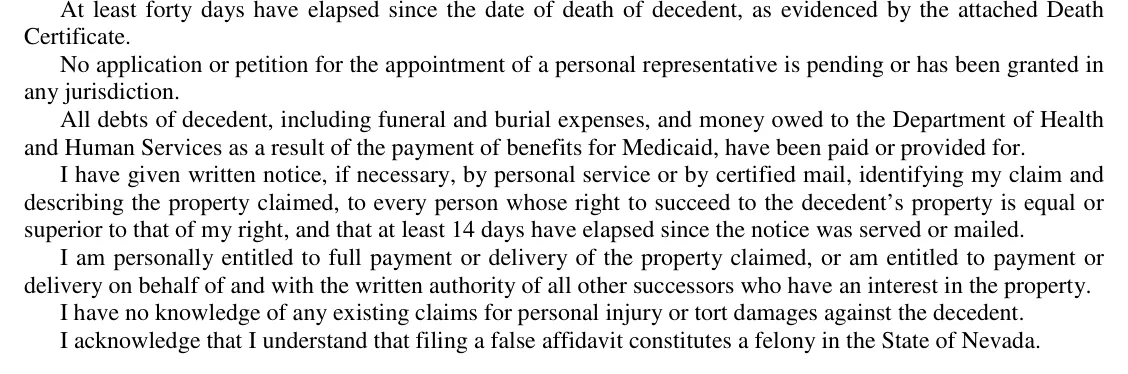
The statements you swear to. The rest of the form is printed statements, so read each one before you sign. They say that at least forty days have passed since the death, as shown by the attached death certificate, and that no application or petition to appoint a personal representative is pending or has been granted anywhere. They also say that all of the decedent's debts, including funeral and burial expenses and money owed to the Department of Health and Human Services for Medicaid benefits, have been paid or provided for. You confirm that, if necessary, you gave written notice of your claim by personal service or certified mail to everyone whose right to the property is equal to or greater than yours, and that at least 14 days have passed since. You also confirm that you are entitled to the property yourself, or on behalf of and with the written authority of all other successors, and that you know of no claims against the decedent for personal injury or other damages (tort claims). The last line warns that filing a false affidavit is a felony in Nevada. Attach the death certificate to the form.Step 6: sample entries, not a real document.
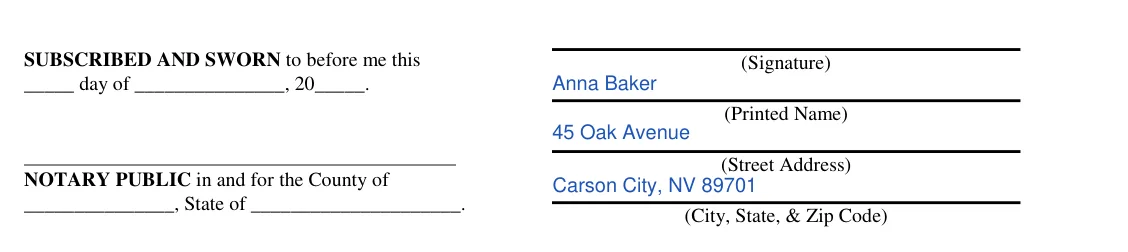
Signature, address and notary (bottom of the form). The notary block says the affidavit is subscribed and sworn before the notary, so sign on the (Signature) line in front of the notary. Then print your name, street address, and city, state and ZIP code on the lines below. The notary fills in the date and the NOTARY PUBLIC lines on the left. The statewide self-help site says this affidavit avoids the need to file anything in court. Give the signed affidavit and the death certificate to the person or company you named as holding the property.Step 7: sample entries, not a real document.
These answers come from Nev. Rev. Stat. § 146.080, the Nevada law that sets the conditions for a small estate affidavit. They cover the value limit, the waiting period, real property and personal representatives.
Do I Need Probate for a Small Estate?
Not when the estate qualifies. Nevada lets a person with a right to succeed to the decedent's property collect it 40 days after the death, without getting letters of administration or waiting for a will to be probated.[1.1] The estate must stay within the applicable amount, which is $150,000 for a surviving spouse and $25,000 for any other claimant.[1.4]
What is the amount for a small estate affidavit?
Nevada sets two amounts, depending on who claims the property:
$150,000 if the claimant is the surviving spouse of the decedent.
The value does not count amounts owed to the decedent for armed forces service or motor vehicles registered to the decedent.[1.2]
How much does an estate have to be worth to go to probate in Nevada?
Nevada's small estate affidavit is open only while the estate stays within the applicable amount. That amount is $150,000 when the claimant is the surviving spouse and $25,000 for any other claimant.[1.4]
Can real property be claimed with a small estate affidavit?
The statute says the property must not include any real property, any interest in real property, or any mortgage or lien on it.[1.2]
Does a pending personal representative petition matter?
Yes. No petition for the appointment of a personal representative may be pending or have been granted in any jurisdiction.[1.3]
Mara has been practicing estate planning and trust law in California since 2003, taking pride in helping clients of all backgrounds and asset profiles form a complete and customized estate plan. Her specialties are: estate planning, wills and trusts, trust and probate administration.