
A Nevada non-compete agreement is a written contract in which an employee promises not to work for a competitor after the employment ends. Under NRS Nevada law, that promise is void unless it meets four tests in Nev. Rev. Stat. § 613.195.[1] The free FormsPal template has blanks for the term, the competitors, the area and the county.
Last Updated: October 2026. This guide is reviewed and updated regularly to reflect current Nevada law. If you notice an error or outdated information, please contact us.
Build Your Document
Answer a few simple questions to make your document in minutes
Save and Print
Save progress and finish on any device, download and print anytime
Sign and Use
Your valid, lawyer-approved document is ready
A non-compete agreement is a promise by an employee not to compete with the employer after leaving. Employers use these agreements to protect the business from a former employee who joins a competitor or takes customers and staff along. In Nevada, courts enforce the promise only if it passes the tests in the law section below.[1] For a national overview, see our general non-compete agreement template.
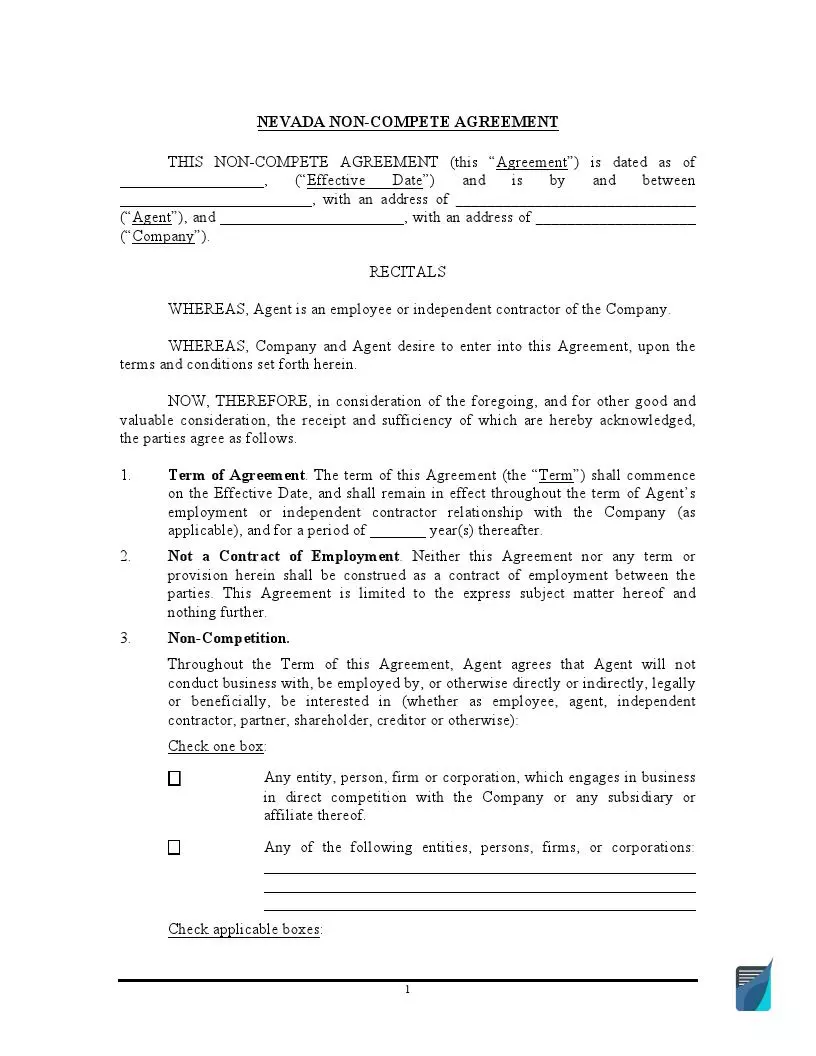
The free Nevada non-compete agreement is a three-page form between an Agent, who is an employee or independent contractor, and a Company. It names Nevada law and asks for a Nevada county. You fill in the blanks and check the boxes that apply. These are its parts:
The form says it is not a contract of employment. For contractors, FormsPal also has an independent contractor non-compete agreement template.
In NRS Nevada terms, the non-compete rule is Nev. Rev. Stat. § 613.195, part of the Nevada Revised Statutes. A noncompetition covenant, which is the statute's name for a non-compete promise, is void and unenforceable unless it passes four tests. Here are the statute's words:
A noncompetition covenant is void and unenforceable unless the noncompetition covenant: (a) Is supported by valuable consideration; (b) Does not impose any restraint that is greater than is required for the protection of the employer for whose benefit the restraint is imposed; (c) Does not impose any undue hardship on the employee; and (d) Imposes restrictions that are appropriate in relation to the valuable consideration supporting the noncompetition covenant.
In plain words, the promise needs valuable consideration behind it. It may not go further than the employer needs for its protection, and it may not cause the employee undue hardship. Its restrictions must also fit the consideration given in return.[1]
Under Nev. Rev. Stat. § 613.195(2), a noncompetition covenant may not restrict a former employee from serving a former customer or client who voluntarily chose to leave and seek the employee's services. This holds when the former employee did not solicit the customer or client and otherwise complies with the covenant's limits on time, geographical area and scope of activity.[1]
If your employment ends because of a reduction in force, a reorganization or a similar restructuring, a noncompetition covenant is only enforceable while the employer is paying your salary, benefits or equivalent compensation, including severance pay (Nev. Rev. Stat. § 613.195(5)).[1]
A court can revise a covenant instead of ending it. This applies when valuable consideration supports the covenant and one of these is true:
In those cases, the court must revise the covenant to the extent necessary and enforce it as revised.[1]
Either side can bring the case. An employer can sue to enforce a covenant, and an employee can sue to challenge one.[1]
These short answers come from Nev. Rev. Stat. § 613.195, the Nevada rule on non-compete covenants. They cover what voids a covenant, whether non-competes are legal, and what an employer can ask of a former employee. For a specific situation, contact a Nevada attorney.
A noncompetition covenant is void and unenforceable unless it meets all four of these conditions:
Nevada's statute sets conditions for a non-compete rather than banning it. A covenant that fails them is void and unenforceable. A covenant also may not apply to an employee who is paid solely on an hourly wage basis, exclusive of any tips or gratuities.[1]
It is enforceable when it meets the four conditions of the statute. If it has valuable consideration but its limits on time, area or scope are not reasonable, courts revise it to the extent necessary and enforce it as revised.[1]
Yes, when the covenant meets the four conditions in Nev. Rev. Stat. § 613.195 and does not apply to an employee paid solely on an hourly wage basis.[1]
A non-compete agreement can do that, but only if it meets the statute's conditions. A covenant that does not is void and unenforceable.[1]
Popular Local NCA Forms
A lot of firms frequently want to prevent their workers from turning into the company’s competitors when their relationship ends. Different US states have different constraints and policies involving non-compete covenants. Here are some of the most requested local NCAs looked up by people.

General information, not legal or tax advice.
