
A Minnesota non compete agreement is a written contract in which a worker promises not to work for a competitor or start a rival firm. Minnesota law makes any covenant not to compete contained in a contract or agreement void and unenforceable. The exceptions are a covenant agreed upon during the sale of a business and one agreed upon in anticipation of the dissolution of a business.[1] The free FormsPal template records the parties, the term and the signatures.
Last Updated: October 2026. This guide is reviewed and updated regularly to reflect current Minnesota law. If you notice an error or outdated information, please contact us.
Build Your Document
Answer a few simple questions to make your document in minutes
Save and Print
Save progress and finish on any device, download and print anytime
Sign and Use
Your valid, lawyer-approved document is ready
A Minnesota non compete agreement is a contract between an employer and a worker. The worker agrees not to take a job with a competing firm, or open one, while the working relationship lasts and for a stated time after it ends. Employees, partners and independent contractors can all be the worker.
Employers use non compete agreements to protect information such as:
A clear written form helps employers and employees see what the employment relationship allows after it ends.
Minnesota's statute on covenants not to compete is Minn. Stat. § 181.988. Its main rule is quoted here, and the statute then covers the points listed after the quote, such as who counts as an employee and what happens in a sale of a business.[1]
Any covenant not to compete contained in a contract or agreement is void and unenforceable
Under Minn. Stat. § 181.988, a covenant not to compete does not include a nondisclosure agreement or an agreement designed to protect trade secrets or confidential information, so those agreements are not void under this rule.[1]
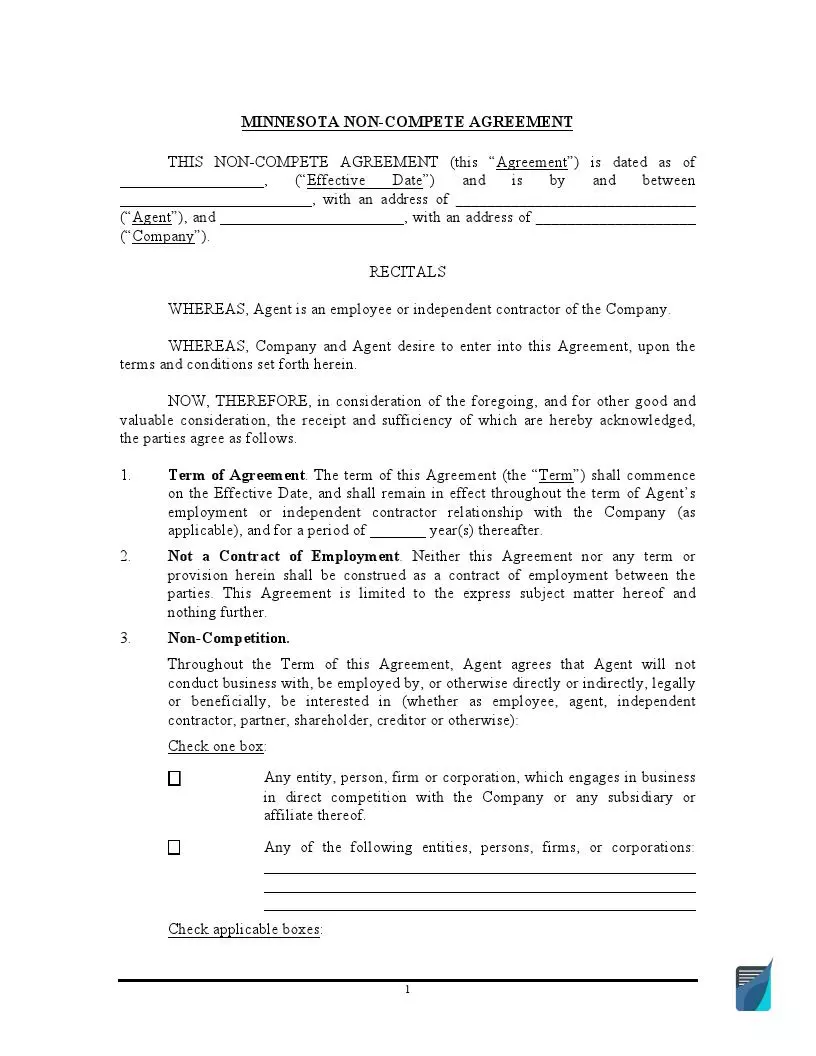
In this section of the statute, "employee" means any individual who performs services for an employer, including independent contractors.[1] The FormsPal form names the worker the Agent and says the Agent is an employee or independent contractor of the employer.
A covenant not to compete is valid and enforceable if it is agreed upon during the sale of a business or in anticipation of the dissolution of a business.[1] The person selling the business, the partners, members or shareholders, and the buyer may agree on a temporary and geographically restricted covenant. It may keep the seller from carrying on a similar business within a reasonable geographic area and for a reasonable length of time.[1]
If goods change hands in the same deal, the Minnesota bill of sale form records that transfer.
Minnesota limits what an employer can require of employees who primarily reside and work in Minnesota. As a condition of employment, the employer may not require the employee to agree to a provision that would do either of the following:
A void covenant does not take the rest of the contract down with it. The invalidity of a covenant not to compete does not make any other provision in the same contract or agreement void or unenforceable.[1]
Nothing in this subdivision shall be construed to render void or unenforceable any other provisions in a contract or agreement containing a void or unenforceable covenant not to compete.
An employee who enforces these rights can ask the court for attorney fees. In addition to injunctive relief and any other remedies available, a court may award an employee who is enforcing rights under this section reasonable attorney fees.[1]
Whether the sale-of-a-business exception fits your situation depends on the facts of your deal. Read the statute and ask a lawyer licensed in Minnesota before you sign anything.
The FormsPal Minnesota form has three pages. It is made between a worker, called the Agent, and an employer, called the Company. The recitals say the Agent is an employee or independent contractor of the employer. You fill in the names, the addresses, the effective date and the number of years the term runs after the working relationship ends, then each party signs.
Fill in every blank before you sign, and keep a signed copy for each party. To complete the downloaded non compete form on a screen, use the PDF editor. If your employees live and work elsewhere, choose the non-compete agreement template page for their location.
Most problems with a signed form start with a blank that was skipped or a box that was left unchecked. Before the Agent and the Company sign, go through each point on the form.
Non compete agreements are also called NCAs, noncompete agreements or covenants not to compete. The FormsPal form calls the worker the Agent and the employer the Company.
Under Minn. Stat. § 181.988, any covenant not to compete contained in a contract or agreement is void and unenforceable. The statute makes an exception for a covenant agreed upon during the sale of a business.[1]
A covenant not to compete contained in a contract or agreement is void and unenforceable under Section 181.988 of the Minn. Stat. A covenant agreed upon during the sale of a business is valid and enforceable.[1]
In Minnesota, the statute voids a covenant not to compete in a contract or agreement. The covenant is valid and enforceable where the sale-of-a-business exception applies.[1]
A covenant not to compete in your contract is void and unenforceable under Minn. Stat. § 181.988, unless it was agreed upon during the sale of a business.[1] Employers and employees should both ask a lawyer licensed in Minnesota about their own non compete agreements.
General information, not legal or tax advice.
Popular Local NCA Forms
In Minnesota, a covenant not to compete in a contract or agreement is void and unenforceable under Minn. Stat. § 181.988, apart from narrow exceptions such as one agreed upon during the sale of a business. Discover more about the most common states requested by our website users with regards to non-compete forms.

Other NCA Forms by State
