
A Minnesota bill of sale is a written record of a vehicle sale between a seller and a buyer. It names both parties, describes the vehicle and states the price and the date of sale. A titled vehicle is transferred on the certificate of title itself, and for a vehicle not subject to titling a bill of sale can assign ownership.[2] It must identify the vehicle and include the date of sale and the buyer’s name.[1]
Last Updated: October 2026. This guide is reviewed and updated regularly to reflect current Minnesota law. If you notice an error or outdated information, please contact us.
Build Your Document
Answer a few simple questions to make your document in minutes
Save and Print
Save progress and finish on any device, download and print anytime
Sign and Use
Your valid, lawyer-approved document is ready
| Document Name | Minnesota Vehicle Bill of Sale Form |
| Other Names | Minnesota Car Bill of Sale, Minnesota Automobile Bill of Sale |
| DMV | Minnesota Driver and Vehicle Services |
| Role of the Bill of Sale | For a vehicle not subject to titling, a bill of sale that identifies the vehicle and includes the date of sale and the buyer’s name can assign ownership[1] |
| Avg. Time to Fill Out | 15 minutes |
| # of Fillable Fields | 62 |
Different items need different Minnesota bill of sale forms. FormsPal offers a motor vehicle form, a boat form, a firearm form and a general form for items such as furniture, machinery, motorcycles, bicycles and trailers. Pick the one that matches what you are selling, and note that this page walks through the vehicle form step by step. You can also browse all bill of sale forms.
Minnesota bill of sale for a vehicle records the sale of a car, truck or other motor vehicle. It lists the vehicle, the seller, the buyer, the price and the date of sale, so both people keep the same written record.
| Alternative Name | Car Bill of Sale |
| Seller’s Signature | Signature line on the form |
| Buyer’s Signature | Signature line on the form |
| Notarization | Acknowledgment page on the form |
| Download | PDF Template |

Minnesota bill of sale for a boat records the sale of a boat between two private parties. It lists the boat, the seller, the buyer, the price and the date. The Minnesota DNR watercraft application is listed under Relevant Official Forms below. A Minnesota watercraft license is valid for three calendar years, or the part of that period that starts in the year it is issued, and expires on December 31 of the last year (Minn. Stat. § 86B.401, subd. 5).[3]
| Alternative Name | Vessel Bill of Sale |
| Seller’s Signature | Seller signs |
| Buyer’s Signature | Buyer usually signs |
| Notarization | Check the requirements for your transaction |
| Download | PDF Template |

Minnesota bill of sale for a firearm records the transfer of a firearm. It lists the firearm, the seller, the buyer, the price and the date. The Minnesota permit application is listed under Relevant Official Forms below. A private sale of a pistol or semiautomatic military-style assault weapon must go through a licensed firearms dealer, or the buyer must show a valid transferee permit and a current state or federal ID (Minn. Stat. § 624.7134, subd. 2).[4]
| Alternative Name | Gun Bill of Sale |
| Seller’s Signature | Seller signs |
| Buyer’s Signature | Buyer usually signs |
| Notarization | Check the requirements for your transaction |
| Download | PDF Template |

A general bill of sale in Minnesota records the key details of a deal. It works for items such as furniture, livestock, machinery, art pieces, motorcycles, bicycles and trailers. Many people also keep one as a personal record of a transaction.
| Alternative Name | Generic Bill of Sale |
| Seller’s Signature | Seller signs |
| Buyer’s Signature | Buyer usually signs |
| Notarization | Check the requirements for your transaction |
| Download | PDF Template |
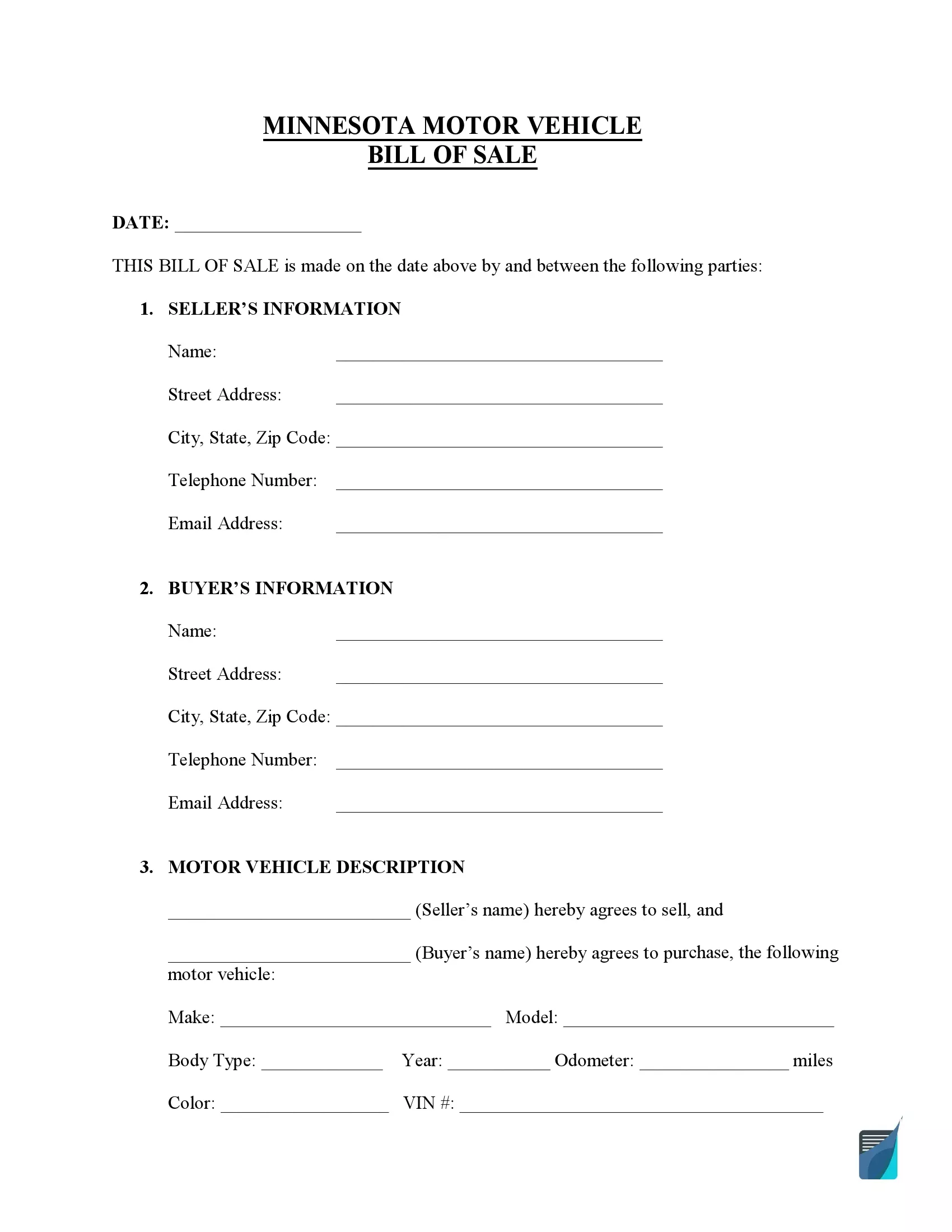
Fill in the Minnesota motor vehicle bill of sale in the order the form shows it, from the date on page 1 to the acknowledgment on page 4. You can create the form online or fill in the PDF with our PDF editor. Have the seller’s and the buyer’s details, the VIN and the odometer reading ready.
Step 1: Date of Document
On page 1, enter the date at the top of the form.

Step 2: Seller’s Information
Fill in the seller’s details in the first section:

Step 3: Buyer’s Information
Fill in the same details for the buyer in the second section.

Step 4: Motor Vehicle Description
Write the seller’s name and the buyer’s name in the agreement lines. Then describe the vehicle:

Step 5: Purchase Date, Purchase Price and Method
On page 2, enter the purchase date and the total price in U.S. dollars. Then tick how the price is paid:
Next, tick one payment method: cash, check with its number, cashier’s check or money order. Finish with one taxes box, either included in the price or not included.

Step 6: Miscellaneous Provisions and Signatures
Page 3 starts with the miscellaneous provisions, which have no fields to fill in. Read them before you sign. Then the seller and the buyer each sign, print their name and date their line. The form also has a witness line with a signature, a date and a printed name.

Step 7: Acknowledgment
Page 4 holds the acknowledgment for a notary. Minnesota has no statute that requires a bill of sale to be notarized, so this page is for parties who choose to use it. If you do, sign before the notary. The notary completes the county, the date and the officer’s name, then adds a seal.

A Minnesota vehicle sale has a seller side and a buyer side. The seller signs over the title and reports the sale, and the buyer applies for a new certificate of title. These duties come from Minn. Stat. § 168A.10.[2]
The seller has these tasks:
The buyer has a deadline. The buyer must act within 20 calendar days after assignment to the buyer of the vehicle title certificate. In that time the buyer must execute the application for a new certificate of title in the space provided on the certificate. The buyer must also cause the certificate to be mailed or delivered to the department.[2] Count the days with our deadline calculator.
A vehicle that is not subject to titling follows a different path. The seller may assign ownership on the back of the Minnesota registration card, on an application for Minnesota registration (PS2000) or on a bill of sale. The bill of sale must identify the vehicle being sold and include the date of sale and the name of the buyer.[1]
Fees change often, so check the Minnesota DVS pages before you go. You can apply at a DVS Deputy Registrar’s office. DVS also explains the registration tax and the wheelage tax. Papers people often gather:
Application to Title and Register a Vehicle in Minnesota

Use a motor vehicle power of attorney if you plan to authorize someone else to address the DMV on your behalf.

Use a Minnesota Uniform Firearm Application Permit to Carry a Pistol to get a permit to carry a weapon in Minnesota. This application must be submitted in person.

These answers cover how to sell a car in Minnesota and how the title changes hands. Each one is based on Minn. Stat. § 168A.10 or the Minnesota DVS guide listed under Sources, so you can check the wording yourself.
The seller signs over the title and delivers it to the buyer immediately. Within ten days of the date of sale, the seller returns the "Notice of Sale" to the department. A sale by or to a licensed motor vehicle dealer is outside that rule. The buyer then applies for a new certificate of title within 20 calendar days.[2]
Two people each have a task. The seller executes the assignment and warranty of title and reports the sale. The buyer executes the application for a new certificate of title.[2] A signed bill of sale gives both of you a written record of the price and the date.
At the time of delivery, the owner executes an assignment and warranty of title to the buyer. The seller states the actual selling price in the space provided on the certificate. The seller also states the true cumulative mileage registered on the odometer, or that the actual mileage is unknown if the reading is known to differ from the true mileage.[2]

Other Minnesota Forms
General information, not legal or tax advice.

