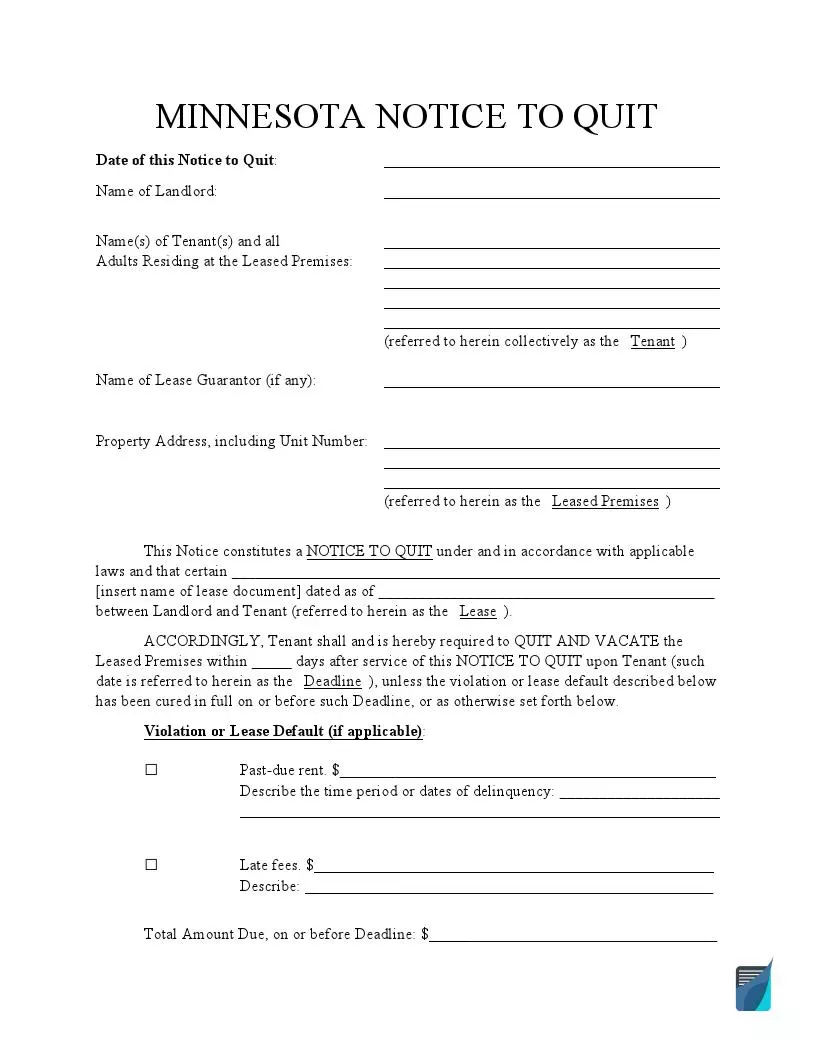
A Minnesota eviction notice is a written notice a landlord serves on a tenant to end the tenancy for nonpayment of rent, a lease violation, or without cause, before the landlord can file an eviction case in court. Minnesota law gives a tenant at least 14 days to pay the rent due or move out before the landlord can file for nonpayment.[3]
Last Updated: September 2026. This MN eviction notice guide is reviewed and updated regularly to reflect current Minnesota law. If you notice an error or outdated information, please contact us.
A landlord may not force a tenant out through self-help. State law limits what a landlord can do outside the court process to retake the property, cut off utilities, or take control of a tenant's belongings.[1] Use the builder below to create a Minnesota eviction notice for your situation.
Minnesota Eviction Laws
Minnesota's eviction rules are found in chapter 504B of the Minnesota Statutes. For nonpayment of rent, a landlord must give the tenant a written notice at least 14 days before filing an eviction case. The tenant can avoid the case by paying what is owed or moving out within that window.[3]
The court eviction action itself is governed by Minn. Stat. §§ 504B.281 to 504B.371, the Eviction Actions part of chapter 504B. The ban on self-help removal sits in § 504B.225 and the notice rule for ending a tenancy at will in § 504B.135.[4]
Minnesota Eviction Notice Laws Details
| Rent Grace Period | Not specified |
| Notice of Non-Payment | 14 days[3] |
| Notice of Non-Compliance | Not specified |
| State Laws | Minn. Stat. §§ 504B.225, 504B.285, 504B.321[1][2][3] |
Special notice rules apply if the rental property changes hands. After a foreclosure, the new owner must give a qualifying tenant a minimum of 90 days' written notice to vacate, timed to the redemption period or the end of the tenant's lease term. Where a contract for deed is terminated, the tenant must get a minimum of two months' written notice to vacate.[2]
- Tenant with no lease or a short lease after foreclosure: a minimum of 90 days' notice to vacate, given no sooner than the redemption period ends.
- Tenant with a longer lease after foreclosure: the new owner must let the tenant stay through the end of the lease term, and give a minimum of 90 days' notice to vacate effective no sooner than the lease expires.
- Tenant under a terminated contract for deed: at least two months' written notice to vacate, given no sooner than one month after the termination period expires.
Eviction Notice Types Used in Minnesota
Minnesota landlords use two main notices. A 14-day notice covers a tenant who does not pay rent on time, and a notice to quit ends a month-to-month tenancy without a lease violation. Fill in the eviction notice template with the property address, the tenant's name, and the reason before you serve it.
A Minnesota eviction notice is also called a notice to quit or a notice to vacate. All three names describe the same document.
- 14-Day Notice to Quit (Nonpayment of Rent). The tenant has 14 days from the date of the notice to pay the amount due or vacate before the landlord can file an eviction case.[3]
- Notice to Quit (Month-to-Month or No-Cause Termination). Used to end a tenant-at-will's tenancy without a lease violation. The written notice must be at least as long as the interval between rent due dates, or three months, whichever is less, so a month-to-month tenancy needs at least one full rental period's notice (Minn. Stat. § 504B.135).[5] A tenant who stays on the property after the tenancy ends by this notice can be evicted through an unlawful detainer action.[2]
Keep a copy of your MN eviction notice and proof you delivered it, in case the case goes to court.
Create a free high-quality Minnesota Eviction Notice online now!
Eviction Process in Minnesota
When a tenant does not respond to the eviction notice, the next step is usually a court case. The landlord files a complaint with the court, the tenant may answer at the court appearance set in the summons, either party may demand a jury, and the court or jury then decides the case (Minn. Stat. §§ 504B.321, 504B.335).[6]
- Serve the notice. Choose the notice that matches the reason for eviction, fill in the correct terms, and deliver it to the tenant.
- File with the court. If the tenant does not move out or fix the problem, the landlord starts the eviction action by filing a complaint with the court and pays the court's civil filing fee when that first paper is filed (Minn. Stat. §§ 504B.321, 357.021).[7]
- Notify the tenant. Once the case is filed, the landlord has the documents delivered to the tenant, usually through a process server, so the tenant knows the trial has started.
- Let the tenant respond. A tenant who disagrees with the case can file an Eviction Action Answer to raise a defense before the hearing.
- Complete the eviction. If the court or jury finds for the landlord, the court enters judgment for recovery of the premises and issues a writ of recovery of premises and order to vacate, and the officer who executes it gives the tenant 24 hours to leave before removing the tenant (Minn. Stat. §§ 504B.345, 504B.365).[8]
A landlord cannot force a tenant out without a court order. Minnesota law makes it a misdemeanor for a landlord, or someone acting for the landlord, to force a tenant out or lock them out. It is also a misdemeanor to shut off electricity, heat, gas, or water to force the tenant out without going through the courts.[1]
“A landlord, an agent, or person acting under the landlord's direction or control who unlawfully and intentionally removes or excludes a tenant from lands or tenements or intentionally interrupts or causes the interruption of electrical, heat, gas, or water services to the tenant with intent to unlawfully remove or exclude the tenant from lands or tenements is guilty of a misdemeanor.”
A Minnesota eviction case usually involves a few standard court forms. The landlord's complaint and the summons start the case, the tenant may answer at the first court appearance, and a writ of recovery of premises and order to vacate carries out the judgment if the tenant does not leave. Minnesota law also prescribes the forms of the summons and the writ (Minn. Stat. §§ 504B.321, 504B.335, 504B.345, 504B.361).[4]
- Eviction Action Complaint (HOU102). The landlord files this complaint to start the eviction action and pays the court's filing fee when it is filed (Minn. Stat. §§ 504B.321, 357.021).[3]
- Eviction Action Answer (HOU202). The tenant can file this form to respond to the landlord's complaint and raise a defense.
- Writ of Recovery of Premises and Order to Vacate. When the court or jury finds for the landlord, the court immediately issues this writ, and the officer who executes it demands that the tenant leave within 24 hours and, if the tenant does not, removes the tenant and puts the landlord in possession (Minn. Stat. §§ 504B.345, 504B.365).[9]
What Are the Rules for Eviction in Minnesota?
Along with the notice periods above, Minnesota gives tenants several defenses and protections once a landlord files an eviction case. These rules limit retaliation, limit evicting a victim of certain acts, and limit the fees a court can require during the case.[2]
- Retaliation defense. In a nonpayment case, a tenant has a defense if the landlord raised the rent or cut services as a penalty for a lawful act the retaliation provision protects. The tenant must prove this by a preponderance of the evidence and tender to the court or the landlord the rent due under the tenant's original obligation. If the landlord served the notice to quit within 90 days of that protected act, the burden shifts to the landlord to prove the notice was not retaliatory.[2]
- A landlord may not start an eviction case against a tenant solely because the tenant was the victim of an act the statute lists, or because the tenant used a statutory right to terminate the lease early. A landlord who violates this can be liable for the tenant's reasonable attorney fees and costs to clear the record.[2]
- A landlord can combine a claim of nonpayment of rent with a claim of a lease violation in the same case, and the court hears them as alternative grounds. When both are combined, the tenant gets up to seven extra days to pay any rent the court finds due.[2]
- A Minnesota court cannot require a tenant to post rent with the court as a condition of raising a claim, defense, or counterclaim related to the landlord's utility billing or practices.[2]
Each rule above cites its official Minnesota Statutes source.
General information, not legal or tax advice.
Sources
Unless noted otherwise, the sources below are from the Minn. Stat..
- Minn. Stat. § 504B.225.
- Minn. Stat. § 504B.285.
- Minn. Stat. § 504B.321.
- Minn. Stat. ch. 504B.
- Minn. Stat. § 504B.135.
- Minn. Stat. § 504B.335.
- Minn. Stat. § 357.021.
- Minn. Stat. § 504B.365.
- Minn. Stat. § 504B.345.
With over 25 years of experience as a business and transactional attorney, Jennifer has mastered the craft of closing highly successful deals for her clients. Through her wide-ranging expertise in commercial contracts, real estate transactions, M&A and corporate law, Jennifer secures results that are second-to-none.