
Minnesota LLC Operating Agreement

A Minnesota LLC operating agreement is a written document that sets out how a limited liability company is owned and run. Minnesota law defines the operating agreement as the agreement of all the members, including a sole member. It can be oral, in a record, implied, or any combination of these.[1]

Last Updated: October 2026. This guide is reviewed and updated regularly to reflect current Minnesota law. If you notice an error or outdated information, please contact us.
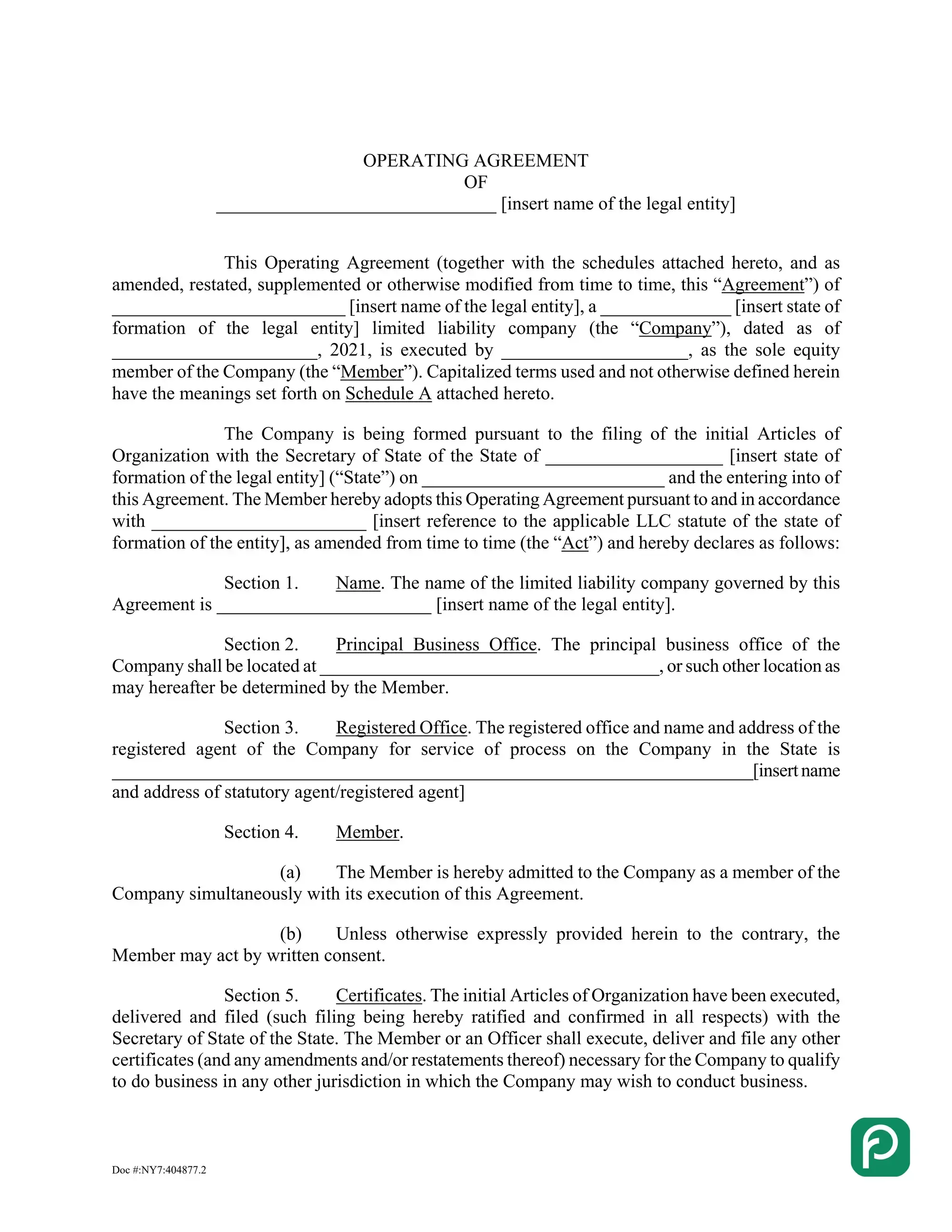
Minnesota LLC operating agreement preview

Create a free high quality Minnesota LLC Operating Agreement online now!

Build Your Document

Answer a few simple questions to make your document in minutes

Save and Print

Save progress and finish on any device, download and print anytime

Sign and Use

Your valid, lawyer-approved document is ready

Download the Minnesota LLC Operating Agreement: PDF or Word (.docx) or OpenDocument (.odt)

A written agreement gives the owners one place to check how the business runs and which rules apply. You can complete our fillable LLC operating agreement template online with FormsPal's step-by-step builder.

What Is a Minnesota LLC Operating Agreement?

In Minnesota, the operating agreement is the agreement of all the members of a limited liability company, including a sole member.[1] It governs how the owners deal with each other and with the LLC. It also governs the rights and duties of a manager or governor, the company's activities, and how the agreement can be amended.[2]

"Operating agreement" means the agreement, whether or not referred to as an operating agreement and whether oral, in a record, implied, or in any combination thereof, of all the members of a limited liability company, including a sole member, concerning the matters described in section 322c.0110, subdivision 1.

Minn. Stat. § 322c.0102[1]

Three points follow from the statute:

  • The agreement does not have to be a signed document. The definition covers an agreement that is oral, in a record, implied, or any combination of these.[1]
  • A one-owner LLC can have one. The definition includes a sole member.[1]
  • The LLC chapter fills any gap. To the extent the agreement does not otherwise provide for a matter it can govern, the chapter governs that matter.[2]
The definition includes oral and implied agreements. In practice, a signed written agreement gives the owners a record to check if they later disagree about what they agreed.

What a Minnesota Operating Agreement Cannot Change

Owners can set most of their own terms, but Minnesota's LLC chapter sets legal requirements that limit what an operating agreement may do. Under section 322C.0110, the agreement may not do any of the following. The list puts each of those requirements in plain words.[2]

  • Change the LLC's capacity to sue and be sued in its own name.
  • Change the law that applies under section 322C.0106.
  • Change the power of the court under section 322C.0204.
  • Eliminate the duty of loyalty, the duty of care or any other fiduciary duty, except as subdivisions 4 to 7 allow.
  • Eliminate the contractual obligation of good faith and fair dealing under section 322C.0409, subdivision 4, except as subdivisions 4 to 7 allow.
  • Unreasonably restrict the duties and rights stated in section 322C.0410.
  • Change the power of a court to decree dissolution in the circumstances in section 322C.0701, subdivision 1, clauses (4) and (5).
  • Change the requirement to wind up the LLC's business under section 322C.0702, subdivisions 1 and 2, clause (1).
  • Unreasonably restrict a member's right to bring an action under sections 322C.0901 to 322C.0906.
  • Limit the right to approve a merger, conversion or domestication under section 322C.1015 to a member that will have personal liability for the surviving, converted or domesticated organization.
  • Restrict the rights under the chapter of a person who is not a member, manager or governor, except as section 322C.0112, subdivision 2 provides.

Do not assume every clause in a template is allowed. Compare each clause with this list before you sign. That is a simple compliance step. Ask a licensed Minnesota attorney about any clause that comes close to one of these limits.

The first limit protects a power the statute gives every Minnesota LLC. Under section 322C.0105, subdivision 1, a limited liability company has the capacity to sue and be sued in its own name and the power to do all things necessary or convenient to carry on its activities.[3]

What an Operating Agreement Can Change

Inside those limits, the members can reshape several duties and protections in the agreement itself. The agreement can set a method for approving an act that would otherwise breach the duty of loyalty. It can also move a responsibility from one owner to others, and limit what members, managers and governors owe the LLC in money damages.[2]

  • Approval of a loyalty conflict. The agreement may specify the method by which a specific act or transaction that would otherwise violate the duty of loyalty is authorized or ratified by one or more disinterested and independent persons after full disclosure of all material facts.
  • Shifted responsibilities in a member-managed LLC. If the agreement expressly relieves a member of a responsibility and puts it on one or more others, it may also eliminate or limit any fiduciary duty that went with that responsibility, for the benefit of the person who was relieved.
  • Indemnification. The agreement may alter or eliminate the indemnification that the statute gives a member, manager or governor under section 322C.0408, subdivision 2.
  • Liability for money damages. The agreement may eliminate or limit a member's, manager's or governor's liability to the LLC and its owners for money damages.

The last point has exceptions. The agreement cannot eliminate or limit liability for:

  • breach of the duty of loyalty
  • a financial benefit that the person received but is not entitled to
  • a breach of a duty under section 322C.0406
  • intentional infliction of harm on the LLC or an owner
  • an intentional violation of criminal law

Terms a Court Can Invalidate

A court decides any claim that a term of an operating agreement is manifestly unreasonable. It judges the term as of the time it became part of the agreement, and it considers only circumstances that existed then.[2]

The court may invalidate the term only on one ground. Given the LLC's purposes and activities, it must be readily apparent that either the term's objective is unreasonable or the term is an unreasonable means to reach its objective.[2]

What the FormsPal Minnesota Form Contains

FormsPal's Minnesota form has 31 numbered sections and three schedules. Section 8 sets the company up as manager-managed, with a Board of one or more Managers. The rest of the form falls into these groups:

  • Basics, Sections 1 to 5: name, principal business office, registered office, the member and certificates.
  • Purpose and management, Sections 6 to 9: purposes, powers, managers and officers.
  • Liability and money, Sections 10 to 15: limited liability, capital contributions, additional contributions, allocation of profits and losses, distributions, fiscal year, books and records.
  • Membership and exit, Sections 16 to 22: other business, exculpation and indemnification, assignment, resignation, admission of additional members, dissolution and waiver of partition.
  • Closing terms, Sections 23 to 31: third-party rights, severability, entire agreement, governing law, amendments, counterparts, notices, effectiveness and disregarded entity status.
  • Schedules A to C: definitions, the member with the managers and officers, and the initial capital contribution.

Most of this text is fixed. You only fill in the blanks and tick the boxes. Sections 8 to 15 on management, money and records are the essential ones to read closely before you sign. The steps below show where each blank is.

How to Fill Out the FormsPal Minnesota Form

FormsPal's Minnesota form is a single-member operating agreement. It names one owner as the sole equity member of the LLC and runs 15 pages, including Schedules A to C. Have the LLC's name, the registered agent's details and the date the Articles of Organization were filed ready. Then work through the form in this order.

  1. Page 1, title and preamble: enter the LLC's name, the state of formation, the date and the Member's name as the sole equity member. The date line already prints the year 2021, so correct it if you sign in a different year.
  2. Page 1, second paragraph: enter the state, the date the Articles of Organization were filed with the Secretary of State and the reference to the Minnesota LLC statute.
  3. Sections 1-3, page 1: repeat the LLC name, enter the principal business office address, and enter the name and address of the registered agent.
  4. Section 6, Purposes, page 2: check one box. Either describe the business in the blank or check All matters permitted by applicable law.
  5. Section 8, Managers, page 2: enter the initial number of Managers. Their names go on Schedule B.
  6. Section 8(g), Compensation, page 3: select one of the two boxes, either that expenses may be paid or that there is no compensation or reimbursement. The second box is on page 4.
  7. Section 9, Officers, page 4: check either The Company shall not have Officers or The Company shall have Officers.
  8. Section 15, Fiscal Year, page 6: enter the date the fiscal year starts and the date it ends.
  9. Section 30, Effectiveness, page 10: enter the date the entity was legally formed.
  10. IN WITNESS WHEREOF, page 11: the Member signs on the By line and prints the Name and Title. The form has no notary, witness or acknowledgment block.
  11. Schedule A, page 12: enter the date the entity was legally formed in the Articles of Organization definition.
  12. Schedule B, page 14: enter the Member's name and address, then the Initial Managers and Initial Officers, up to six of each.
  13. Schedule C, page 15: describe what the Member contributed to the Company as the initial capital contribution.

When every blank is filled in, read the whole operating agreement once. Check that the LLC name, the dates and the addresses match on every page. Then sign it and keep a copy with the LLC records. A signed written agreement can protect the business, because it records the rules the owners chose.

This page covers Minnesota's LLC chapter only, not federal tax rules or licensing.

A Minnesota LLC is formed when its articles of organization are filed with the Secretary of State together with the filing payment (section 322C.0201, subdivision 4). Use that filing date wherever the form asks when the entity was formed.[4]

Every Minnesota LLC must keep a registered office, but naming a registered agent is optional (section 322C.0113).[5]

If you name a registered agent, the agent's business office must be the same as your registered office (section 5.36).[6]

Frequently Asked Questions

Can I write my own operating agreement for my LLC?

Yes, the members can set their own terms. Under Minnesota law, the operating agreement governs relations among the members and between the members and the LLC. It also governs the rights and duties of a manager or governor, the company's activities, and how the agreement is amended.[2] Those terms must stay inside the limits listed above. A template such as FormsPal's is one way to put them in writing.

Can a single-member LLC have an operating agreement?

Yes. Minnesota's definition covers the agreement of all the members of a limited liability company, including a sole member.[1] FormsPal's Minnesota form is written for an LLC with one owner.

Can a Minnesota operating agreement be oral?

Minnesota's definition covers an agreement that is oral, in a record, implied, or any combination of these.[1] A signed written agreement is easier to check later, so many members put the terms in writing.

General information, not legal or tax advice.

Popular Local Operating Agreement Forms

An LLC operating agreement is an instrument that customizes the terms of a limited liability company in line with the specific requirements of its owners and outlines the internal decision-making principles in an organized fashion. Discover more about the most common states requested by our visitors concerning operating agreements.


Sources

Unless noted otherwise, the sources below are from the Minn. Stat.

  1. Minn. Stat. § 322c.0102.
  2. Minn. Stat. § 322C.0110.
  3. Minn. Stat. § 322C.0105.
  4. Minn. Stat. § 322C.0201.
  5. Minn. Stat. § 322C.0113.
  6. Minn. Stat. § 5.36.
Published: May 3, 2022
Jennifer M. Settles
Jennifer M. Settles
Author & Attorney
With over 25 years of experience as a business and transactional attorney, Jennifer has mastered the craft of closing highly successful deals for her clients. Through her wide-ranging expertise in commercial contracts, real estate transactions, M&A and corporate law, Jennifer secures results that are second-to-none.