
A Wisconsin eviction notice is a written notice a landlord serves on a tenant to end the tenancy for nonpayment of rent, a lease violation, or a nuisance. The landlord serves it before filing an eviction case in court. Wisconsin law sets the number of days of notice a tenant must get. The number depends on the reason for eviction, the length of the lease, and whether the same problem has happened before.
Last Updated: September 2026. This guide is reviewed and updated regularly to reflect current Wisconsin law. If you notice an error or outdated information, please contact us.
Build Your Document
Answer a few simple questions to make your document in minutes
Save and Print
Save progress and finish on any device, download and print anytime
Sign and Use
Your valid, lawyer-approved document is ready
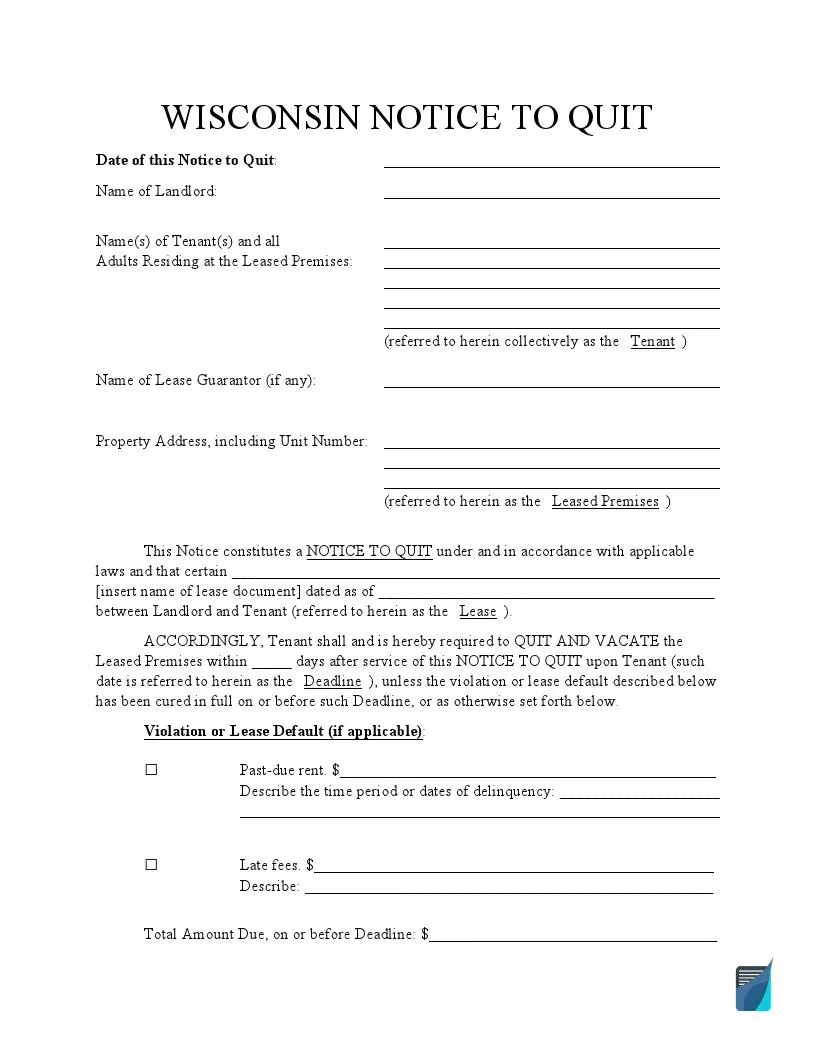
The notice states the reason for eviction and the deadline the tenant has to pay the rent owed, fix the violation, or move out. A notice by itself does not remove a tenant from the property. The landlord must still file in court and get a judgment before a sheriff can remove the tenant.
Wisconsin sets a minimum notice period before a landlord can file to evict a tenant. The length depends on the reason for eviction, the length of the lease, and whether the same problem happened before. A tenant who pays late or breaks another lease term typically gets at least 5 days to fix it before the tenancy ends.[1]
A Wisconsin eviction notice is also called a notice to quit or a notice to vacate.
The notice periods below are minimums. A landlord can always give a tenant more time than the law requires, but giving less time than the statute allows can make the notice invalid and delay the whole eviction case.
Authorizes the eviction or exclusion of a tenant from the premises, other than by judicial eviction procedures as provided under ch. 799.
Either the landlord or the tenant can end a month-to-month or other periodic tenancy, but only by giving the other party written notice of at least 28 days, and the termination date must fall at the end of a rental period (Section 704.19(2) and (3)). If rent is payable more often than monthly, notice equal to the rent-paying period is enough.[3]
| Rent Grace Period | None unless the lease provides one |
| Notice for Nonpayment of Rent | At least 5 days (14 days for a repeat default within 1 year)[1] |
| Notice for Lease Violation | At least 5 days (14 days for a repeat violation within 1 year, 30 days under a lease of more than one year)[1] |
| Self-Help Eviction | Not allowed. The landlord must get a court order.[2] |
| State Law | Wis. Stat. § 704.17[1] |
Wisconsin landlords use several eviction notices. The type depends on the reason for eviction, how long the notice period is, and whether the tenant gets a chance to fix the problem before the tenancy ends. The notices below cover nonpayment, lease violations, and nuisance or criminal activity.
For example, Anna Baker rents to Ben Carter under a month-to-month tenancy at 123 Main Street, Austin, TX 78701 (a fictional example, not a real property). If Ben pays his rent late, Anna can give him a 5-Day Notice to Pay or Vacate.
If Ben already got a late-payment notice once in the past year and pays late again, Anna does not have to offer him another chance to pay. She can give him a 14-Day Notice to Vacate instead. Choosing the right notice starts with identifying the reason for eviction and checking whether the same problem happened before.
Wisconsin law requires an eviction notice to be in writing and delivered the way the statute specifies. If the notice meets those requirements, the tenant is not entitled to remain in or use the property after the termination date the notice states.[1]
A notice for nonpayment that states the wrong amount due is still valid when both of the following are true.[1] This means an honest math mistake by the landlord, such as leaving out a partial payment the tenant already made, does not by itself void an otherwise proper notice.
As Wisconsin law uses the term, rent includes any rent that is past due along with any late fees owed on that overdue rent. A lease clause that sets different termination rules than the statute is not enforceable, except in a lease for more than one year. A lease clause that conflicts with the criminal-activity termination rules is never enforceable.[1]
In practice, many landlords deliver the notice by hand or send it by certified mail. This gives them proof of the date it was given, since that date starts the notice period. Keeping a copy of the notice and any proof of delivery can help later if the case goes to court.
Evicting a tenant in Wisconsin follows a set order. The landlord serves the required notice, then files in court if the tenant does not comply. The tenant is only removed after a judge issues an order that a sheriff carries out.
Wisconsin law does not let a landlord remove a tenant, change the locks, shut off utilities, or take a tenant’s belongings outside the court eviction process. Only a sheriff carrying out a court order may remove a tenant.[2] A tenant who believes a landlord is trying to force them out without going to court can contact local law enforcement or a tenant rights organization for help.
A Wisconsin eviction case in court typically involves several documents beyond the notice itself. Below are the forms most often used, from the initial complaint through the final order for removal.
Not every case uses every one of these documents. A straightforward nonpayment case where the tenant moves out after the notice period may never reach a Writ of Possession. A contested case can involve all five before it is over.

General information, not legal or tax advice.
Unless noted otherwise, the sources below are from the Wisconsin Statutes.
