
The Wisconsin small estate affidavit is a transfer by affidavit for an estate whose property subject to administration is worth no more than $50,000 in gross value. The affiant can be an heir, a trustee of a revocable trust, the person named in the will as personal representative, or the decedent's guardian at death. That person may collect money due the decedent, receive the property and have evidence of interest transferred.[1] This page also walks through the form step by step.
Last Updated: October 2026. This guide is reviewed and updated regularly to reflect current Wisconsin law. If you notice an error or outdated information, please contact us.
Build Your Document
Answer a few simple questions to make your document in minutes
Save and Print
Save progress and finish on any device, download and print anytime
Sign and Use
Your valid, lawyer-approved document is ready
Wisconsin allows a transfer by affidavit under Wis. Stat. § 867.03 when the property subject to administration in the state does not exceed $50,000 in gross value.[1] Real property and notice to the state health department have their own rules, listed below.
Real property has its own rules. A person named in the will as personal representative may not receive real property by affidavit. If the affidavit describes real property or a lien, the heir, trustee or guardian must give the heirs a copy and notice of intent to record, at least 30 days before submitting it to the register of deeds.[1]
The notice for real property goes by certified mail or by personal service. The affidavit is then recorded in each county in Wisconsin where the real property is located.[1]
The Wisconsin Department of Health Services gets its own notice. The heir, trustee, person named in the will to act as personal representative, or guardian gives it by certified mail, return receipt requested. It applies where the decedent or the decedent's spouse ever received long term care program benefits, medical assistance, long term community support services or the other aid the section lists.[1]
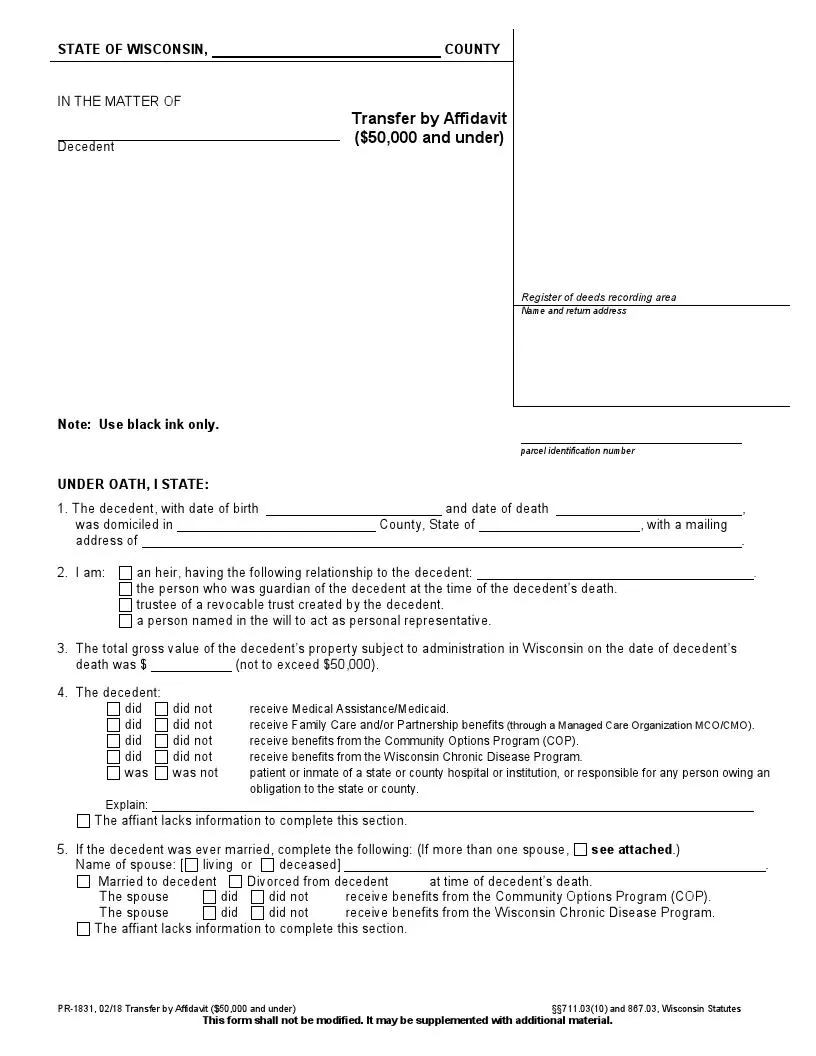
The affidavit form asks about these benefits in items 4 and 5. Its item 8 repeats the certified mail step for the Estate Recovery Program.
Under Wis. Stat. § 867.03(2g)(b), property transferred by the affidavit stays subject to the Department of Health Services' right to recover an amount equal to the recoverable medical assistance and other listed aid paid on behalf of the decedent or the decedent's spouse. The rule covers benefits the state paid, not medical bills left unpaid.[1]
A holder who transfers money or property to the affiant under the affidavit is released from liability to the same extent as if the transfer had been made to the personal representative of the estate. If, during the 30-day wait, the holder receives a second affidavit for the same decedent from another person, the holder may not transfer anything unless a court orders it.[1]
This table sums up the same Wisconsin requirements in short form.
| Max. Estate | $50,000 in gross value of property subject to administration |
| Waiting Period | 30 days after the affidavit is received, when it comes from the person named in the will as personal representative |
| Real Property | Not for the person named in the will as personal representative. Heirs get a copy and a notice at least 30 days before recording |
| Health Department Notice | Certified mail, return receipt requested, when the decedent or spouse received the listed benefits |
| State Law | Wis. Stat. § 867.03[1] |
Looking for another state? See all small estate affidavit forms.

The Wisconsin small estate affidavit form has two pages and ten parts to complete in this guide. The form holds the decedent and affiant details on page 1 and the assets and signature blocks on page 2. Use black ink only, as the form says, and follow the steps below in order.
Have these details ready before you start, so you can fill the form in one sitting:
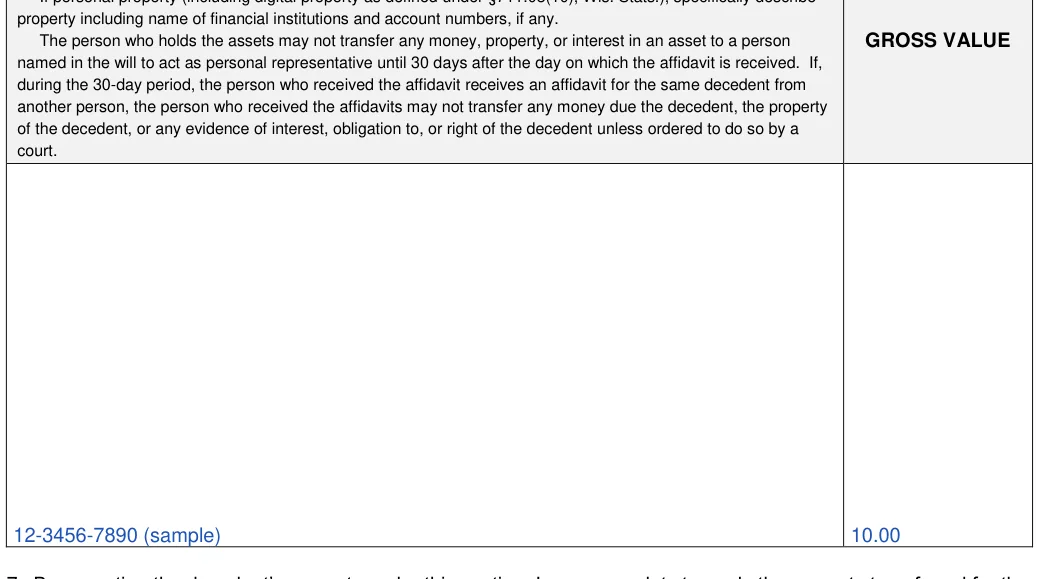
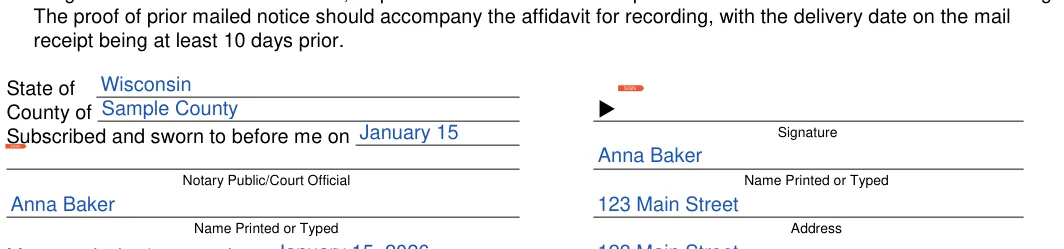
The screenshots under each step show the FormsPal Wisconsin small estate affidavit template filled with sample entries in blue, so you can see where each answer goes. The names, addresses, dates and amounts are examples only.

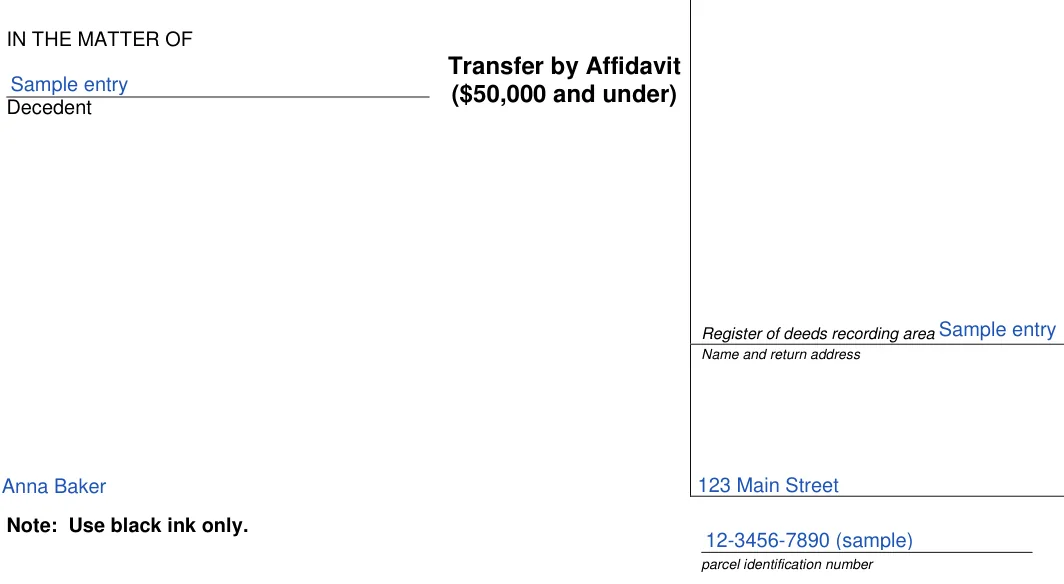

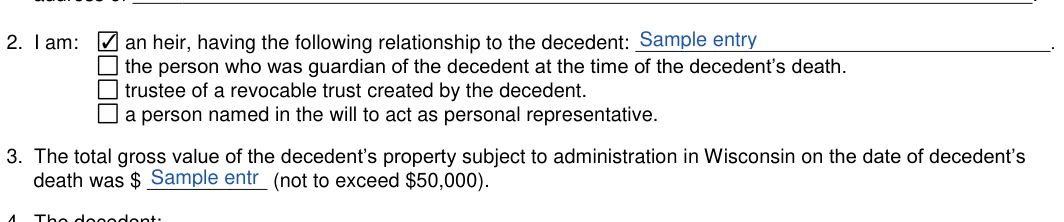

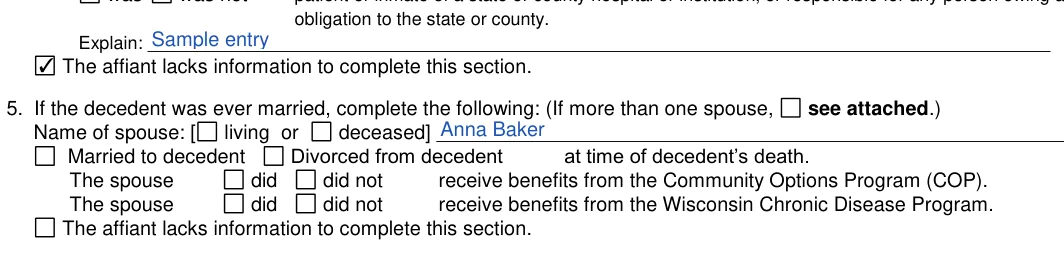


These short answers cover the questions people ask most about the Wisconsin small estate affidavit. The $50,000 limit and the 30-day notice for real property are the two numbers to keep in mind.
The limit is $50,000 in gross value. It applies to the decedent's property subject to administration in Wisconsin, and the person who signs the affidavit is called the affiant.[1]
A small estate is one where the decedent leaves property subject to administration in Wisconsin that does not exceed $50,000 in gross value. An heir, a trustee of a revocable trust, the person named in the will as personal representative, or the decedent's guardian at death can then use the affidavit.[1]
If the affidavit describes an interest in or lien on real property, the heirs get a copy and a notice of intent to record at least 30 days before it goes to the register of deeds. The notice goes by certified mail or by personal service.[1]
The heir, trustee, person named in the will or guardian gives it by certified mail, return receipt requested. It applies where the decedent or the decedent's spouse ever received long term care program benefits, medical assistance, long term community support services or the other aid the section lists.[1]
General information, not legal or tax advice.
The facts on this page come from one official source, the Wisconsin statute on transfer by affidavit. It sets the $50,000 limit, the people who may sign, the 30-day periods and the notice rules.
