
A Wisconsin prenuptial agreement is a written contract that two people sign before the wedding. It sets how their property, debts, and spousal support will be handled during the marriage and if it ends. Wisconsin law calls the document a marital property agreement and governs it under Section 766.58 of the Wisconsin Statutes.[1]
Last Updated: September 2026. This guide is reviewed and updated regularly to reflect current Wisconsin law. If you notice an error or outdated information, please contact us.
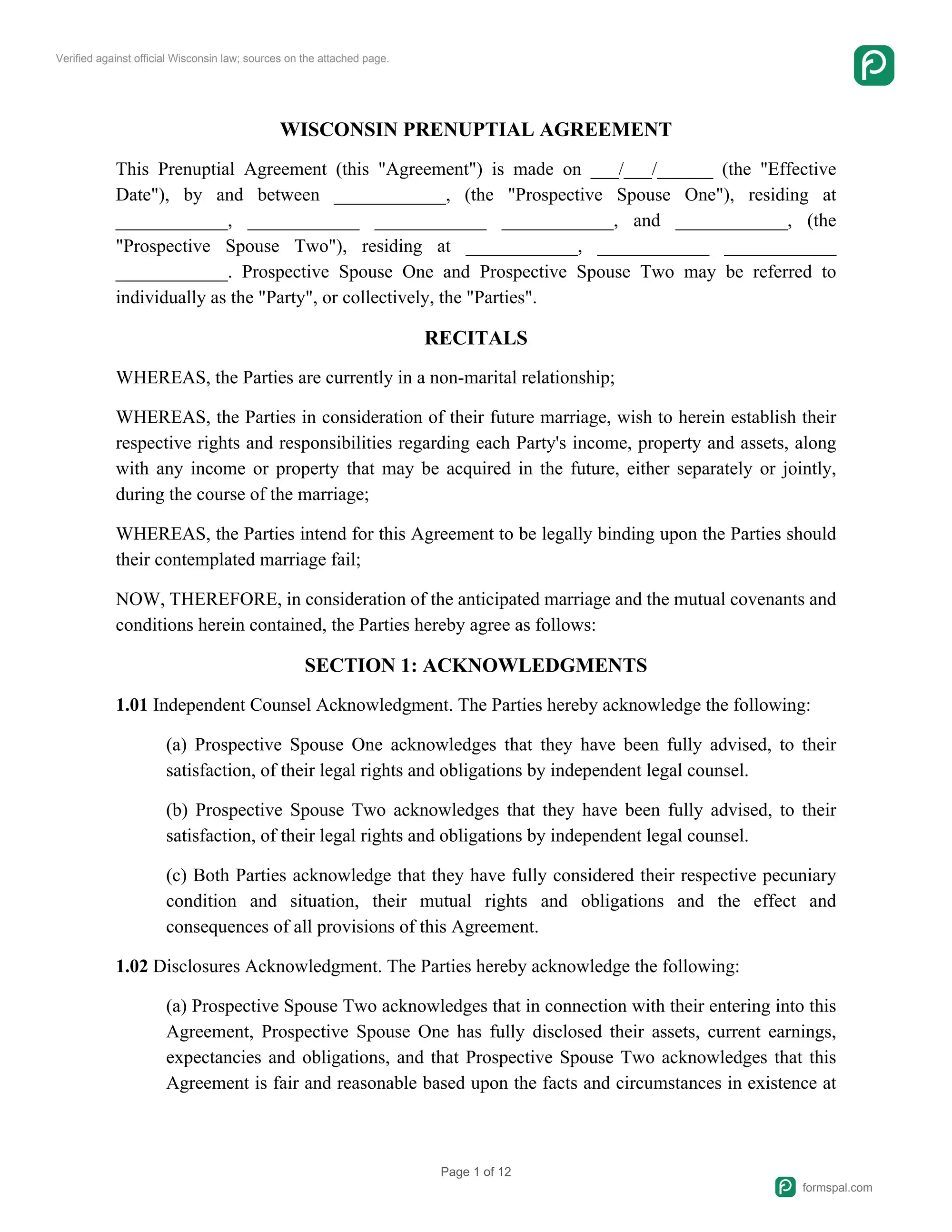
Build Your Document
Answer a few simple questions to make your document in minutes
Save and Print
Save progress and finish on any device, download and print anytime
Sign and Use
Your valid, lawyer-approved document is ready
Only the two spouses may be parties to it. Both must sign, and the agreement takes effect only when they marry. It can settle property either partner owns now or acquires later, and it can waive or reduce spousal support. It cannot cut what a child is owed in support.[1]
Not every couple needs a prenup. It earns its place when one partner brings real estate, business assets, or debts into the marriage. The same goes for couples with children from an earlier relationship, or with two very different incomes.
Popular Local Prenuptial Agreement Forms
Wisconsin does not use the Uniform Premarital Agreement Act that most states adopted. Premarital contracts here sit inside the Wisconsin Marital Property Act, and Section 766.58 of the Wisconsin Statutes sets the rules for them. The statutory form requirement is short. The agreement must be a document signed by both spouses, and only the spouses may be parties to it.[1]
A marital property agreement shall be a document signed by both spouses.
Five things have to be right for the agreement to hold.
Married people and people who intend to marry may record a marital property agreement at the county register of deeds office.[1] The statute says spouses "may" record, so it is a choice rather than a filing you have to make.
Section 766.58 gives a marital property agreement wide reach. It can set rights in and obligations with respect to any of either or both spouses' property, whenever and wherever it was acquired. It can decide who manages and controls that property. It can also say what happens on divorce, on death, or on any other event the two of you name.[1]
These are the subjects the statute lists.
Business assets, retirement accounts, and the debts each partner brings in all fall inside that list, because the statute reaches property of either spouse whenever and wherever acquired.[1] That is why couples who own a business or carry heavy student loans reach for a prenup most often.
Three limits sit on top of that list. A marital property agreement may not adversely affect the right of a child to support. It may not cover a matter that violates public policy or a statute imposing a criminal penalty. And a change to spousal support taking effect during the marriage may not leave a spouse with less than necessary and adequate support.[1]
Couples often assume a prenup can rule out alimony for good. In Wisconsin it can modify or eliminate spousal support. But a change that takes effect during the marriage cannot push one spouse below necessary and adequate support, counting every source of support available.[1]
Custody and physical placement are a separate matter. They fall under chapter 767 of Wisconsin law, not the marital property statute, and the family court decides them on the best interest of the child, so a prenup cannot settle them in advance.
Yes. A Wisconsin prenup that meets Section 766.58 is enforceable, and the statute names the narrow grounds a spouse can raise against one. Whether the agreement is unconscionable is for the court to decide as a matter of law. If the spouses agree in writing to arbitrate a dispute under the agreement, that arbitration agreement is enforceable under Chapter 788.[1]
A spouse resisting a marital property agreement has to show one of the following.
One timing rule matters here too. Some terms only bite on divorce or on the death of a spouse. For those, the statute of limitations on enforcement is tolled until the marriage is dissolved or ends by death.[1]
Building a Wisconsin prenup takes five steps. You list what each of you owns and owes, then agree on how those assets and debts will be handled. You put the terms in writing, sign well before the wedding, and keep a copy each. The disclosure you do first is what protects the agreement later.[1]
By signing a new one. A marital property agreement may be amended or revoked only by a later marital property agreement. A handshake, an email, or a note in the margin will not undo it. The later document has to meet the same rules as the first. It must be written, signed by both spouses, and between the two of you alone.[1]
Couples who are already married use the same tool. The statute lets people intending to marry enter an agreement as if they were married, and that agreement simply waits for the wedding to take effect.[1]

A Wisconsin prenuptial agreement is a contract two people sign before marriage to fix the rights and obligations each will have in the other's property. Chapter 766 of the Wisconsin Statutes calls it a marital property agreement. Section 766.58 requires a document signed by both spouses, limits the parties to the spouses themselves, and makes the agreement effective only upon the marriage.[1]
A prenup is enforceable without consideration, so neither partner has to hand over money or property in return for a signature.[1]
Wisconsin is a marital property state. Income earned and most assets acquired by either spouse during the marriage belong to both of them in equal shares. A divorce court starts from an equal split, and a prenup is how a couple changes that default before it ever applies.
You can. Section 766.58 requires a document signed by both spouses, and it addresses the lawyer question head on. Where legal counsel is retained, one lawyer representing both of you does not by itself make the agreement unconscionable. Neither does one spouse having a lawyer while the other does not.[1]
A prenup you write yourself still has to clear the same bar. Fair and reasonable disclosure and a voluntary signature are what the statute tests.[1]
Use the free Wisconsin prenuptial agreement template at the top of this page to get the structure right. Give each side time to read it well before the wedding. If either of you is unsure about a term, a local family law attorney can review the draft.
Other Prenuptial Agreement Forms by State
