
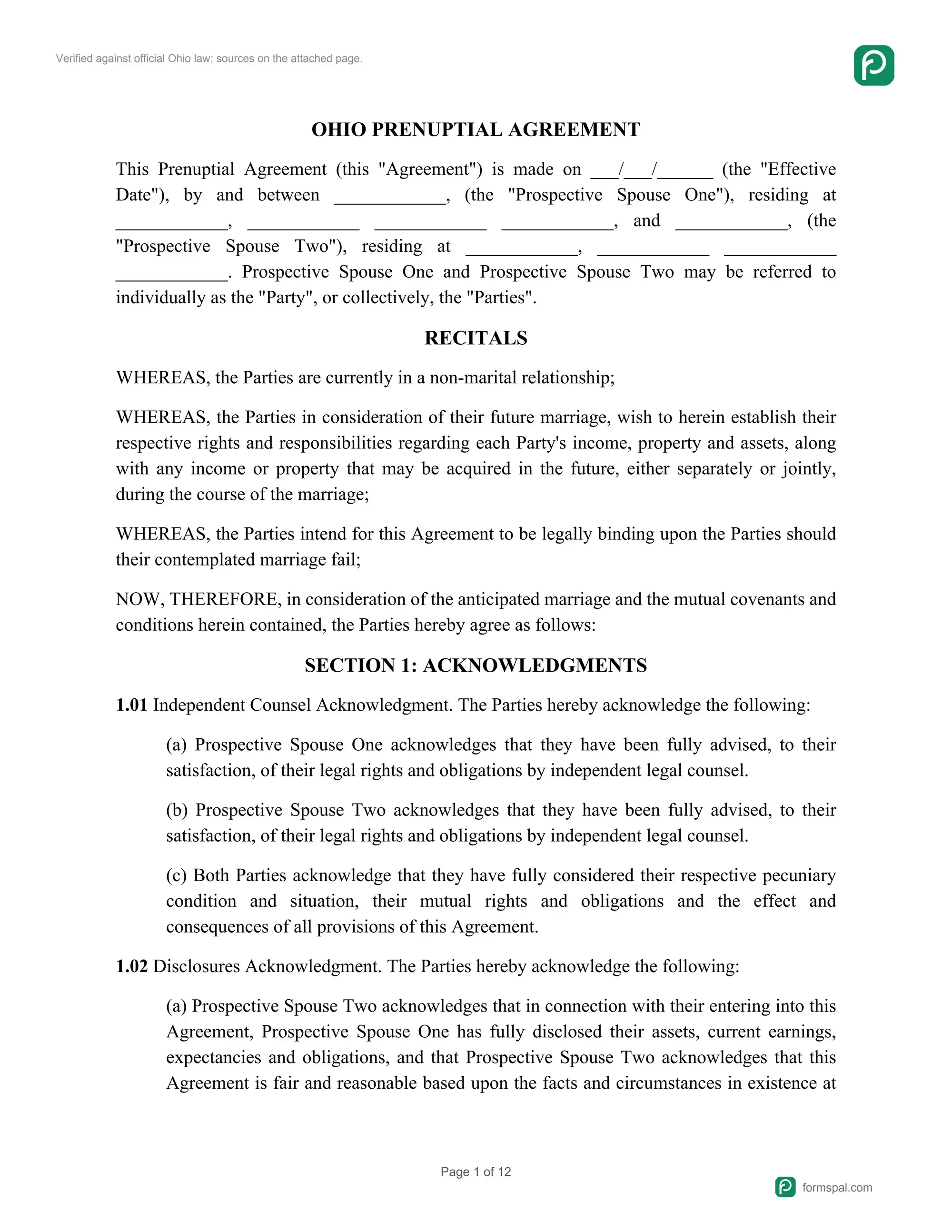
An Ohio prenuptial agreement is a written contract that two people sign before their wedding to set out how their property, debts, and spousal support will be handled if the marriage ends. Ohio law will not enforce a promise made in consideration of marriage unless it is in writing and signed by the party being charged with it.[1]
Last Updated: September 2026 - This guide is reviewed and updated regularly to reflect current Ohio law. If you notice an error or outdated information, please contact us.
Build Your Document
Answer a few simple questions to make your document in minutes
Save and Print
Save progress and finish on any device, download and print anytime
Sign and Use
Your valid, lawyer-approved document is ready
The agreement also keeps named assets out of the pool a divorce court divides, because property excluded by a valid antenuptial agreement counts as separate property in Ohio.[5] It cannot settle child custody or child support. Our prenuptial agreement template covers the terms Ohio allows and leaves out the ones it does not.
Ohio's statutes call this document an antenuptial agreement. You will also see it called a prenup, a premarital agreement, or a marriage contract. All four name the same contract signed before the wedding, and the Ohio Revised Code uses "antenuptial" throughout.
A prenup is a contract that fixes the financial terms of a marriage in advance, so that a divorce court or a probate court applies the couple's own agreement instead of Ohio's default rules. It covers property brought into the marriage, property acquired during it, debts, and spousal support. Couples can include every term Ohio allows or only the few that matter to them.
A completed agreement answers questions like these:
Popular Local Prenuptial Agreement Forms
Ohio has no single prenuptial agreement statute. The rules come from three places. The statute of frauds requires a signed writing. Decisions of the Ohio Supreme Court set the fairness test Ohio courts apply to prenuptial agreements. The property and probate sections of the Ohio Revised Code say what a valid agreement can keep out of a divorce or an estate.
Section 1335.05 of the Ohio Revised Code is the rule that matters at signing. An agreement made upon consideration of marriage has to be in writing. It also has to be signed by the party it is being enforced against, or set out in a signed memorandum.[1] Nothing in that section calls for a notary or for witnesses. Both spouses should still sign, so that either one can enforce the agreement later.
A valid agreement changes what counts as marital property. Ohio's property division statute lists real or personal property excluded by a valid antenuptial or postnuptial agreement as separate property, which a court does not divide between the spouses.[5] That is the mechanism behind most prenups. An asset named in the agreement stays with the spouse who brought it.
Couples most often name:
Ohio law puts two subjects out of reach for prenuptial agreements. A prenup cannot set child custody, and it cannot fix or waive child support. Ohio courts decide custody on the best interests of the child at the time of the divorce. The right to support belongs to the child rather than to the parents. A clause that tries to settle either question is struck out, and the rest of the agreement usually survives.
Yes. Ohio courts enforce prenuptial agreements that meet the four conditions above, and the state's property division statute expressly recognizes an agreement that excludes assets from the marital estate. What a court will not do is rubber-stamp one. A judge reads the agreement against the circumstances at the time it was signed, and an agreement that fails a condition can be set aside in whole or in part.
A court is most likely to refuse an Ohio prenuptial agreement when one of these is true:
After a spouse dies, the window to attack an antenuptial agreement is short. An agreement a decedent was party to stays valid unless an action to set it aside begins within four months after the executor or administrator of the estate is appointed.[2] Miss that window and the agreement stands.
Work through the document in order, and finish it well before the wedding. An agreement signed in the days before a ceremony invites the argument that one spouse had no real chance to refuse it. Give yourselves weeks rather than hours, and keep a copy of everything each of you disclosed.

Four things. The agreement has to be in writing and signed by both spouses. Both people have to enter it freely, with no fraud, duress, coercion, or overreaching. Each has to know what the other owns, in kind and in value. And the terms cannot encourage divorce or let one spouse profit from ending the marriage. Ohio courts drew that test from Gross v. Gross, and the legislature wrote the same four conditions into statute in 2023.
Section 3103.061 of the Ohio Revised Code carries those conditions. It governs an agreement between spouses that modifies or terminates an antenuptial agreement, and it makes such an agreement valid and enforceable, with or without consideration, when all four apply.[4]
The agreement is in writing and signed by both spouses; The agreement is entered into freely without fraud, duress, coercion, or overreaching; There was full disclosure, or full knowledge, and understanding of the nature, value, and extent of the property of both spouses; The terms do not promote or encourage divorce or profiteering by divorce.
Yes. Ohio spouses may contract with each other to modify or terminate an antenuptial or postnuptial agreement, or any other agreement that alters their legal relations with each other. Before the 2023 amendment, married couples in Ohio had no clear way to rewrite their own marital agreements.
That authority sits in Section 3103.06 of the Ohio Revised Code.[3] A change or a cancellation has to clear the same four conditions as the original agreement: a signed writing, free consent, full disclosure, and terms that do not encourage divorce.[4]
You do not have to exchange anything of value to make the change stick. Section 3103.061 says an agreement that modifies or terminates an antenuptial agreement is valid and enforceable with or without consideration.[4]
Nothing in Ohio law requires a lawyer to draft a prenuptial agreement. What the law requires is a signed writing, honest disclosure, and terms a court will not read as an invitation to divorce. A template gets the structure and the legal language right. What a template cannot do is check that your own financial disclosure is complete.
In practice, many Ohio family law attorneys recommend that each spouse have an independent attorney review the draft, since separate advice makes it harder to argue later that a signature was not voluntary. Independent review is not required by Ohio law, and an agreement signed without it can still be enforced.
No. Ohio law divides marital property by equitable distribution, which means a divorce court splits marital property by what is fair in the couple's circumstances rather than down the middle. Ohio is not a community property state, so nothing becomes half yours automatically on the wedding day.
A prenuptial agreement is how couples replace that discretion with a rule of their own. Property the agreement excludes is separate property, and a court does not divide separate property between the spouses.[5]
It depends on whether a lawyer drafts it. Ohio attorneys who publish their rates average about $820 to draft a prenuptial agreement and about $450 to review one that is already written. A completed template costs a fraction of either figure. The trade-off is that a lawyer will question your disclosure and a template will not.
Review only is the middle path many Ohio couples take. You draft the agreement from a template, then each spouse pays for an hour of independent review before signing.
It is worth it when one of you owns something you want to keep whole: a family business, an inheritance, a house bought before the wedding, or a debt you do not want shared. Without an agreement, an Ohio court decides what is fair at the end of the marriage, and neither spouse controls that decision.
The agreement works at death as well as at divorce. Property a valid antenuptial agreement excludes stays separate,[5] and once four months pass from the appointment of the estate's executor, the agreement can no longer be challenged.[2]
Other Prenuptial Agreement Forms by State
Unless noted otherwise, the sources below are from the Ohio Rev. Code.
