
An Indiana prenuptial agreement is a written contract that two people sign before they marry. It sets out how their property, their debts, and any spousal maintenance will be handled if the marriage ends in divorce. Indiana law calls it a premarital agreement and defines it as an agreement between prospective spouses that is executed in contemplation of marriage and becomes effective upon marriage.[1.2]
Last Updated: September 2026. This guide is reviewed and updated regularly to reflect current Indiana law. If you notice an error or outdated information, please contact us.
Build Your Document
Answer a few simple questions to make your document in minutes
Save and Print
Save progress and finish on any device, download and print anytime
Sign and Use
Your valid, lawyer-approved document is ready
The contract must be in writing and signed by both parties, and it is enforceable even though neither side pays anything for it.[1.4] It can settle almost every financial question a couple faces, but it cannot reduce a child's right to support.[1.5]
Prenup, prenuptial agreement, and premarital agreement all name the same document in Indiana. Title 31 of the Indiana Code, the state's family law title, uses the last of those throughout. The rules sit in Article 11, Chapter 3, which the code itself titles the Uniform Premarital Agreement Act.
Section 31-11-3-5 of the Indiana Code lists what a prenup may settle. The list is broad and almost entirely financial. It reaches any property either of you owns now or acquires later, wherever that property sits.[1.5] The state defines property widely, as any legal or equitable interest in real or personal property, including income and earnings.[1.3]
You and your future spouse can use the contract to set:
A business interest counts as property here, and so does a future or contingent interest.[1.3] If you own a business, name those assets in the contract rather than rely on the general wording.
Indiana puts two hard limits on a prenup, and both sit in Section 31-11-3-5 of the Indiana Code. Outside them, you and your future spouse can settle almost any financial question, whether it concerns assets you already own or assets you expect later. Inside them, a clause has no effect however carefully it is drafted and however willingly both of you agreed to it.
Child support is the limit couples get wrong most often. You can agree on who pays the mortgage or how a business is divided. You cannot sign away what a child is owed, because the courts set child support themselves whatever the contract says.
One clause is carved out and governed elsewhere. If your contract contains a portability agreement, as defined by Indiana Code Section 31-11-7-5(a)(4), that part is governed by Section 31-11-7-5 instead.[1.6]
Popular Local Prenuptial Agreement Forms
The rules for premarital agreements sit in Article 11, Chapter 3 of Title 31 of the Indiana Code, the state's family law title. The chapter runs to eleven short sections. They define the contract, list what it may settle, say how it is signed, and set out the narrow grounds for refusing to enforce it. The chapter applies to any premarital agreement executed on or after July 1, 1995.[1.1]
The list of formalities is short. A premarital agreement must be in writing and signed by both parties.[1.4] That is the whole statutory test. Nothing in the chapter calls for a notary or for witnesses.
The contract is also enforceable without consideration.[1.4] Neither of you has to give the other money or property in exchange for signing, which is how a prenup differs from an ordinary business contract.
Notarization is not required here. In practice, many couples still sign in front of a notary anyway, as a precaution in case one side later claims a signature was forged.
A premarital agreement becomes effective upon marriage.[1.7] Signing does nothing on its own. If the wedding never happens, the contract never starts.
After the marriage, the contract may be amended or revoked only by a written agreement signed by the parties. A spoken change counts for nothing. The amendment or the revocation is itself enforceable without consideration.[1.8]
Whether the marriage was valid matters as well. A document that would otherwise have been a premarital agreement is then enforceable only to the extent necessary to avoid an inequitable result.[1.10]
One deadline rule is unusual. Any statute of limitations that applies to a claim under a premarital agreement is tolled during the marriage of the parties.[1.11] The clock starts again when the marriage ends.
A prenup is not enforceable if the party resisting it proves one of two things.[1.9] Those two grounds are the whole list. Unhappiness with the bargain is not one of them, and neither is a later change in either partner's finances.
A court shall decide an issue of unconscionability of a premarital agreement as a matter of law.
Spousal maintenance has its own safety valve. Say the contract eliminates maintenance, and that causes one party extreme hardship in circumstances not reasonably foreseeable when it was executed. A court may then order the other party to pay maintenance anyway, but only as far as needed to avoid that hardship.[1.9]
The statute sets only two formal requirements, a writing and two signatures, so most of the work sits elsewhere. It goes into deciding what the contract will settle, and into gathering the financial figures that support those decisions. Settle the money questions first and the drafting becomes short.
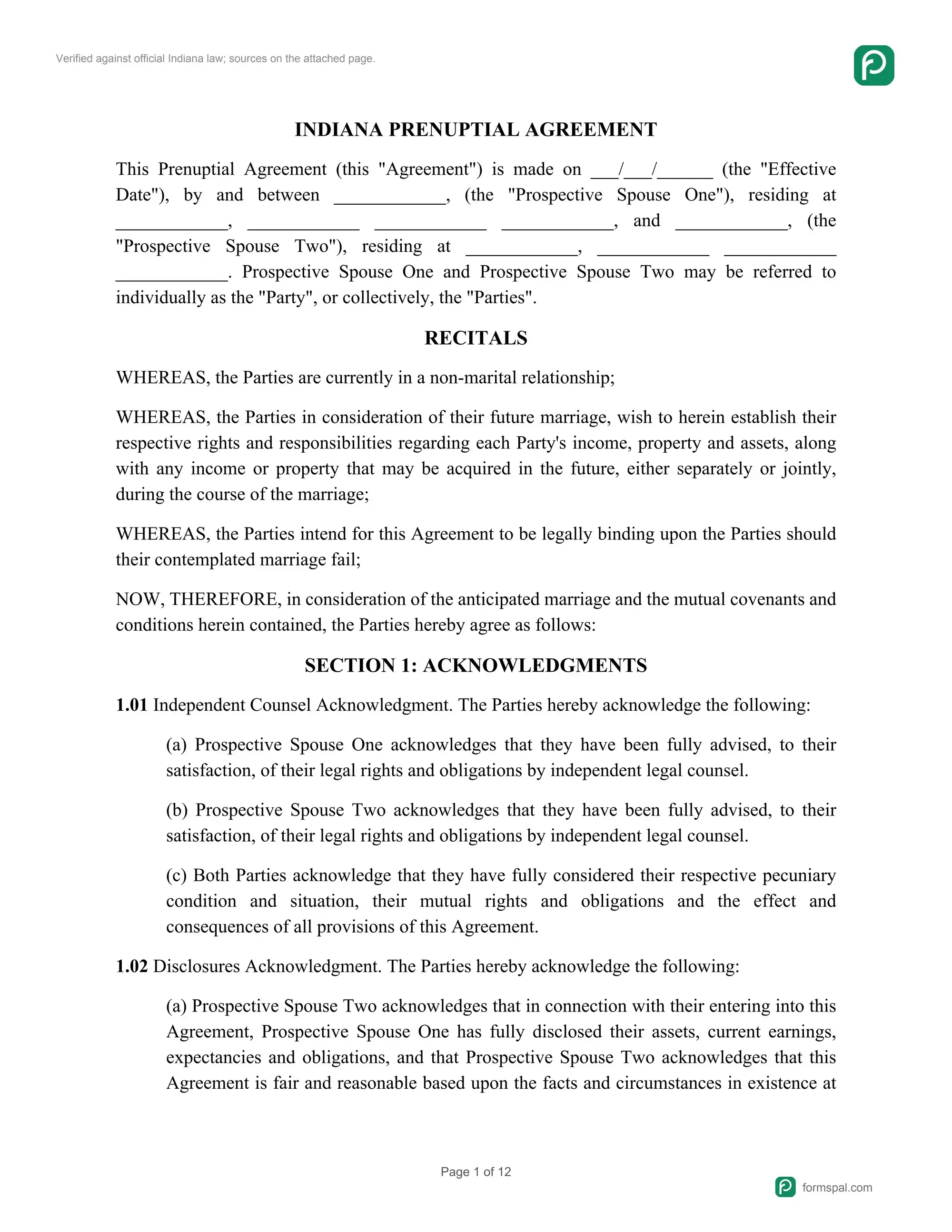
Use the builder above to produce a free Indiana prenuptial agreement template you can fill in. You can also start from the blank prenup agreement template and adapt it to your own facts.
Yes. Nothing in Chapter 3 requires a lawyer to draft or review the contract. The statutory test is a writing that carries both signatures, and the agreement is enforceable without consideration.[1.4] The statute says nothing about who drafts the agreement, so a template you complete yourselves faces the same two requirements as a document a lawyer prepares.
What a lawyer adds is not validity but insulation. Separate legal counsel for each of you makes the voluntariness ground harder to run later, and that is the ground most contested cases turn on. The wider the gap between what the two of you own, the more that matters.

Yes, in most cases. Indiana courts will enforce a prenup unless the spouse resisting it proves that they did not sign voluntarily, or that the contract was unconscionable when it was executed. Those are the only two grounds in the statute. A court decides the unconscionability question itself, as a matter of law.[1.9]
Other Prenuptial Agreement Forms by State
