
Updated:
An Indiana power of attorney is written authority for your agent. Under Ind. Code § 30-5-4-1, the principal signs it before a notary public or witnesses. Indiana adults need one most when illness, travel or a sale keeps them away.
This page explains each Indiana power of attorney type, its signing rule, and how to make, sign and revoke one.
Key facts
Build Your Document
Answer a few simple questions to make your document in minutes
Save and Print
Save progress and finish on any device, download and print anytime
Sign and Use
Your valid, lawyer-approved document is ready
An Indiana power of attorney comes into force when the principal signs a written grant of powers to a named agent before a notary public or witnesses (Ind. Code § 30-5-4-1). An agent cannot obtain it alone: the principal signs, or another person signs at the principal's direction (Ind. Code § 30-5-4-1).
Each Indiana power of attorney form below covers one kind of authority, and its card shows its other names and signing requirements. The list matches a job to its form:
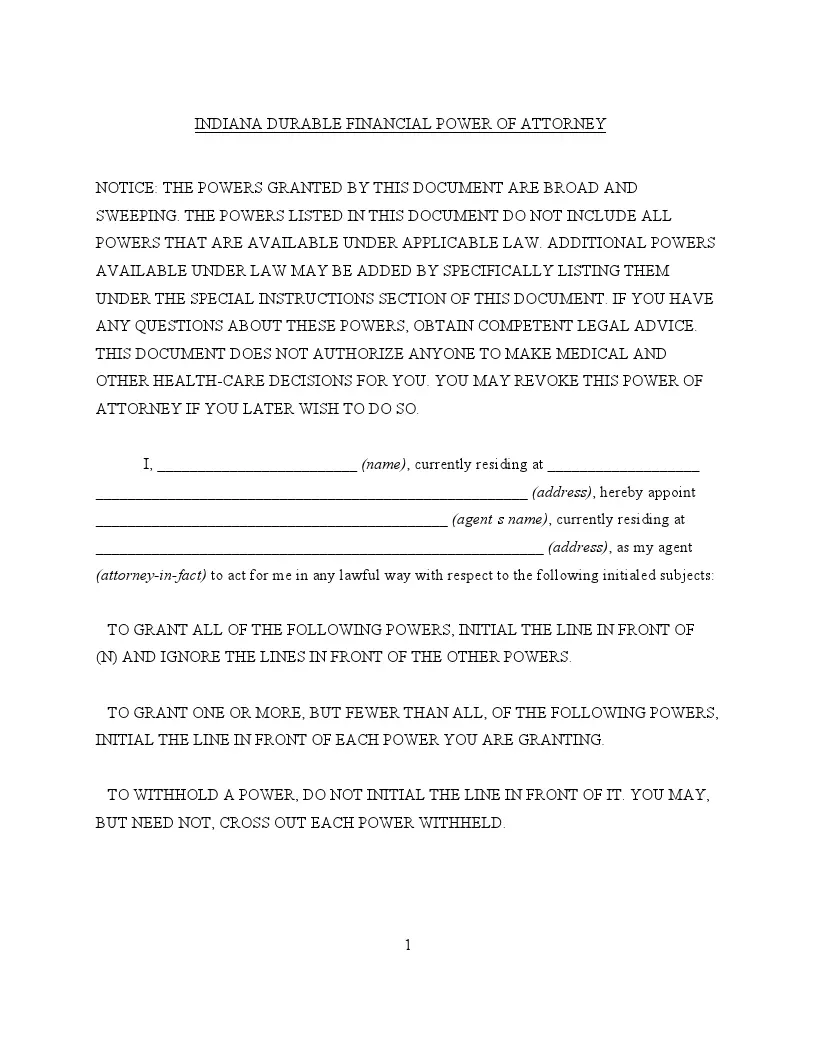
Durable power of attorney gives an agent authority over the principal's finances and property that continues if the principal becomes incapacitated. Indiana law keeps a power of attorney in force through the principal's incapacity, except as otherwise stated in the document (Ind. Code § 30-5-10-3(a)).
| Also Known As | Indiana DPOA |
| Signing Requirements | Notary public or at least two witnesses (Ind. Code §§ 30-5-4-1, 30-5-4-1.5) |
| Download | PDF Template |

Medical power of attorney names a health care representative to make health care and treatment decisions for you when you cannot make them yourself. An Indiana health care advance directive is signed by the declarant in the presence of two adult witnesses or a notarial officer (Ind. Code § 16-36-7-28).
| Also Known As | Health Care POA or MPOA |
| Signing Requirements | Two adult witnesses or a notarial officer (Ind. Code § 16-36-7-28) |
| Download | PDF Template |

General power of attorney gives an agent broad authority over the principal's money and property, such as bank accounts, bills and sales. An Indiana general power of attorney keeps working after the principal's incapacity unless the document states otherwise (Ind. Code § 30-5-10-3(a)), so a form meant to end at incapacity says so in its text.
| Also Known As | Generic Financial POA |
| Signing Requirements | Notary public or at least two witnesses (Ind. Code §§ 30-5-4-1, 30-5-4-1.5) |
| Download | PDF Template |

Limited power of attorney gives an agent authority for one task or a set period, such as selling a piece of property while you are away. The document lists only the powers granted and, if you choose, the date and time it terminates (Ind. Code § 30-5-10-2).
| Also Known As | Special POA |
| Signing Requirements | Notary public or at least two witnesses (Ind. Code §§ 30-5-4-1, 30-5-4-1.5) |
| Download | PDF Template |

Child power of attorney lets a parent name someone to care for a child while the parent is away. Indiana calls this document a parental power of attorney, and its time limits are set out in the parental power of attorney section below.
| Also Known As | Minor POA |
| Signing Requirements | A properly executed power of attorney (Ind. Code § 29-3-9-1) |
| Download | PDF Template | Parental Power of Attorney |

Real estate power of attorney is a legal form that any Indiana individual can sign if they want to appoint an agent for conducting certain actions with their real estate. The agent chosen by the real estate POA can sell, rent, and complete some other actions with the property.
| Also Known As | Limited Real Estate POA |
| Download | PDF Template |

State tax power of attorney (Form POA-1 in the state of Indiana) lets you appoint an agent, most likely your accountant, to handle your tax paperwork. Your agent can also process other actions with the Indiana Department of Revenue on your behalf.
| Also Known As | Tax POA |
| Signing Requirements | Grantor Only |
| Download | Form POA-1 |

Vehicle power of attorney, or Form 1940 in Indiana, allows any vehicle owner to transfer specific responsibilities and powers to another individual. Among such powers can be vehicle registration, title renewal, and other actions that can be processed in the Indiana Bureau of Motor Vehicles (BMV).
| Also Known As | BMV POA |
| Signing Requirements | Notary Public |
| Download | PDF Template | Form 1940 |

Revocation power of attorney ends an existing Indiana power of attorney. Unless the document states otherwise, it may be revoked only by a written instrument that identifies it and is signed by the principal (Ind. Code § 30-5-10-1(a)).
| Also Known As | POA Termination Form |
| Signing Requirements | Notarization is Advised |
| Download | PDF Template |
An Indiana power of attorney is valid when it meets the four conditions of Ind. Code § 30-5-4-1, listed here:
The statute lists no court approval and no filing with a state office among these conditions (Ind. Code § 30-5-4-1).
An Indiana power of attorney is signed by the principal, or by another person at the principal's direction, in the presence of a notary public or of witnesses (Ind. Code § 30-5-4-1). The principal picks one of the two routes below.
The notary route takes the place of witnesses: the principal signs in the presence of a notary public (Ind. Code § 30-5-4-1). When another person signs at the principal's direction, the notary must state that this person signed on the principal's behalf at the principal's direction (Ind. Code § 30-5-4-1).
The witness route needs the signatures of the principal and at least two witnesses on the document (Ind. Code § 30-5-4-1.5). Any person who is competent to be a witness in Indiana at the time of attestation may act as an attesting witness (Ind. Code § 30-5-4-1.3). A witness's later incapacity does not impair a document already signed (Ind. Code § 30-5-4-1.3).
A power of attorney signed before witnesses is void if both of these are true (Ind. Code § 30-5-4-1.3):
A power of attorney signed in counterparts, with the principal and the witnesses signing separate paper copies, follows extra rules when that route is used (Ind. Code § 30-5-4-1.5):
An Indiana financial power of attorney stays in force if the principal becomes incapacitated, except as otherwise stated in the document (Ind. Code § 30-5-10-3(a)). A general and a durable financial POA therefore both survive incapacity in Indiana unless the document itself says it ends then (Ind. Code § 30-5-10-3(a)).
When the document is written to end at the principal's incapacity, it does not end as to an agent or other person who acts in good faith without actual knowledge of the incapacity (Ind. Code § 30-5-10-3(b)).
An Indiana power of attorney may name its start: it may specify the date on which the power becomes effective, or it may become effective upon the occurrence of an event (Ind. Code § 30-5-4-2). The document states the event in plain words, for example the principal's incapacity.
An Indiana power of attorney ends at a stated time, on revocation or on the principal's death, under these rules:
An Indiana health care advance directive, the document that names a health care representative, is signed by the declarant in the presence of two adult witnesses or a notarial officer (Ind. Code § 16-36-7-28). Each route has its own rule:
A living will is a separate document; the Indiana living will page covers it.
An Indiana parental power of attorney lets a parent of a minor delegate powers over the child's health care, support, custody or property for a period not exceeding twelve months, unless one of the exceptions below applies (Ind. Code § 29-3-9-1).
An Indiana revocation of power of attorney is a written instrument that identifies the power of attorney revoked and is signed by the principal, unless the original document states otherwise (Ind. Code § 30-5-10-1(a)).
The principal is the person who creates the power of attorney and grants the authority. The agent, also called an attorney-in-fact, is the person the principal names to act for them. Choose an agent you trust, because the agent acts for you within the powers the document gives.
Yes: the four conditions of Ind. Code § 30-5-4-1 (in writing, an attorney in fact named, power granted, signed before a notary public or witnesses) do not include a lawyer. An attorney or directed paralegal must supervise the signing only when the principal and witnesses sign separate counterparts (Ind. Code § 30-5-4-1.5).
The fastest route is to fill in the form for your purpose and sign it before one notary public, which Ind. Code § 30-5-4-1 accepts in place of witnesses. The witness route needs at least two witnesses present at the signing (Ind. Code § 30-5-4-1.5).
Ind. Code § 30-5-4-1 lists no state fee and no filing with a state office among the conditions for a valid power of attorney. Ask the notary public ahead of time about any charge for the notarization.
An agent can act on the principal's bank accounts when the document grants power over them, since Ind. Code § 30-5-4-1 requires the document to give the attorney in fact the power to act on behalf of the principal. Show the bank the signed document before the agent first acts there.
Form POA-1 is the Indiana tax power of attorney: it lets a representative, such as an accountant, handle tax matters with the Indiana Department of Revenue for you. The tax power of attorney card above holds the form.
Keep the signed original in a safe place and give your agent a copy. Tell the people and organizations that will deal with your agent, such as your bank, that the document exists.
POA templates are probably the most commonly used ones in the US. Listed below are probably the most requested power of attorney papers.

We offer a range of major Indiana documents to anyone in quest of simplicity when filling out various paperwork.
General information, not legal or tax advice.
