
Updated:
A Kentucky power of attorney is a signed document naming an agent. Under Ky. Rev. Stat. § 457.040, the document stays durable unless it says incapacity ends it. This page covers each Kentucky POA form, how to sign it, and when it ends.
Key facts
Build Your Document
Answer a few simple questions to make your document in minutes
Save and Print
Save progress and finish on any device, download and print anytime
Sign and Use
Your valid, lawyer-approved document is ready
Kentucky power of attorney forms come in nine types: durable, medical, general, limited, minor child, real estate, tax, vehicle and revocation. Each type gives the agent a different set of powers. Each entry below shows the form's other names and how it is signed.
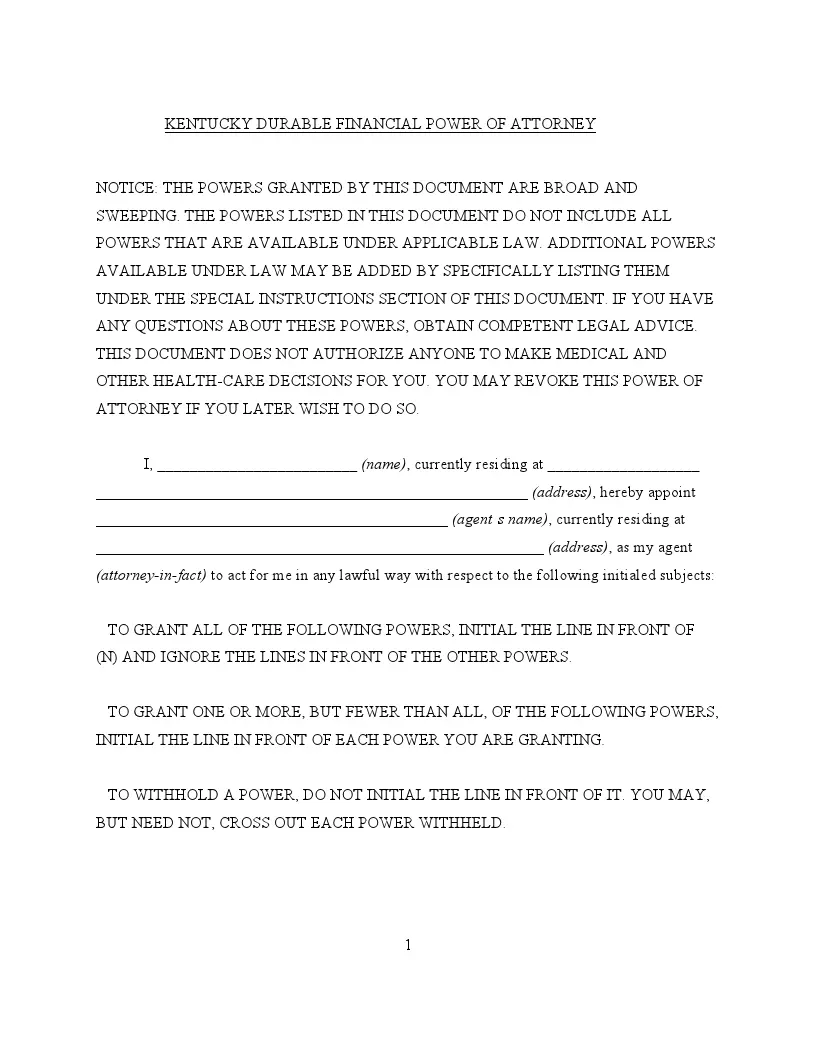
A Kentucky durable power of attorney names an agent for money and property matters and keeps working if the principal becomes incapacitated. Under Ky. Rev. Stat. § 457.040, a power of attorney is durable unless it expressly provides that the principal's incapacity terminates it.
| Also Known As | Kentucky DPOA |
| Signing Requirements | Principal's signature (notary recommended) |
| Download | PDF Template |

A Kentucky medical power of attorney is part of the Living Will Directive, an advance directive that names a health care surrogate to make treatment decisions when the principal cannot. KRS § 311.625(2) requires the directive to be in writing, dated and signed, and either witnessed by two or more adults or acknowledged before a notary public.
| Also Known As | Health Care POA or MPOA |
| Signing Requirements | Notary Public or Two (2) Witnesses |
| Download | PDF Template | Living Will Directive |

A Kentucky general power of attorney gives an agent broad authority over the principal's money and property. The statutory form in Ky. Rev. Stat. § 457.420 lists the subjects the agent may cover, such as real property, banks, taxes and retirement plans, and the principal initials each one.
| Also Known As | Generic Financial POA |
| Signing Requirements | Principal's signature (notary recommended) |
| Download | PDF Template |

A Kentucky limited power of attorney gives an agent authority for one task or one period, such as selling a property while the principal is away. Under Ky. Rev. Stat. § 457.100, a document that specifically states a purpose terminates when that purpose is accomplished.
| Also Known As | Special POA |
| Signing Requirements | Principal's signature (notary recommended) |
| Download | PDF Template |

The Kentucky Power of Attorney for Minor Child (Form AOC-796) is the child power of attorney: it lets a parent delegate care and custody of a child to another person while the parent is away. Ky. Rev. Stat. § 403.352 limits the delegation to a period not to exceed one year.
| Also Known As | Minor POA |
| Signing Requirements | Notary Public |
| Download | PDF Template | Kentucky Power of Attorney for Minor Child (Form AOC-796) |

A Kentucky real estate power of attorney lets an agent sell, buy, rent or manage a named property for the owner. The document should describe the property and the acts the agent may take with it.
| Also Known As | Limited Real Estate POA |
| Signing Requirements | Principal's signature (notary recommended) |
| Download | PDF Template |

The tax power of attorney entry links IRS Form 2848, the federal form that names a representative, such as an accountant, to act for a taxpayer before the IRS. Form 2848 covers federal tax matters; ask the Kentucky Department of Revenue which form it accepts for state tax matters.
| Also Known As | Tax POA |
| Signing Requirements | Taxpayer and each named representative |
| Download | Form 2848 |

Form TC 96-336 is the Kentucky vehicle power of attorney: it names a person to handle vehicle steps for the owner, such as a title transfer or a mileage disclosure, with the Kentucky Transportation Cabinet.
| Also Known As | TC POA |
| Signing Requirements | Notary Public |
| Download | PDF Template | Form TC 96-336 |

A Kentucky revocation of power of attorney cancels an earlier power of attorney or an agent's authority. Termination is not effective as to the agent or another person that, without actual knowledge of the termination, acts in good faith under the power of attorney (Ky. Rev. Stat. § 457.100). A revocation therefore works only as far as it is known: the agent and every bank or other person holding the old document need a copy.
| Also Known As | POA Termination Form |
| Signing Requirements | Notarization is Recommended |
| Download | PDF Template |

These Kentucky documents often sit beside a power of attorney in a plan for illness, travel or death.
A Kentucky power of attorney is made by the principal alone: the document needs a chosen form, the principal's signature and a copy for the agent.
A Kentucky power of attorney is signed by the principal, or by another individual in the principal's conscious presence who signs the principal's name at the principal's direction, under Ky. Rev. Stat. § 457.050. If another individual signs, the document must state the reason for that method of signing (Ky. Rev. Stat. § 457.050).
A Kentucky power of attorney signature is presumed genuine if the principal acknowledges it before a notary public or another individual authorized by law to take acknowledgments (Ky. Rev. Stat. § 457.050). The statutory form in Ky. Rev. Stat. § 457.420 ends with a notary acknowledgment block for that purpose. A health care advance directive follows its own signing rule, set out in the medical section below.
A Kentucky power of attorney is effective when executed unless the principal provides in it that it becomes effective at a future date or upon a future event or contingency (Ky. Rev. Stat. § 457.090(1)). The statutory form says the same: it is effective immediately unless the principal states otherwise in the Special Instructions (Ky. Rev. Stat. § 457.420).
A Kentucky power of attorney is accepted by the agent through exercising authority, performing duties as an agent, or any other assertion or conduct indicating acceptance, unless the document provides otherwise (Ky. Rev. Stat. § 457.130).
The right Kentucky power of attorney depends on the task the agent will handle: money, health care, a child, a property, taxes or a vehicle. Match the task to a document below, then open its entry above.
| Your task | Document |
|---|---|
| Name an agent for your money matters | Durable power of attorney |
| Let someone handle everyday finances | General power of attorney |
| Hand off one specific matter | Limited power of attorney |
| Name someone to make health care decisions | Medical power of attorney (Living Will Directive) |
| Leave your child in someone's care | Child power of attorney (Form AOC-796) |
| Sell, buy or rent a property | Real estate power of attorney |
| Deal with federal tax matters | Tax power of attorney (IRS Form 2848) |
| Transfer a vehicle title | Vehicle power of attorney (Form TC 96-336) |
| Cancel an earlier power of attorney | Revocation power of attorney |
A task that spans money and health care calls for two documents: the statutory form does not authorize the agent to make health care decisions (Ky. Rev. Stat. § 457.420).
The Kentucky statutory form power of attorney is the fill-in form set out in Ky. Rev. Stat. § 457.420: a document substantially in that form creates a statutory form power of attorney with the meaning and effect KRS Chapter 457 gives it. The form authorizes an agent to make decisions about the principal's property, including money.
The form in Ky. Rev. Stat. § 457.420 has these parts:
The statutory form entitles the agent to reasonable compensation unless the principal states otherwise in the Special Instructions (Ky. Rev. Stat. § 457.420). The form designates one agent; a principal who wants more than one names a coagent in the Special Instructions, and coagents are not required to act together unless those instructions say so (Ky. Rev. Stat. § 457.420).
A Kentucky power of attorney is durable by default: under Ky. Rev. Stat. § 457.040, a document created under KRS Chapter 457 is durable unless it expressly provides that it is terminated by the principal's incapacity.
A non-durable document terminates when the principal becomes incapacitated (Ky. Rev. Stat. § 457.100). Incapacity does not end a non-durable document as to an agent or other person who, without actual knowledge of the incapacity, acts in good faith under it (Ky. Rev. Stat. § 457.100).
A springing power of attorney is a document that takes effect on a future date or event, and Ky. Rev. Stat. § 457.090(1) allows that when the principal provides for it in the document. A springing document can also be durable, since durability concerns when the authority ends, not when it starts.
A Kentucky medical power of attorney is an advance directive that names a health care surrogate, and KRS § 311.625(2) requires it to be in writing, dated, and signed by the grantor or at the grantor's direction. The Kentucky living will page covers the treatment wishes part of the directive.
A Kentucky advance directive is either witnessed by two or more adults in the presence of the grantor and of each other, or acknowledged before a notary public or other person authorized to administer oaths (KRS § 311.625(2)).
Under KRS § 311.625(2), none of the following shall be a witness or serve as the notary public for an advance directive:
A Kentucky advance directive cannot name a facility's staff as surrogate: an employee, owner, director or officer of a health care facility where the grantor is a resident or patient shall not be designated or act as surrogate, unless related to the grantor within the fourth degree of consanguinity or affinity or a member of the same religious or fraternal order (KRS § 311.625(4)).
A Kentucky power of attorney for a minor child delegates a parent's care and custody rights to another person, named as the attorney-in-fact, for a period not to exceed one year (Ky. Rev. Stat. § 403.352). The official Kentucky form for this delegation is Form AOC-796.
Under Ky. Rev. Stat. § 403.352, the parent keeps these powers, which a minor child power of attorney cannot delegate:
A Kentucky minor child power of attorney calls for a background check if the agent is not a grandparent, aunt, uncle or adult sibling of the child: a full criminal history and child abuse and neglect check shall be conducted before the document is executed (Ky. Rev. Stat. § 403.352(10)). The results are kept with the document, and a child shall not be placed with an individual whose check shows a criminal history of child abuse and neglect (Ky. Rev. Stat. § 403.352(10)).
A Kentucky minor child power of attorney can be revoked at any time: the parent or legal custodian shall have the authority to revoke or withdraw it at any time (Ky. Rev. Stat. § 403.352). The attorney-in-fact named in it shall not be compensated for serving (Ky. Rev. Stat. § 403.352).
A Kentucky power of attorney terminates when one of the events listed in Ky. Rev. Stat. § 457.100 occurs, the first being the principal's death. The agent's authority can also end on its own while the document stays in force.
Under Ky. Rev. Stat. § 457.100, a power of attorney terminates when:
Under Ky. Rev. Stat. § 457.100, an agent's authority terminates when:
Revoking a Kentucky power of attorney is a written act by the principal, followed by notice.
A new Kentucky power of attorney does not revoke an earlier one unless the new document provides that the earlier one, or all others, are revoked (Ky. Rev. Stat. § 457.100).
A Kentucky power of attorney places legal duties on the agent that continue until the agent resigns or the document is terminated or revoked, as the agent notice in Ky. Rev. Stat. § 457.420 explains.
The agent notice in Ky. Rev. Stat. § 457.420 tells the agent to:
An agent who is not the principal's ancestor, spouse or descendant may not use the principal's property to benefit the agent, unless the Special Instructions include that authority (Ky. Rev. Stat. § 457.420).
The agent acts for you, so talk with the person before you sign, so the role does not come as a surprise. Then ask three questions about that person:
Kentucky power of attorney law sits mainly in KRS Chapter 457, the Uniform Power of Attorney Act. The table lists each section this page cites and when it applies.
| Section | What it covers |
|---|---|
| Ky. Rev. Stat. § 457.040 | When the document is durable |
| Ky. Rev. Stat. § 457.050 | Who signs, and when a signature is presumed genuine |
| Ky. Rev. Stat. § 457.090(1) | When the document takes effect |
| Ky. Rev. Stat. § 457.100 | When the document or an agent's authority ends |
| Ky. Rev. Stat. § 457.130 | When an agent accepts the appointment |
| Ky. Rev. Stat. § 457.420 | The statutory form power of attorney |
| KRS § 311.625(2) | How an advance directive is signed, and who cannot witness it when it is signed |
| Ky. Rev. Stat. § 403.352 | A parent's delegation of care and custody of a child, only up to the period the section allows |
A Kentucky power of attorney is a document in which the principal names an agent to act for the principal. The powers can be broad or limited to one task, depending on the document chosen.
The Kentucky statutory form in Ky. Rev. Stat. § 457.420 is the simplest option: a document substantially in that form creates one. The form itself advises the principal to seek legal advice before signing if the principal has questions about the authority it grants.
No: a Kentucky power of attorney terminates when the principal dies (Ky. Rev. Stat. § 457.100). An agent or another person who acts in good faith without actual knowledge of the death is still protected for that act, since termination is not effective as to such a person (Ky. Rev. Stat. § 457.100).
The best Kentucky power of attorney is the one that matches the task: a durable power of attorney for money and property, an advance directive for health care decisions, and Form AOC-796 for a child's care.
A Kentucky power of attorney lasts until it terminates when one of the events in Ky. Rev. Stat. § 457.100 occurs, such as the principal's death or revocation. It survives the principal's incapacity unless it expressly provides that incapacity terminates it (Ky. Rev. Stat. § 457.040).
General information, not legal or tax advice.
Unless noted otherwise, the sources below are from the Kentucky Revised Statutes.
