
A Kentucky living will is a written advance directive. It lets you state, in advance, which medical treatments you want or refuse if you become unable to communicate your wishes, such as after a serious illness or accident. It is one type of living will form recognized under Kentucky law.
Last Updated: September 2026. This guide is reviewed and updated regularly to reflect current Kentucky law. If you notice an error or outdated information, please contact us.
The Kentucky Living Will form is part of the Kentucky advance directive. In this document, you can decide and arrange for basic health care services in advance:
A Kentucky living will is valid when it is in writing, dated, and signed by you, or by someone else at your direction. You must then have two or more adult witnesses sign in your presence and in each other's presence. As an alternative, you can have the document acknowledged before a notary public or another person authorized to administer oaths.[1]
“An advance directive shall be in writing, dated, and signed by the grantor, or at the grantor's direction, and either witnessed by two (2) or more adults in the presence of the grantor and in the presence of each other, or acknowledged before a notary public or other person authorized to administer oaths.”
Kentucky law also limits who can serve as a witness. None of the following may act as a witness:[1]
Each witness must be at least eighteen years old. If you name a health care surrogate, note one restriction. An employee, owner, director, or officer of a health care facility where you are a resident or patient cannot serve as your surrogate. The one exception is a person related to you within the fourth degree of consanguinity or affinity, or a member of the same religious or fraternal order.[1]
Kentucky law also refers to this document as an advance directive. Many people pair it with a health care surrogate designation, as this form does, so one document both states your treatment wishes and names a decision-maker.
Yes, but notarization is only one option. Kentucky law lets you validate a living will either of two ways. You can have it signed in front of two or more adult witnesses, or have it acknowledged before a notary public or another person authorized to administer oaths. You do not need both.[1]
The Living Will Form includes two sections:
| Document Name | Kentucky Living Will Form |
| State Form Name | Kentucky Living Will Directive and Health Care Surrogate Designation |
| Signing Requirements | Two Witnesses or Notary Public |
| Validity Requirements | Ky. Rev. Stat. § 311.625 |
| Avg. Time to Fill Out | 13 minutes |
| # of Fillable Fields | 48 |
| Available Formats | Adobe PDF; Microsoft Word |
| State Laws: Ky. Rev. Stat. § 311.625 | |
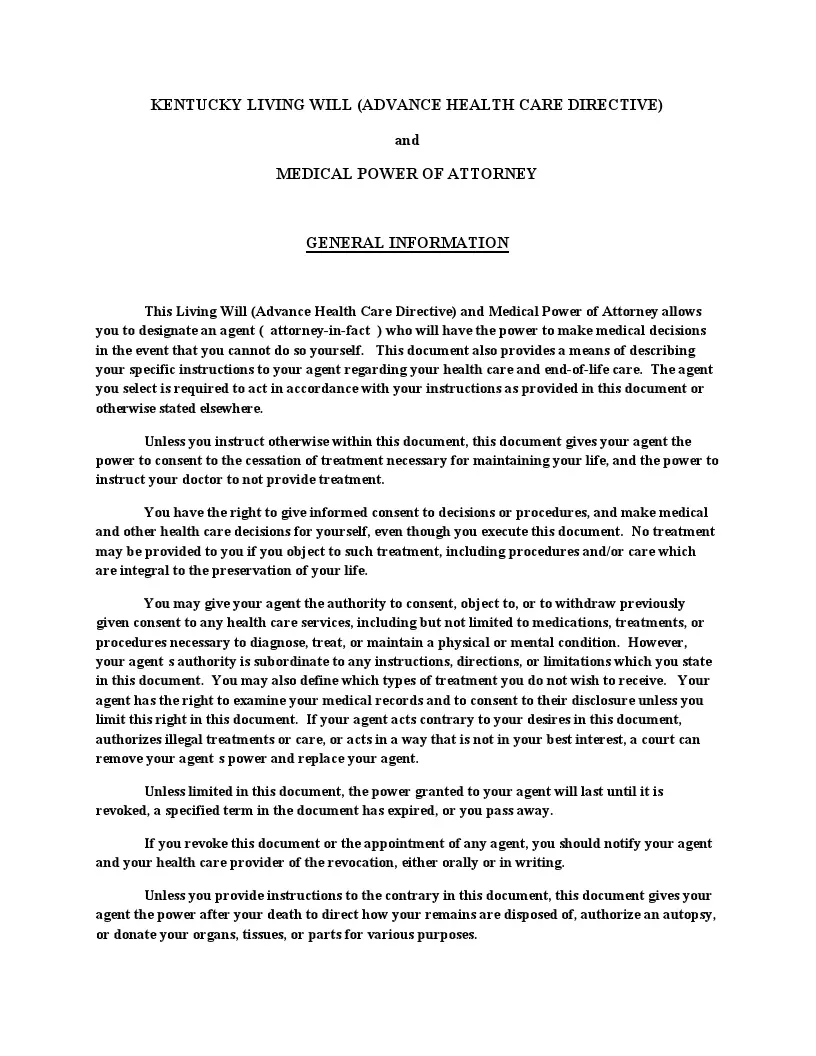
Filling out the Kentucky Living Will form takes about ten minutes. Work through the declaration, the health care treatment choices, and the agent's powers in the form's own order, then sign in front of two witnesses or a notary public. The outline below follows the form section by section.


General information, not legal or tax advice.
