
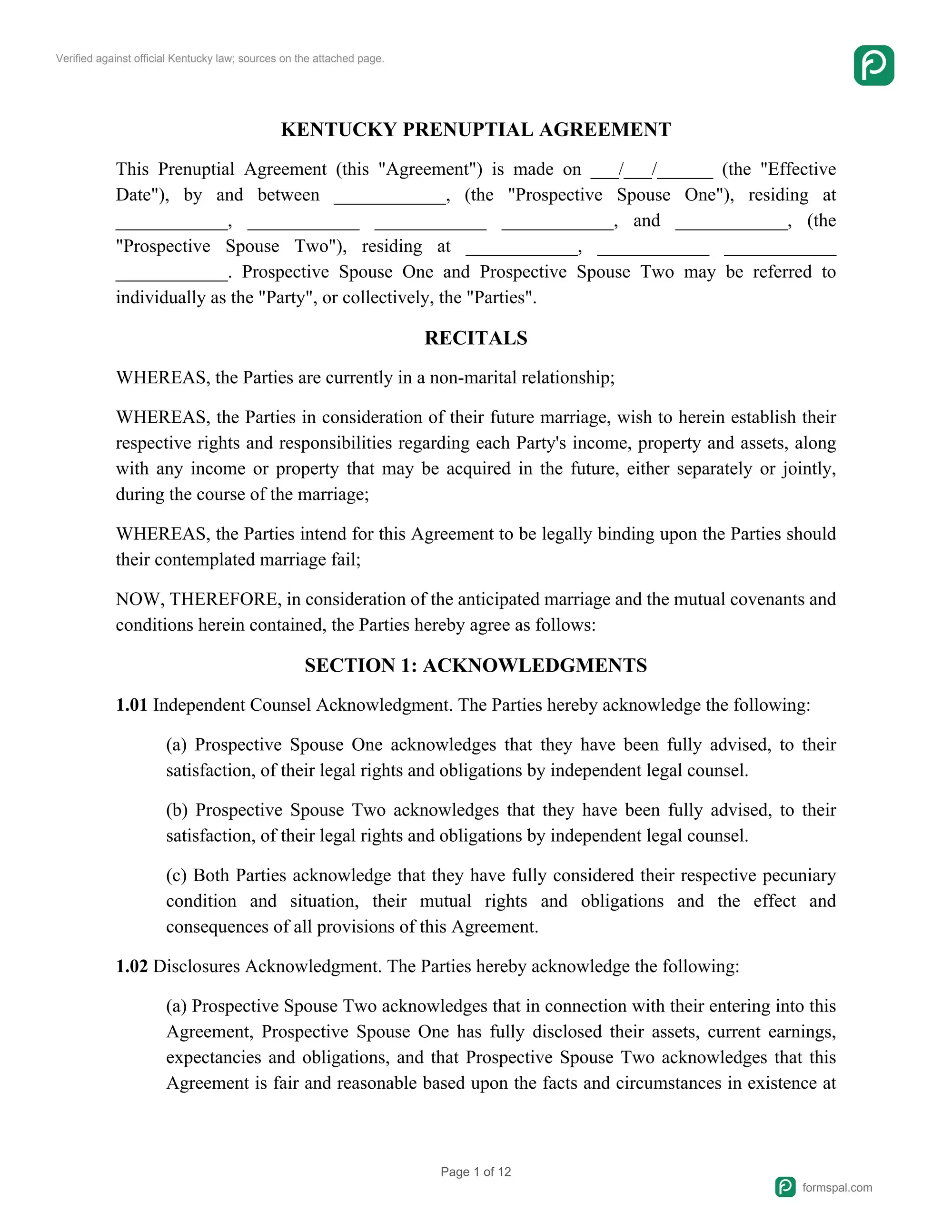
A Kentucky prenuptial agreement is a written contract that a couple signs before the wedding. It sets out who owns what, who owes what, and how property and spousal support are handled if the marriage ends.
Last Updated: September 2026 This guide is reviewed and updated regularly to reflect current Kentucky law. If you notice an error or outdated information, please contact us.
Build Your Document
Answer a few simple questions to make your document in minutes
Save and Print
Save progress and finish on any device, download and print anytime
Sign and Use
Your valid, lawyer-approved document is ready
It takes effect only once you are married, and it applies in the event of a divorce or the death of a spouse. It cannot fix child support or custody, because a court decides those issues for itself.
Our free printable prenuptial agreement form covers the standard terms, and the document builder fills them in for you.
Kentucky has no statute written only for prenuptial agreements. A premarital contract is judged as a contract, so the controlling rule sits in the statute of frauds. An agreement made in consideration of marriage must be in writing, and it must be signed by the party it is enforced against.[1] The rest comes from general contract principles and from the property rules in Chapter 403.
Two things make the contract legally binding. It must be in writing, and it must carry the signature of the party it is enforced against.[1] Have both of you sign, so that either partner can rely on the document later.
That section does not call for a notary or for witnesses.[1] In practice, many couples notarize anyway, because a notary records who signed and when. It is also common to sign weeks ahead rather than days ahead, so that neither partner can easily claim later to have been pressured.
The agreement works by moving assets out of the marital pot before a court ever looks at them. Section 403.190 of the Ky. Rev. Stat. lists what is not marital property, and that list includes property the couple has set aside by agreement.[2]
Property excluded by valid agreement of the parties.
Within that limit you can settle most financial questions, including:
A signed prenup is not automatically a valid one. Courts look at how the agreement was made, and these are the reasons they most often refuse to enforce one:
Kentucky does not require either partner to hire an attorney. Agreements reviewed by separate legal counsel are much harder to attack, because each side can show it understood what it signed.
Terms that made sense at the start can stop fitting after fifteen years. You can amend the agreement or cancel it and write a new one.
Do it the same way you made it. Put the change in writing, state plainly what is being revoked or replaced, and have both partners sign. Keep both agreements together, the original and the amendment.[1]
The work is mostly financial disclosure and planning. Each partner writes down what they own and owe, the two of you trade those lists, and only then do you decide what the agreement should say. Start months ahead so nobody is signing in a hurry.
Yes. An agreement that is in writing and signed satisfies the statutory formality,[1] and Section 403.190 of the Ky. Rev. Stat. then treats the property you excluded as outside the marital estate.[2] Courts here have enforced premarital agreements that plan for divorce since 1990. A judge can still refuse one signed under pressure or without honest financial disclosure.
A prenup settles money and property, and nothing about the children. A court decides child support and custody itself at the time of the divorce, so a clause fixing either one is struck even when both partners agreed to it. Courts also refuse terms that are punitive or that try to run married life day to day.
There is no published KY rate. Nationally, a lawyer drafted prenuptial agreement runs roughly $1,000 to $10,000 per person. The price tracks how tangled your financial affairs are, whether either of you owns a business, and how much the two sides negotiate. Completing a template yourself costs a small fraction of that.
No. Kentucky divides marital property between the partners rather than halving every asset. A prenup changes the question instead of answering it. Property excluded by a valid agreement of the parties is not marital property at all under Section 403.190 of the Ky. Rev. Stat., so the court never reaches it.[2]

Unless noted otherwise, the sources below are from the Ky. Rev. Stat..
