
A Kentucky promissory note is a written promise to repay a loan, signed by the borrower and made out to the lender. This Kentucky promissory note template records the amount borrowed, the interest rate, the payment dates and whether the loan is backed by collateral. People use it for personal or business loans. Fill the form out online or download the PDF form.
Last Updated: October 2026. This guide is reviewed and updated regularly to reflect current Kentucky law. If you notice an error or outdated information, please contact us.
Build Your Document
Answer a few simple questions to make your document in minutes
Save and Print
Save progress and finish on any device, download and print anytime
Sign and Use
Your valid, lawyer-approved document is ready
A promissory note names the borrower and the lender, the sum lent, the interest rate and the due date, and the borrower signs it. This holds for a standard promissory note template as well. Each state sets its own rules for loans, and the Kentucky template lets you pick one of two types. A business can use the same form to record a loan from an owner or from another business.
Apart from the collateral lines, both types of the form ask for the same details.
Popular Local Promissory Note Forms
Individuals and companies often want promissory notes to borrow money from other individuals and businesses and keep away from lending institutions. Here are some of the most requested local promissory notes searched by people.
The state of Kentucky sets a legal interest rate of 8% per year, and the parties may agree in writing to pay more.[1.1] For a written contract with an original principal of $15,000 or less, the agreed rate cannot exceed 4% above the Federal Reserve discount rate on 90-day commercial paper or 19%, whichever is less.[1.2] Above $15,000, any rate may be agreed.[1.1]
At a per annum rate not to exceed four percent (4%) in excess of the discount rate on ninety (90) day commercial paper in effect at the Federal Reserve Bank in the Federal Reserve District where the transaction is consummated or nineteen percent (19%), whichever is less, on money due or to become due upon any contract or other obligation in writing where the original principal amount is fifteen thousand dollars ($15,000) or less
In plain words, the rules in Ky. Rev. Stat. § 360.010 work like this:
| Document Name | Kentucky Promissory Note Form |
| Other Name | KY Promissory Note |
| Max. Rate | 8% legal rate when no rate is agreed, written contract of $15,000 or less: 4% above the 90-day commercial paper discount rate or 19%, whichever is less, written contract above $15,000: any rate |
| Relevant Laws | Kentucky Revised Statutes, Section 360.010 |
| Avg. Time to Fill Out | 10 minutes |
| # of Fillable Fields | 28 |
| Available Formats | Adobe PDF |
Prejudgment interest is the interest a lender may recover after a borrower defaults and before a court enters judgment. Under the state statute, Ky. Rev. Stat. § 360.010, a written note that states a rate keeps that rate after default. A note that states no rate earns interest at the legal rate of interest.[1.1]
The interest rate blank on the form matters after a default too. Fill it in, so the note states the rate you agreed on.
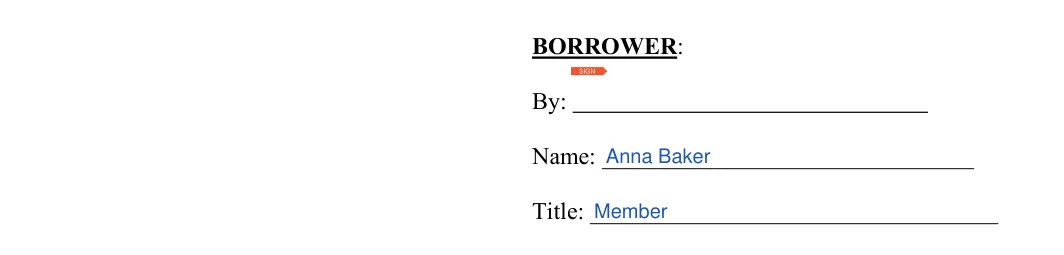
The FormsPal Kentucky promissory note template is a three-page document. Page 1 holds the loan details and the payment terms, page 2 holds the security terms and the default terms, and page 3 holds the signature blocks. This section summarizes what the printed text of the template says, so you know what you are signing.
The borrower promises to pay the principal amount, or the unpaid principal of the loans made if that is less. Interest runs on the unpaid principal from the date the loan is made until it is repaid in full, at the per annum rate you enter.
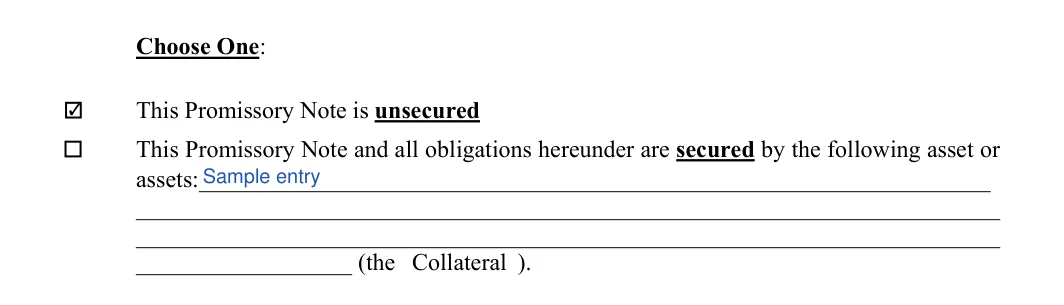
On page 2 you check one of two choices. An unsecured promissory note rests on the borrower's promise alone. A secured promissory note lists the collateral, meaning the asset or assets that back the loan.
If you choose a secured note, the template makes the borrower sign the security documents the lender reasonably requests. The borrower states that the collateral is unencumbered and that the borrower owns it. The borrower agrees not to sell, transfer or further encumber the collateral, and to keep it insured, until the note is repaid in full. When the note is repaid, the lender's security interest in the collateral ends.
These are the form's own terms, written as legal wording for the note. They are not a statement of what Kentucky law requires. For legal advice on a specific loan, or to change a term, talk to a lawyer licensed in Kentucky before you sign.
Choose a secured promissory note when the loan is large or the lender wants something to fall back on. Choose an unsecured promissory note when the loan is small or the two parties trust each other, as in a loan between family members or a small business and its owner. The template covers both, and the only difference in the form is the collateral on page 2. The rest of the form stays the same for a personal or a business loan.
Whichever you pick, finish the note the same day the money changes hands. Each party should keep a signed copy, and the borrower should keep a record of every payment made. Some people also sign in front of a notary public to confirm each other's identities. The template has no notary block.
The Kentucky promissory note template has 28 fillable fields. The steps below walk through a filled-in Kentucky promissory note example, following the form's own parts from the top of page 1 to the signature blocks on page 3.
Fill the form in on screen with the online PDF editor or print it and write by hand.
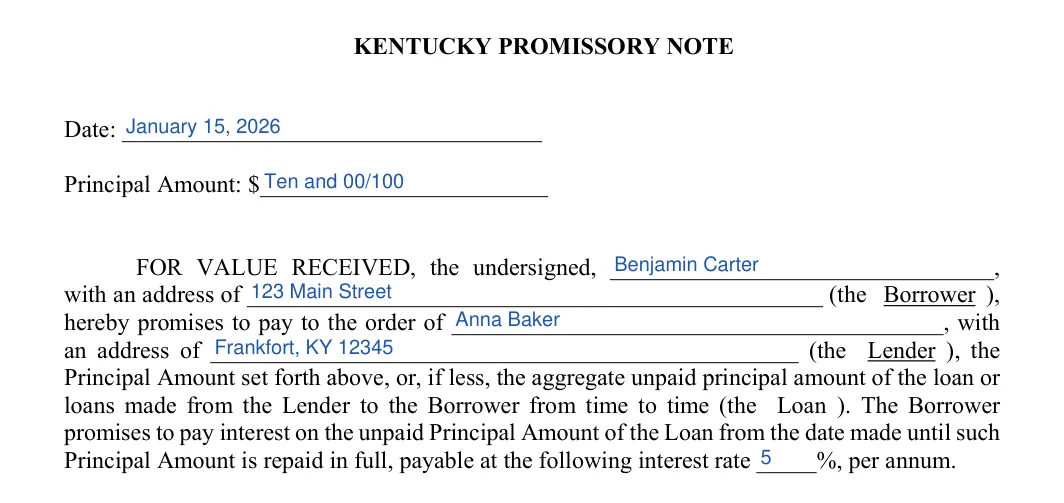
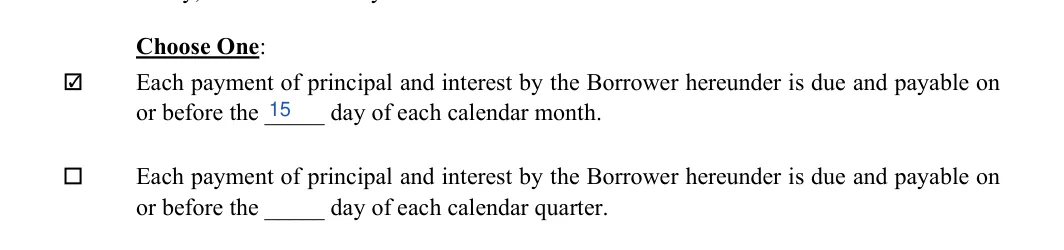
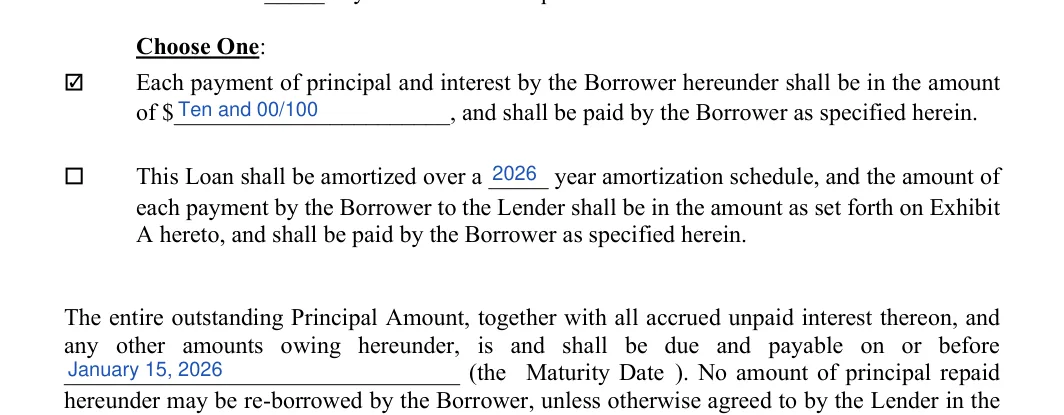
The screenshots under each step show the FormsPal Kentucky promissory note template filled with sample entries in blue, so you can see where each answer goes. The names, addresses, dates and amounts are examples only.

Questions about a Kentucky promissory note usually come down to the interest rate and how much a lender may charge. The answers below cover the legal rate, the legal ceiling for loans of $15,000 or less and what the state allows above that amount.
For a written contract with an original principal of $15,000 or less, 30% is above the limit. The ceiling is 4% above the discount rate on 90-day commercial paper or 19%, whichever is less.[1.2] A written contract with an original principal above $15,000 may carry any rate.[1.1] So whether 30% is allowed depends on the size of the loan.
Yes, for a written contract with an original principal of $15,000 or less. The rate may not exceed 4% above the discount rate on 90-day commercial paper at the Federal Reserve Bank in the district where the transaction is consummated, or 19%, whichever is less.[1.2] For a written contract with an original principal above $15,000, the statute allows any rate.[1.1]
Usury law decides whether the interest a note may charge is capped, and at what rate. In Kentucky, Ky. Rev. Stat. § 360.010 sets these limits:
The special case is a written contract or obligation with an original principal of $15,000 or less. For that case, the statute caps the rate at 4% above the discount rate on 90-day commercial paper in effect at the Federal Reserve Bank in the district where the transaction is consummated, or 19%, whichever is less.[1.1]
General information, not legal or tax advice.

Other Promissory Note Forms by State
