South Carolina Promissory Note Template

A South Carolina promissory note is a written promise to repay a loan, with the amount, rate and payment dates in writing. Under S.C. Code Ann. § 37-10-106, interest is limited to six percent per annum unless a written contract expressly sets a different rate.[1.3] Use the free FormsPal template below to build the note online or download it as a PDF.

Last Updated: October 2026. This guide is reviewed and updated regularly to reflect current South Carolina law. If you notice an error or outdated information, please contact us.
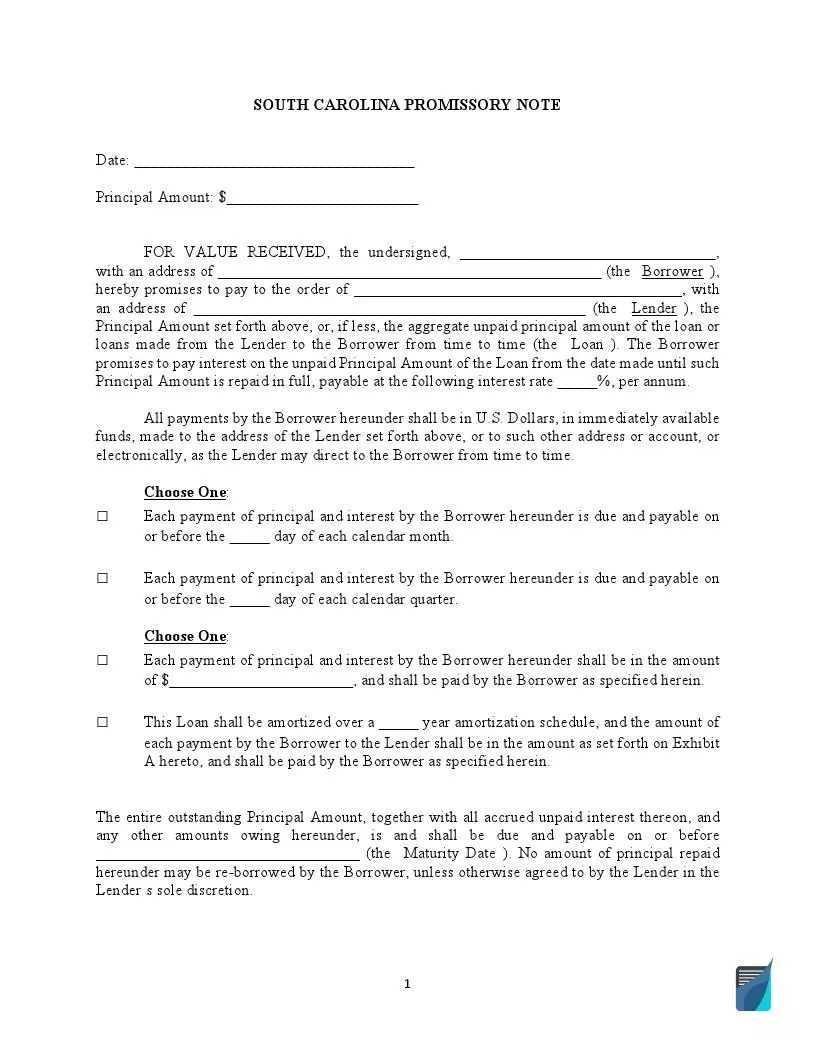
South Carolina promissory note form preview

Create a free high quality South Carolina Promissory Note online now!

Build Your Document

Answer a few simple questions to make your document in minutes

Save and Print

Save progress and finish on any device, download and print anytime

Sign and Use

Your valid, lawyer-approved document is ready

... or download your South Carolina Promissory Note Template as a  PDF file

The FormsPal template, like our basic promissory note template, sets out the terms that govern the loan:

  • The names and addresses of the borrower and the lender
  • The amount borrowed, called the principal
  • The interest rate
  • How and when the debt is paid back
  • An amortization schedule, if you choose one

South Carolina Usury Laws

South Carolina limits interest on a loan to six percent per annum unless a written contract expressly provides a different rate. The limit is in S.C. Code Ann. § 37-10-106, which also covers the legal rate of interest and life insurance policy loans.[1.3] The statute words the limit this way.

No greater interest than six percent per annum shall be charged, taken, agreed upon or allowed upon any contract arising in this state for the hiring, lending, or use of money or other commodity, either by way of straight interest, discount or otherwise, except upon written contracts wherein, by express agreement, any rate of interest may be charged, except as otherwise provided in this title or by law.

S.C. Code Ann. § 37-10-106

In plain words, six percent per annum is the ceiling unless the parties agree to another rate in a written contract. Other provisions of the S.C. Code or other law can still limit the rate.

Chapter 10 of Title 37 of the S.C. Code sets these related rules.

  • When a contract, judgment or other document uses the term "legal rate of interest" or "lawful rate of interest," it means the rate specified in Section 34-31-20, unless the document says otherwise.[1.3] Section 34-31-20(A) sets that legal interest at eight and three-fourths percent per annum for accounts stated and for any sum of money that is due and draws interest according to law. It is not the six percent limit in Section 37-10-106.[2.1]
  • Interest on a life insurance policy loan may not exceed eight percent per annum unless other law provides otherwise.[1.3]
  • The debtor (the borrower) may prepay in full at any time without penalty the debt represented by a personal, family, or household purpose loan agreement that is secured in whole or in part by a first or junior lien on real estate, if the aggregate of all sums advanced will not exceed one hundred fifty thousand dollars ($150,000).[1.1]

Breaking the rules in this chapter can cost a creditor money. The debtor can sue to recover actual damages. The debtor can also recover a penalty set by the court of at least one thousand five hundred dollars ($1,500) and at most seven thousand five hundred dollars ($7,500). Neither claim can be brought as a class action.[1.2]

South Carolina Promissory Note Form Details

Document Name South Carolina Promissory Note Form
Other Name SC Promissory Note
Max. Rate Six percent per annum unless a written contract expressly sets another rate[1.3]
Relevant Laws S.C. Code Ann. § 37-10-106
Avg. Time to Fill Out 10 minutes
# of Fillable Fields 28
Available Formats Adobe PDF
On the form, the person who borrows is the Borrower and the person who lends is the Lender. You may also hear them called the maker and the holder of the note.
Template Preview
Create a free high quality South Carolina Promissory Note online now!

Popular Local Promissory Note Forms

A promissory note (often referred to as loan note) is considered a simple lending document used regularly by both individuals and businesses through all states as a funding source and a substitute for loan providers. Discover more about the most popular US states searched by our users with regards to promissory notes.


Filling Out the South Carolina Promissory Note

The South Carolina promissory note template is a three-page form with 28 fillable fields, and you complete it in six parts. Work through the parts in order, check the boxes that match your loan and leave the other choices blank. You can fill in the downloaded PDF with our online PDF editor.

The screenshots under each step show the FormsPal South Carolina promissory note template filled with sample entries in blue, so you can see where each answer goes. The names, addresses, dates and amounts are examples only.
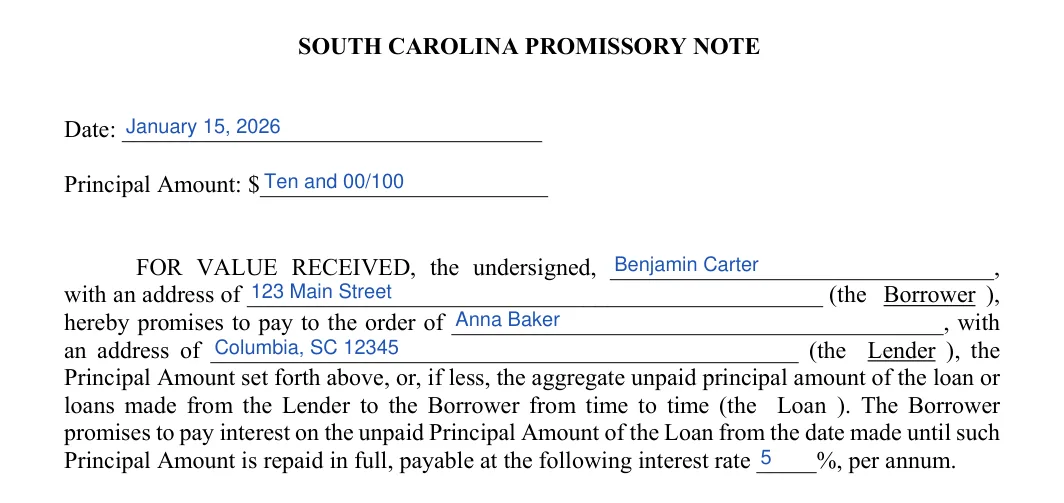
  1. Date, Amount, Parties and Interest Rate (page 1). Enter the date and the principal amount. Then write the Borrower's name and address, the Lender's name and address, and the interest rate per annum.
    South Carolina promissory note: SO UTH CAROLINA PROMISSORY NOTE, filled with sample entries
    Step 1: sample entries, not a real document.
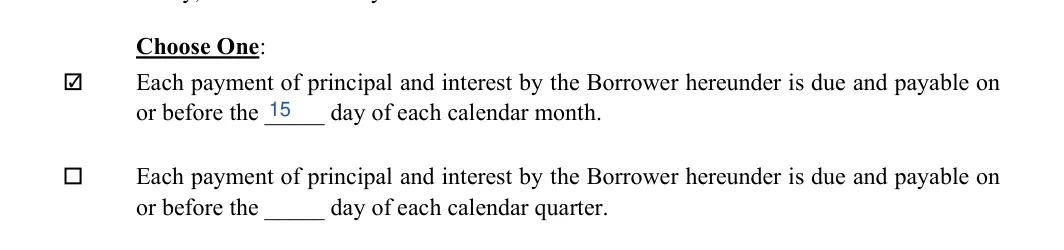
  2. Choose the Payment Due Day (page 1). Check one box. Payments are due either on a set day of each calendar month or on a set day of each calendar quarter. Write the day number in the blank.
    South Carolina promissory note: Choose One, filled with sample entries
    Step 2: sample entries, not a real document.
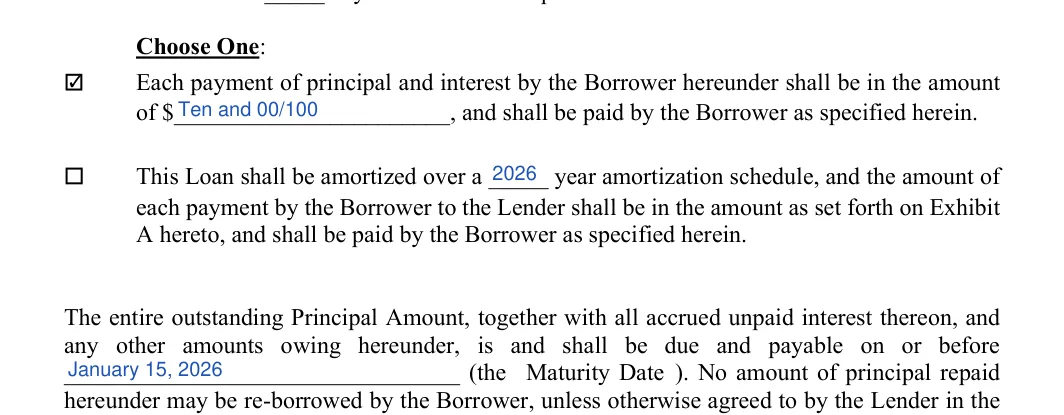
  3. Choose the Payment Amount and Set the Maturity Date (page 1). Check one box. Either each payment is a fixed dollar amount, or the loan is amortized over a number of years and the form refers to an Exhibit A that lists the payment amounts. Then write the Maturity Date, the day the whole balance is due.
    South Carolina promissory note: Choose One, filled with sample entries
    Step 3: sample entries, not a real document.
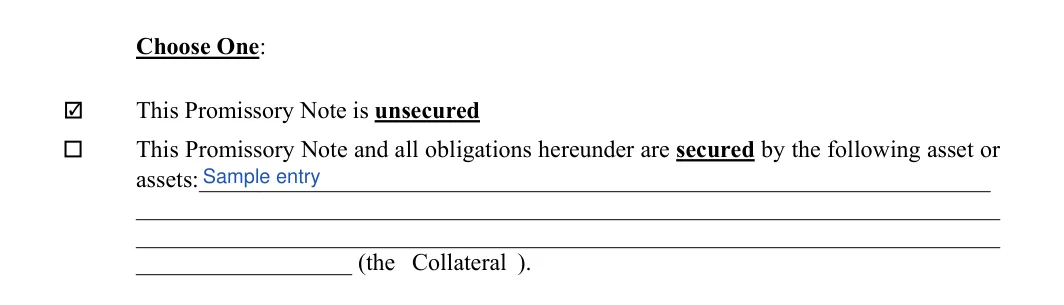
  4. Choose Unsecured or Secured (page 2). Check the unsecured box. Or check the secured box and list the asset or assets that serve as the Collateral for the loan.
    South Carolina promissory note: Choose One, filled with sample entries
    Step 4: sample entries, not a real document.
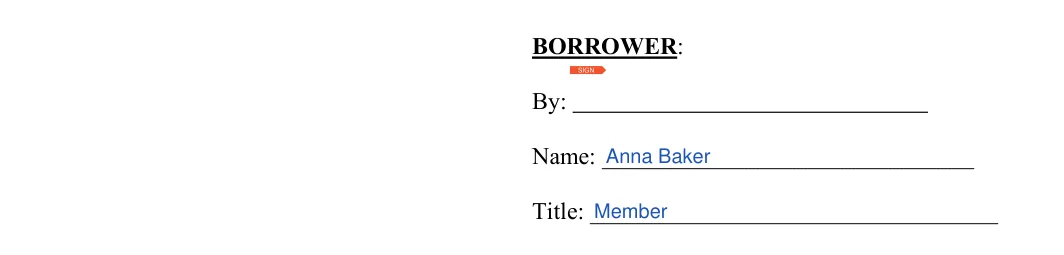
  5. Borrower Signs (page 3). The Borrower signs on the "By" line and prints a name and title.
    South Carolina promissory note: BORROWER, filled with sample entries
    Step 5: sample entries, not a real document.
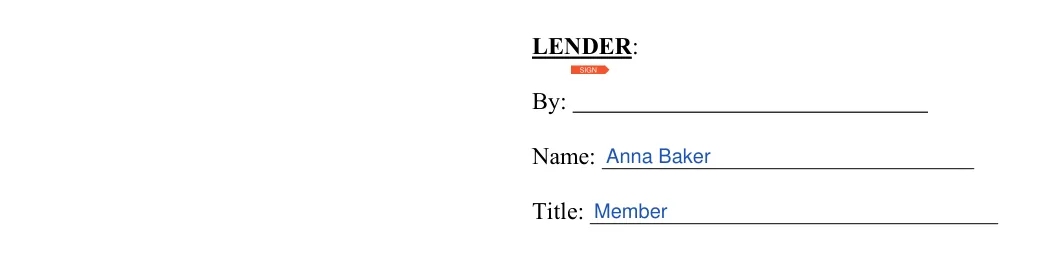
  6. Lender Signs (page 3). The Lender signs on the "By" line and prints a name and title. The form has no witness or notary line.
    South Carolina promissory note: LENDER, filled with sample entries
    Step 6: sample entries, not a real document.

The note already prints a late fee of five percent on any delinquent amount. It also prints the borrower's right to prepay without penalty and a line that South Carolina law governs the note. You do not fill in those terms.

Choosing the Terms of Your Loan

A promissory note works best when both sides settle the loan terms before anyone signs. Decide the amount, the interest rate, how often payments are due and whether the loan is backed by collateral. The FormsPal template for South Carolina asks for each of these choices, as the steps above show.

  • Interest rate. Write the rate in the note. The statute sets six percent per annum when no written contract provides a different rate.[1.3]
  • Payment schedule. Pick a due day each month or each quarter. Then choose a fixed payment amount or an amortization schedule that lists every payment on Exhibit A.
  • Collateral. An unsecured note rests on the borrower's promise alone. A secured note also names an asset that backs the loan.
  • Prepayment. The template lets the borrower prepay at any time, in whole or in part, without a penalty.

Key Terms on the Form

The note uses a few words that are worth knowing before you start. Each one is defined on the form itself.

  • Principal Amount. The sum of money that is lent, written in dollars at the top of page 1.
  • Borrower and Lender. The person who receives the money and the person who lends it.
  • Interest rate. The percentage per annum charged on the unpaid principal.
  • Maturity Date. The date by which the whole unpaid balance and any accrued interest is due.
  • Collateral. The asset or assets that back the loan on a secured note.

Fixed Payments or an Amortization Schedule

With a fixed payment, the note states one dollar amount for every payment. With an amortization schedule, the loan is spread over a set number of years, and Exhibit A lists the amount of each payment. A fixed amount suits a short and simple loan in South Carolina, while a schedule suits a longer loan repaid in installments.

Unsecured and Secured Notes Compared

What backs the loan Unsecured: the Borrower's promise alone. Secured: the promise plus the Collateral named on the form.
Box to check Unsecured: the box that says the note is unsecured. Secured: the secured box, with the assets listed on the lines below it.
Extra terms printed on the form Unsecured: none. Secured: Security Documents, insurance on the Collateral and no sale of the Collateral until the note is repaid.

On a secured note, the form has the Borrower sign the Security Documents the Lender reasonably asks for. The Lender's security interest in the Collateral ends once the principal and all other sums are paid in full. Both choices are set by the box you check on page 2 of the form.

If the loan is larger or more complex, a full loan agreement may suit the deal better than a single note. Either document records what the two sides agreed to.

FormsPal also offers a family loan agreement, a car promissory note and a short IOU for smaller debts, so you can match the document to the loan.

After You Sign the Note

Once the Borrower and the Lender have both signed, the note is ready to use. Good record keeping protects both South Carolina parties for the life of the loan. Keep the paperwork in a safe place and review it whenever a payment is made or a question comes up.

  • Give each party a signed copy, and store the original where it will not be lost.
  • Write down the date and amount of every payment, and ask for a receipt when paying in cash.
  • Put any change to the payment dates or the rate in writing, signed by both parties.
  • When the loan is paid in full, the Lender can mark the original as paid and hand it back to the Borrower.

These steps are common practice and are not a South Carolina rule. To fill in the PDF without printing it, use our online PDF filler.

Frequently Asked Questions

This answer summarizes the interest rules in S.C. Code Ann. § 37-10-106 that apply to a loan on a promissory note. The sections above give the details, including the prepayment rule and the penalty a court can set for breaking the chapter's rules.[1.3]

What are the rules for a promissory note?

The rules this page covers for a South Carolina promissory note are about interest. Three apply under S.C. Code Ann. § 37-10-106.

  • Interest may not exceed six percent per annum on a contract for lending money, unless a written contract expressly provides a different rate.
  • A contract, judgment or other document that uses the term "legal rate of interest" means the rate specified in Section 34-31-20, unless it says otherwise.
  • Interest on a life insurance policy loan may not exceed eight percent per annum unless other law allows more.[1.3]
seal of south carolina state
Other South Carolina Forms
Looking for more South Carolina documents? We provide free forms and straightforward personalization experience to anybody who wishes for less hassle when handling documentation.

General information, not legal or tax advice.

Sources

This guide relies on the South Carolina statute listed below. Each bracketed number in the text above points to the matching entry in this list, so you can check the wording of the law yourself.

  1. S.C. Code Ann. §§ 37-10-103 to 37-10-106.
    • 1.1 § 37-10-103
    • 1.2 § 37-10-105(A)
    • 1.3 § 37-10-106
  2. S.C. Code Ann. § 34-31-20
    • 2.1 § 34-31-20(A)
Published: Aug 16, 2022
Jennifer M. Settles
Jennifer M. Settles
Author & Attorney
With over 25 years of experience as a business and transactional attorney, Jennifer has mastered the craft of closing highly successful deals for her clients. Through her wide-ranging expertise in commercial contracts, real estate transactions, M&A and corporate law, Jennifer secures results that are second-to-none.