
A South Carolina living will is a written declaration under the state’s Death With Dignity Act that lets you refuse life-sustaining procedures. South Carolina calls the document a Declaration of a Desire for a Natural Death.
Last Updated: September 2026. This guide is reviewed and updated regularly to reflect current South Carolina law. If you notice an error or outdated information, please contact us.
Build Your Document
Answer a few simple questions to make your document in minutes
Save and Print
Save progress and finish on any device, download and print anytime
Sign and Use
Your valid, lawyer-approved document is ready
The declaration takes effect once two physicians, one of whom is your attending physician, certify that your condition is terminal or that you are permanently unconscious. At that point you can direct that life-sustaining procedures be withheld or withdrawn, and you can name an agent to enforce or revoke the declaration on your behalf.[1.2]
The document has no legal effect until you sign it before a notary and two witnesses who meet South Carolina’s eligibility rules for witnesses.[1.1]
South Carolina’s living will process is set out in the state’s Death With Dignity Act. To create a valid declaration, sign it before a notary and two witnesses who meet the state’s eligibility rules.[1.1] South Carolina also provides its own statutory declaration form as a starting point.[1.2]
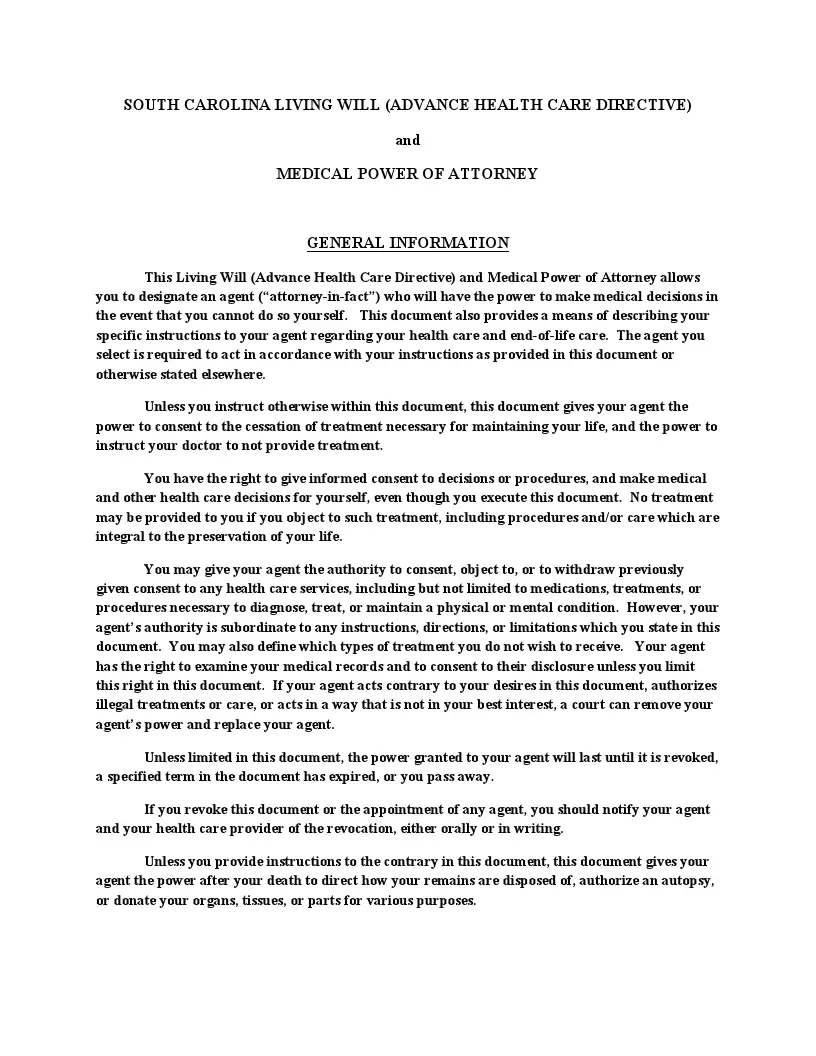
You can download a free copy of the living will form from FormsPal or build it online. Either version must still be signed the same way to be valid.
You must date and sign the declaration in front of a notary public and two witnesses. One of the two witnesses may be the notary. The witnesses must be present with you and with each other when they sign the affidavit portion of the form.[1.1]
Your notary can double as one of your two required witnesses. South Carolina law counts the notary toward the two-witness requirement, so you do not need a third person in the room.
South Carolina restricts who may serve as a witness. A witness cannot be any of the following:
No more than one of the two witnesses may be an employee of the health facility where you are a patient.[1.1]
A common mistake is asking a spouse, a relative, or a treating doctor to witness the form. South Carolina disqualifies all three, so the declaration would not be valid.
By signing, your two witnesses swear to these eligibility facts in an affidavit set out in Section 44-77-50 of the S.C. Code Ann.[1.2]
“If the declarant is a patient in a hospital or a resident in a nursing care facility at the time the declaration is executed, [it must have] been witnessed by an ombudsman as designated by the State Ombudsman, Office of the Governor, with the ombudsman acting as one of the two witnesses.”
In plain terms, if you sign while admitted to a hospital or living in a nursing care facility, one of your two witnesses must be that facility’s designated ombudsman.[1.1] After you finish the declaration, send a copy to your physician, your named agent, and close family so they know your health care wishes before an emergency happens.
| Document Name | South Carolina Living Will Form |
| State Form Name | South Carolina Declaration of a Desire for a Natural Death |
| Signing Requirements | Two Witnesses and a Notary |
| Validity Requirements | Section 44-77-40 |
| Statutory Declaration Form | Section 44-77-50 |
| Avg. Time to Fill Out | 13 minutes |
| # of Fillable Fields | 65 |
| Available Formats | Adobe PDF; Microsoft Word |
| State Laws: South Carolina Code of Laws, Title 44, Chapter 77 (Death With Dignity Act) | |
Popular Local Living Will Forms
Filling out the South Carolina living will form takes eleven steps, from downloading the document to completing the notarized witness affidavit on the final page. You can download the form for free from FormsPal, or use South Carolina’s own statutory declaration text in Section 44-77-50 of the S.C. Code Ann. as a template.[1.2] Follow the form’s own order below so you do not leave a required field blank.


General information, not legal or tax advice.
