
An Alabama living will is a written document that lets you state, in advance, the medical treatments you want or do not want if you become unable to communicate your wishes. Alabama law calls it an advance directive for health care, and it also lets you name a health care agent to carry out those wishes.
Last Updated: September 2026. This guide is reviewed and updated regularly to reflect current Alabama law. If you notice an error or outdated information, please contact us.
The document covers choices such as life-sustaining treatment and artificially provided food and hydration. Alabama residents commonly prepare one as part of estate and end-of-life planning, especially when a serious illness makes future decisions hard to communicate.
A living will only takes effect once a doctor determines you cannot communicate medical decisions yourself. Keep signed copies where your family, doctor, and health care agent can find them.
An Alabama living will must meet the signing rules set out in Ala. Code § 22-8A-4(c) to be legally valid, and the same four rules apply to every living will made in the state, whichever form you use.[1.1] The document must be:
Ask your two witnesses to sign at the same time and in the same room as you. Alabama's witness rule requires them to be present when you sign, and signing together avoids any dispute later about who watched you sign.[1.1]
Any advance directive for health care made pursuant to this chapter shall be: in writing; signed by the person making the advance directive for health care, or by another person in the declarant's presence and by the declarant's expressed direction; dated; and signed in the presence of two or more witnesses at least 19 years of age, neither of whom shall be the person who signed the advance directive for health care on behalf of and at the direction of the person making the advance directive for health care, appointed as the health care proxy therein, related to the declarant by blood, adoption, or marriage, entitled to any portion of the estate of the declarant according to the laws of intestate succession of this state or under any will of the declarant or codicil thereto, or directly financially responsible for declarant's medical care.
Your health care provider, or an employee of that provider who is not related to you, cannot act as your health care proxy (Ala. Code § 22-8A-4(b)(4)).[1.4]
Under Ala. Code § 22-8A-4(a), any competent adult may make a living will.[1.3]
| Document Name | Alabama Living Will Form |
| State Form Name | Alabama Advance Directive for Health Care |
| Signing Requirements | In writing, signed, dated, and witnessed by two or more people at least 19 years old.[1.1] |
| Avg. Time to Fill Out | 13 minutes |
| # of Fillable Fields | 48 |
| Available Formats | Adobe PDF, Microsoft Word |
| State Laws: Ala. Code §§ 22-8A-1 to 22-8A-18 | |
Popular Local Living Will Forms
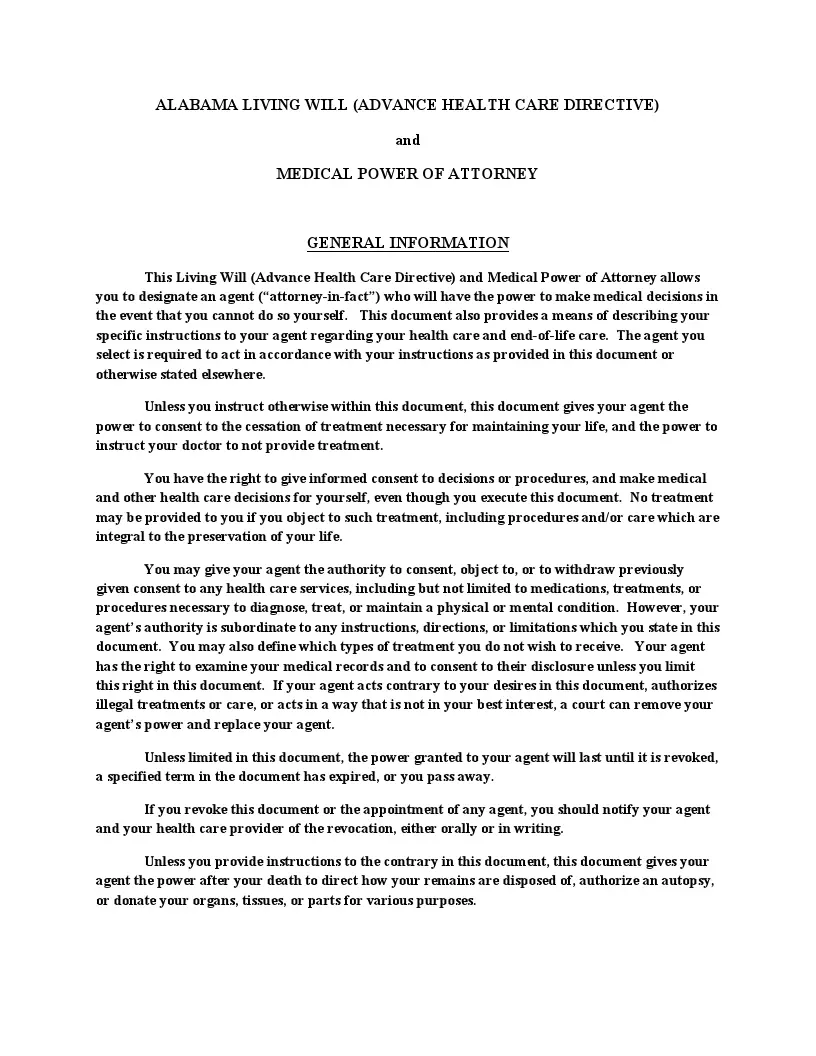
Follow these steps to complete Alabama's living will and medical power of attorney form. The form combines your health care treatment choices with the option to name an agent, so work through it in the order the document uses, from your treatment decisions on page 2 to the witness acknowledgment at the end.

Alabama requires two or more witnesses to sign your living will. Under Ala. Code § 22-8A-4(c), the witnesses must each be at least 19 years old and must watch you sign the document in person.[1.1]
Yes. Alabama law requires the document to be signed, either by you or by someone else who signs in your presence and at your express direction. The document must also be in writing and dated before your witnesses sign it.[1.1]
Alabama law excludes several people from serving as a witness to your living will. A witness cannot be the person who signed the document on your behalf, your named health care proxy, or a relative by blood, adoption, or marriage. A witness also cannot be anyone who stands to inherit from you or is directly financially responsible for your medical care.[1.1]
A common mistake is asking a family member who would inherit from you to serve as a witness. Alabama law makes that person ineligible to serve as a witness on your document.[1.1]
Yes. Ala. Code § 22-8A-4(h) sets out a sample Advance Directive for Health Care that combines a living will with a health care proxy designation in one document.[1.2] This sample form appears in the same Alabama Code section as the signing rules described above.
A witness to an Alabama living will must be at least 19 years old. This age threshold applies under Ala. Code § 22-8A-4(c), along with the other witness eligibility rules described above.[1.1]
General information, not legal or tax advice.
