
A New Jersey living will is a written advance directive, known under state law as an Instruction Directive. It tells medical providers which life-sustaining treatments a person wants or refuses if they can no longer make or communicate health care decisions.
Last Updated: September 2026. This guide is reviewed and updated regularly to reflect current New Jersey law. If you notice an error or outdated information, please contact us.
This FormsPal template combines the instructions with a health care proxy section, letting a resident name a primary health care representative and, optionally, a substitute to carry out those wishes. It addresses medical treatment choices only, not property or finances.
Fill out the free New Jersey living will form below, then download and print it at no cost.
New Jersey law sets exact rules for signing a living will under N.J.S.A. 26:2H-56. The declarant signs and dates the document, or directs someone else to do so. This happens in the presence of two adult witnesses who attest that the declarant is of sound mind and free of duress or undue influence.[1]
Many people ask a friend, neighbor, or coworker who is not named as their health care representative to witness the signing.
Life-sustaining treatment generally means medical care that keeps a person alive without curing the underlying condition, such as a ventilator, a feeding tube, or CPR. A living will lets a resident state in advance which of these treatments they want and which they want withheld, before a medical crisis makes it impossible to ask them directly.
For example, a declarant named Anna Baker might use her instruction directive to ask for pain medication and comfort care to continue, while declining CPR and mechanical ventilation if doctors determine she will not recover. Another declarant might choose the opposite. Both choices are valid under the same directive, because the form exists to record the individual’s own treatment preferences.
Once the directive is signed and witnessed or notarized, keep the original in an accessible place and give copies to the named health care agent, any substitute agent, and the primary doctor. A directive that nobody can find when it is needed cannot guide treatment decisions.
Do not ask your named health care representative to also sign as one of your two witnesses. New Jersey law does not allow this. Choose two other adults, or use notarization instead.[1]
If you lack decision-making capacity, you may still suspend your advance directive by notice or by any act that shows that intent, and you may reinstate it by oral or written notice to your health care representative, physician, nurse or other health care professional (N.J.S.A. 26:2H-57(d)).[1]
| Document Name | New Jersey Living Will Form |
| State Form Name | New Jersey Instruction Directive |
| Signing Requirements | Two Adult Witnesses or Notary Public |
| Validity Requirements | N.J.S.A. 26:2H-56 |
| Avg. Time to Fill Out | 13 minutes |
| # of Fillable Fields | 48 |
| Available Formats | Adobe PDF; Microsoft Word |
| State Laws: New Jersey Statutes, Sections 26:2H-53 to 26:2H-91.2 | |
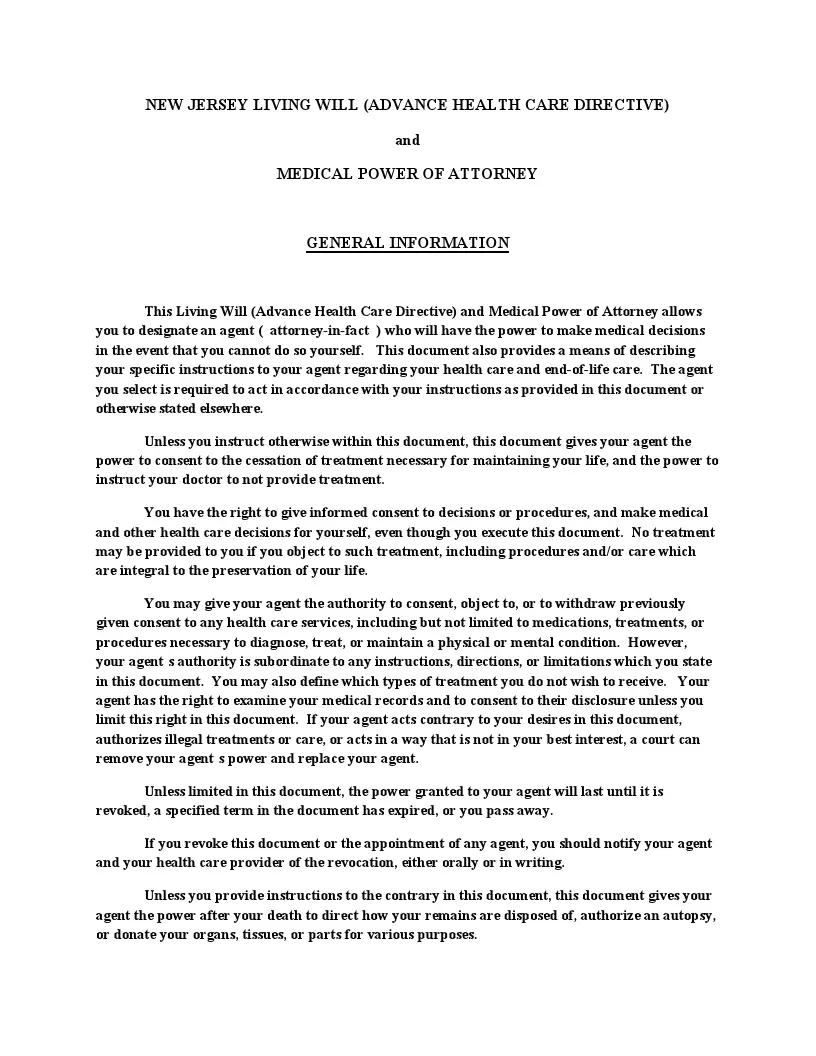
Filling out this advance directive takes most declarants under 15 minutes. The New Jersey living will form asks for the declarant's information, health care and end-of-life treatment choices, an optional health care representative, and the signatures of the declarant and two witnesses or a notary. Complete the steps below in order, using FormsPal's online form builder or a downloaded PDF.


New Jersey requires a living will, called an Instruction Directive, to be signed and dated by the declarant, or by someone directed by the declarant. This happens in the presence of two adult witnesses who attest that the declarant is of sound mind and free of duress or undue influence. A health care representative cannot serve as one of the witnesses. Instead of using witnesses, the declarant can have the signature acknowledged before a notary public, an attorney at law, or another person authorized to administer oaths.[1]
FormsPal’s advance directive PDF walks through each requirement in order, so a declarant can prepare the directive correctly the first time.
A New Jersey living will is valid once it meets the state's execution rules under N.J.S.A. 26:2H-56. It needs the declarant's dated signature, plus either two qualifying adult witnesses or acknowledgment before a notary public, attorney at law, or another person authorized to administer oaths. A declarant only needs to complete one of these two paths for the directive to take legal effect, not both.[1]
General information, not legal or tax advice.
