
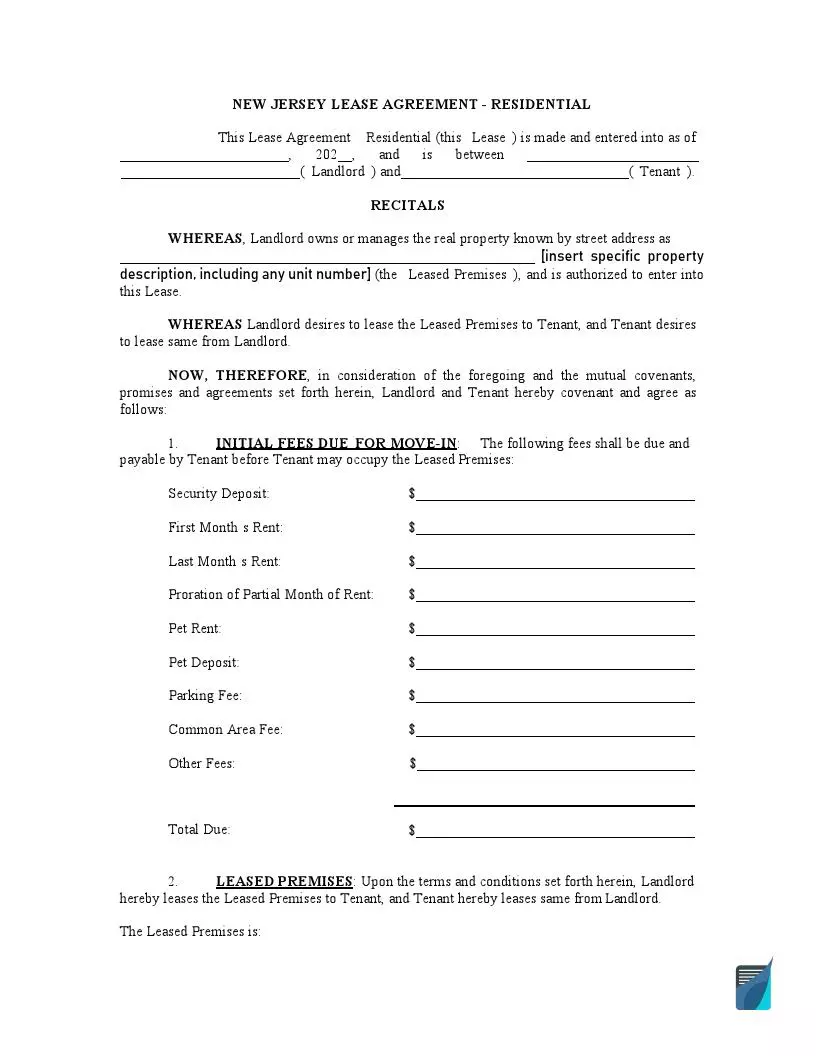
A New Jersey lease agreement is a written contract between a landlord and a tenant that sets the rent, term, and each party's responsibilities for a rental. New Jersey recognizes several versions of this document, including a standard residential lease, a month-to-month lease, a sublease, and a commercial lease. The agreement also lists the security deposit amount and the date it is due back. Download the form in PDF, Word, or OpenDocument format, or build it online with FormsPal's document creator.
Last Updated: September 2026. This guide is reviewed and updated regularly to reflect current New Jersey law. If you notice an error or outdated information, please contact us.
Build Your Document
Answer a few simple questions to make your document in minutes
Save and Print
Save progress and finish on any device, download and print anytime
Sign and Use
Your valid, lawyer-approved document is ready
New Jersey recognizes several types of rental agreements, each suited to a different situation. This page covers eight versions, including a standard residential lease, a room rental agreement, a commercial lease, and a sublease agreement. Review the list below, then choose the version that matches your rental.
Once you pick a version, you can fill it in online with FormsPal's PDF editor or download it and sign it by hand.
The New Jersey Sublease Agreement Form is a type of written agreement between the renter and the landlord that says the landlord allows the renter to sublet the premises.
This type of rental is popular for houses and multi-room apartments, that is, the premises in which you can rent a room or a separate part of the living space. A sublease can also be a daily lease of premises that the renter rented from the landlord for a long time.
The New Jersey Commercial Lease Agreement is a type of contract between the renter and the landlord, which involves the lease of premises for commercial rather than residential purposes. The main difference from a typical residential lease is that the landlord allows the renter to install equipment needed for the business. That equipment can go anywhere on the leased premises.
This type of agreement is most often concluded for a long term, three to five years. Premises rented for commercial purposes are most often offices, warehouses, and production halls.
The New Jersey lease termination letter is a written notice ending a lease that either the tenant or the landlord can send. How much advance notice a termination letter needs depends on the type of tenancy. See Notice to End a Tenancy below for the exact notice periods.
Popular Local Rental Lease Agreement Forms
How much notice a lease requires to end depends on the type of tenancy. Ending a month-to-month tenancy requires 1 month's notice to quit. Ending a year-to-year tenancy requires 3 months' notice to quit. Ending a fixed-term lease that is not renewing requires one term's notice to quit.[1.1]
Not sure how to count a notice period? FormsPal's deadline calculator adds up the days for you.
Security deposits protect the landlord and renter from unforeseen financial losses when the lease ends. New Jersey caps the security deposit at one and a half times one month's rental, according to the terms of the lease.[1.5] New Jersey law requires the security deposit to be returned within 30 days after the termination of the tenant's lease or the licensee's agreement.[1.4]
In New Jersey, the deposit remains the tenant's money and must be held in trust by the person who receives the deposit or advance. Interest earned on the deposit belongs to the person who made the deposit, not the landlord.
It must be paid to the tenant in cash or credited toward the rent due at the renewal or anniversary of the tenant's lease. Whoever invests the security deposit must notify the tenant in writing within 30 days of receipt of the deposit.
If the landlord does not comply, the tenant can give written notice that the security money be applied to the rent payment due or to become due. That amount includes interest at a rate of seven percent per annum. This interest-bearing account requirement does not apply to security advanced under a lease or license agreement for the seasonal use or rental of real property.[1.2]
If a landlord in New Jersey wrongfully withholds the deposit, a court can award the tenant double the amount of that money. The court can also award the full costs of the action and, at its discretion, reasonable attorney's fees. When a lease terminates under the domestic violence provisions described in the statute, the landlord must return the deposit within 15 business days after that termination.
If a tenant is displaced by fire, flood, condemnation, or evacuation under the conditions the statute names, the landlord must have the deposit available. It must be returned within five business days of the tenant's demand.
An owner or lessee who willfully withholds a deposit made on a tenant's behalf by a state entity faces a civil penalty. The penalty is not less than $500 or more than $2,000 for each offense.[1.4]
New Jersey's security deposit law applies to all rental premises or units used for dwelling purposes, except owner-occupied properties with no more than two rental units. That exception does not apply once the tenant gives the landlord 30 days' written notice invoking the law.[1.8]
Some leases try to waive these protections. Any lease provision that lets a person who deposits or advances money waive the protections of this act is absolutely void.[1.6] Do not rely on lease language that claims otherwise.
| Document Name | New Jersey Rental Lease Agreement Form |
| Other Names | NJ Rental Lease, New Jersey Residential Lease Agreement |
| Relevant Laws | New Jersey Statutes, Title 46 |
| Security Deposit Amount | One and a half months’ rent |
| Security Deposit Return | Thirty (30) days from termination date |
| Avg. Time to Fill Out | 18 minutes |
| # of Fillable Fields | 119 |
| Available Formats | Adobe PDF |
New Jersey renters and landlords most often ask about the security deposit. Common questions include how much a landlord can charge, how the money is held, whether it earns interest, and how long a landlord has to return it after the lease ends. The answers below are cited to the state statutes that set each rule, and cover:
In New Jersey, a landlord cannot require more than one and a half times one month's rent as a security deposit.[1.5]
The deposit stays the tenant's money. New Jersey law requires the landlord to hold it in trust, separate from the landlord's own funds.[1.2]
Not automatically. New Jersey law voids any lease provision that waives the security deposit protections in the statute, so the deposit is not simply rent paid in advance. It is money held in trust and returned or applied under the rules above.[1.6]
The landlord must return the deposit within 30 days after the tenant's lease or the licensee's agreement ends.[1.4]
When the deposit earns interest, that interest belongs to the tenant. It must be paid in cash or credited toward rent at the lease's renewal or anniversary.[1.2]

Other Rental Lease Agreement Forms by State
General information, not legal or tax advice.
