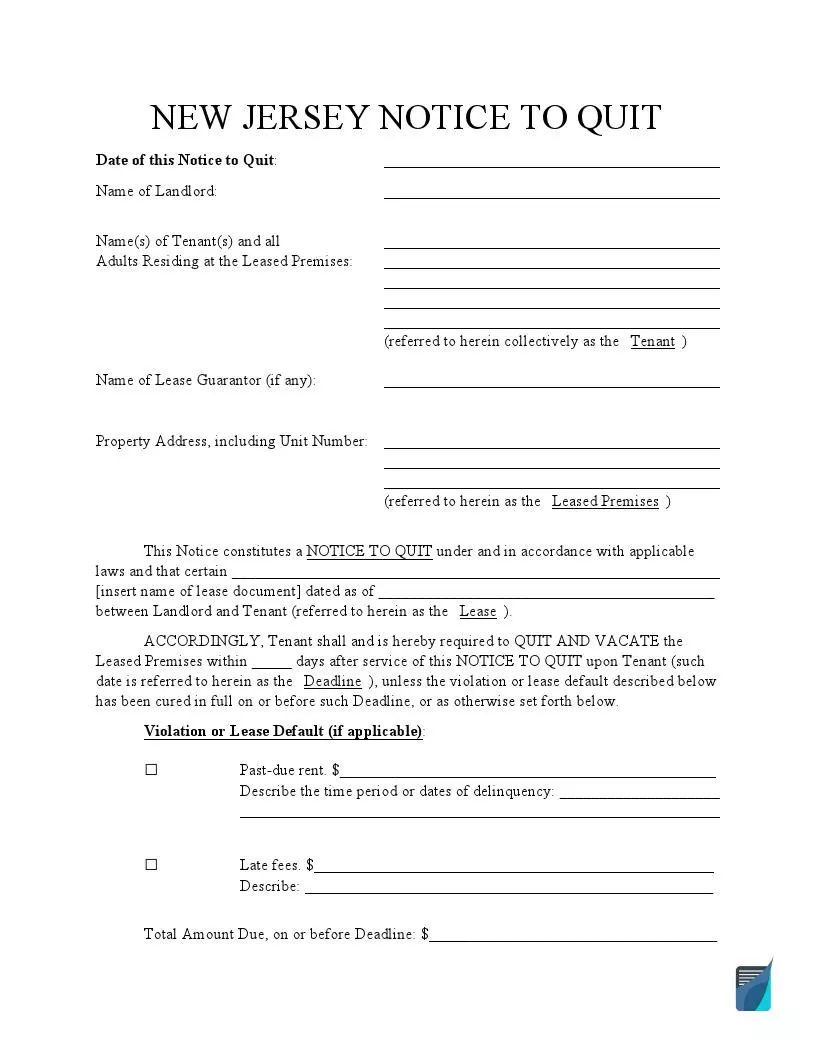
A New Jersey eviction notice is a written notice a landlord serves on a tenant to end a tenancy, stating the cause, and proof of that notice is filed before the court action.[1] Landlords use it for nonpayment of rent, a lease or rules violation, or to end a month-to-month tenancy on one month's notice,[4] and for residential tenants the Anti-Eviction Act limits removal to the good cause grounds it lists.[7]
Last Updated: September 2026. This guide is reviewed and updated regularly to reflect current New Jersey law. If you notice an error or outdated information, please contact us.
New Jersey law sets the notice period, the required content, and how each notice must be served, and every ground has its own rule. Only a Special Civil Part officer may carry out an eviction, a self-help lockout is illegal. Review the eviction notice template and the New Jersey laws below before you serve one.
New Jersey Eviction Laws
New Jersey's Anti-Eviction Act limits why and how a landlord may remove a residential tenant. The law lists the grounds that justify an eviction and sets a notice period or required notice content for most of them. It also requires the landlord to prove in court that the tenant received the notice before a judge will order removal. The sections below cover the notice periods for the most common grounds, then the complete list of just-cause grounds the Act recognizes.
Notice periods for the most common grounds
- Nonpayment of rent: nonpayment under an oral or written lease is a ground for removal. The nonpayment ground itself carries no notice requirement, unlike the grounds that need a notice to cease.[7] Certain tenants in public or subsidized housing may be entitled to a 30-day notice first.[12]
- Habitual late payment: after written notice to cease, habitually failing without legal justification to pay rent that is due is its own ground for removal.[7]
- Nonpayment after a lawful rent increase: failing to pay rent after a valid notice to quit and a notice of a rent increase is a ground for removal, provided the increase is not unconscionable and follows other rent-increase laws.[7]
- Substantial lease or rule violation: the landlord must give written notice to cease first. If the tenant continues the violation, the landlord may then move to terminate the tenancy.[7]
- Disorderly conduct, property damage, or illegal activity: the landlord can give a three-day notice, demanding the tenant leave within three days of service.[1]
- No-cause termination of a periodic tenancy: one month's notice ends a month-to-month tenancy, one term's notice ends a tenancy for another fixed term, and three months' notice ends a tenancy at will or from year to year.[4]
- Owner retiring the unit from residential use: the owner must give 90 days' written notice disclosing the intent to return the unit to residential use.[10]
Other just-cause grounds under the Anti-Eviction Act
New Jersey's Anti-Eviction Act also allows removal on several narrower grounds, each with its own notice or filing rule.
- Demolition or permanent board-up: the landlord must notify the Department of Community Affairs of the intent to start proceedings at the same time the eviction notice is served.[7] A conversion of the premises also cannot be registered for five years after a unit becomes vacant this way.[8]
- Condominium or cooperative conversion: no warrant for possession can issue until the conversion protection law has been fully complied with.[7]
- Sale to a buyer who will occupy the unit: the landlord cannot bring this action unless the tenant was first given the statement the conversion protection law requires.[7]
- Protected senior or disabled tenants: a senior citizen or disabled tenant with protected tenancy status under state law cannot be removed on the retirement, conversion, or sale grounds while that status is active.[7]
- Assault or drug conviction on the premises: the landlord must bring the removal action within two years of the conviction or adjudication, or within two years of the tenant's release from incarceration, whichever is later.[7]
When an owner is retiring a unit under the 90-day notice ground, the owner must also send a copy of the notice to the municipal rent-control agency and to the Department of Community Affairs, each within five days.[9][8] That copy must include a current listing of tenants and rents for the property, unless a current listing is already on file.[9]
A duplicate of the 90-day notice itself must reach the municipal rent board, or the municipal clerk if there is no board, within the first five days of that 90-day period.[10]
New Jersey Eviction Notice Laws Details
| No-Cause, Month-to-Month Tenancy | 1 month's notice |
| No-Cause, Other Fixed Term | 1 term's notice |
| No-Cause, Tenancy at Will or Year-to-Year | 3 months' notice |
| Disorderly Conduct, Damage, or Illegal Activity | 3 days' notice |
| Owner Retiring Unit from Residential Use | 90 days' notice |
| State Laws |
New Jersey Statutes, Sections 2A:18-53 to 2A:18-84 |
Eviction Notice Types Used in New Jersey
New Jersey does not use a single eviction notice. Which one applies, and how long the tenant has after it is served, depends on why the landlord is ending the tenancy. This section covers the main notice types, what each one is for, and what the notice must contain, so you serve the correct one.
An eviction notice is also called a "notice to quit," a "notice to cease," or a "notice to vacate," depending on the ground for eviction and the stage of the process.
Notice to quit, by ground
- Month-to-month tenancy (no cause): at least one month's notice to quit.[4]
- Tenancy for another fixed term (no cause): at least one term's notice to quit.[4]
- Tenancy at will or year-to-year (no cause): at least three months' notice to quit.[4]
- Owner retiring the unit from residential use: 90 days' written notice, disclosing the owner's intent and the specifics of the change in use.[10]
Notice to cease, for conduct-based grounds
- Lease or rule violation: written notice to cease first, then a separate notice to terminate if the violation continues.[7]
- Habitual late payment of rent: written notice to cease first, then removal for continued, unjustified nonpayment.[7]
How a notice must be written and served
- The notice must specify the cause of the termination of the tenancy.[1]
- It must be served personally on the tenant or such person in possession, by giving a copy, or by leaving a copy at the usual place of abode with a family member age 14 or older.[1]
- Court papers such as a summons and complaint may be served on any person actually occupying the premises, not only the tenant, personally or with a family member age 14 or older.[2]
- If entry is denied, or no one is present, the notice or summons can be posted on the door instead. Posting counts as lawful service.[2]
Eviction Notice For Disorderly Conduct, Damage, or Illegal Activity
New Jersey also allows a three-day notice for disorderly conduct, property damage, or illegal activity on the premises.[1] This notice must state the reason for the eviction and give the tenant no more than three days to leave.
Create a free high-quality New Jersey Eviction Notice online now!
Eviction Process in New Jersey
Evicting a tenant in New Jersey means choosing the right notice, serving it correctly, and then asking the court to order removal if the tenant does not leave.[1] The landlord cannot enter or hold the residence without legal process.[11] Once the court issues a warrant of removal, an officer of the court carries out the eviction.[5]
- Select the type of eviction notice. Choose the notice that matches your ground for eviction, a no-cause notice to quit, a notice to cease, or a three-day notice for disorderly conduct, damage, or illegal activity.
- Prepare the eviction notice. Both notice types are available to build and download on this site with our document builder.
- Serve the eviction notice. Deliver it personally to the tenant, or leave a copy at the tenant's usual place of abode with a family member age 14 or older.[1] Keep proof of that service. The court must be shown, by due proof, that the required notice was given, or the case can be dismissed.[4]
- File in Superior Court if the tenant stays. If the tenant does not leave by the notice deadline, the landlord may file a summons and complaint in the Special Civil Part to seek a judgment for possession.
Self-help evictions are illegal. A landlord may not enter or hold a tenant's residence without legal process.[11] In practice that rules out changing the locks, shutting off utilities, or taking the tenant's belongings. The landlord remains liable in a civil lawsuit for an unlawful eviction carried out this way.[6]
A tenant being sued for nonpayment of rent can stop the case at any point before a final judgment. The tenant does this by paying the clerk of the court the rent claimed to be in default, together with the accrued costs of the proceedings, which stops all proceedings.[3]
After the Superior Court rules for the landlord, several court forms carry the case through to a completed eviction. Each form has its own purpose and its own point in the process, from the judgment itself to the officer's execution of the warrant. Below are the forms used most often in a New Jersey landlord-tenant case.
- Warrant of Removal: the court cannot issue this warrant until three days after it enters judgment for possession.[5] Once a residential tenant is served with the warrant, state court guidance gives that tenant three business days to leave before a court officer carries out the removal.[13]
- Summons: sent to the tenant to notify them of the court hearing date on the case.
- Complaint: prepared by the landlord, stating which lease terms the tenant is alleged to have violated.
Frequently Asked Questions
Can You Be Evicted in New Jersey Without Going to Court?
No. A landlord cannot force a tenant out through self-help, meaning changing the locks, shutting off utilities, or physically removing the tenant's belongings, without going through the court process. State law limits what a landlord may do outside of a court order to retake the premises, cut off services, or take control of a tenant's belongings, and only a Special Civil Part officer can lawfully carry out a removal.[11]
"With regard to any real property occupied solely as a residence by the party in possession, such entry shall not be made in any manner without the consent of the party in possession unless the entry and detention is made pursuant to legal process..."
General information, not legal or tax advice.
Sources
Unless noted otherwise, the sources below are from the New Jersey Statutes Annotated.
- New Jersey Statutes Annotated N.J.S.A. 2A:18-53. Accessed September 13, 2026.
- New Jersey Statutes Annotated N.J.S.A. 2A:18-54. Accessed September 13, 2026.
- New Jersey Statutes Annotated N.J.S.A. 2A:18-55. Accessed September 13, 2026.
- New Jersey Statutes Annotated N.J.S.A. 2A:18-56. Accessed September 13, 2026.
- New Jersey Statutes Annotated N.J.S.A. 2A:18-57. Accessed September 13, 2026.
- New Jersey Statutes Annotated N.J.S.A. 2A:18-59. Accessed September 13, 2026.
- New Jersey Statutes Annotated N.J.S.A. 2A:18-61.1. Accessed September 13, 2026.
- New Jersey Statutes Annotated N.J.S.A. 2A:18-61.1c. Accessed September 13, 2026.
- New Jersey Statutes Annotated N.J.S.A. 2A:18-61.1d. Accessed September 13, 2026.
- New Jersey Statutes Annotated N.J.S.A. 2A:18-61.1e. Accessed September 13, 2026.
- New Jersey Statutes Annotated N.J.S.A. 2A:39-1. Accessed September 13, 2026.
- New Jersey Department of Community Affairs. NJ Eviction Guide: Eviction Timeline. Accessed September 13, 2026.
- New Jersey Courts. Landlord/Tenant Self-Help. Accessed September 13, 2026.
With over 25 years of experience as a business and transactional attorney, Jennifer has mastered the craft of closing highly successful deals for her clients. Through her wide-ranging expertise in commercial contracts, real estate transactions, M&A and corporate law, Jennifer secures results that are second-to-none.