
A New York eviction notice is a written notice a landlord serves on a tenant to end the tenancy for nonpayment of rent, a lease violation, or without cause, before filing an eviction case in court.
Last Updated: September 2026. This guide is reviewed and updated regularly to reflect current New York law. If you notice an error or outdated information, please contact us.
Build Your Document
Answer a few simple questions to make your document in minutes
Save and Print
Save progress and finish on any device, download and print anytime
Sign and Use
Your valid, lawyer-approved document is ready
The type of notice, and how much advance notice New York law requires, depends on the reason for the eviction. Use our form building software below to create a New York eviction notice online.
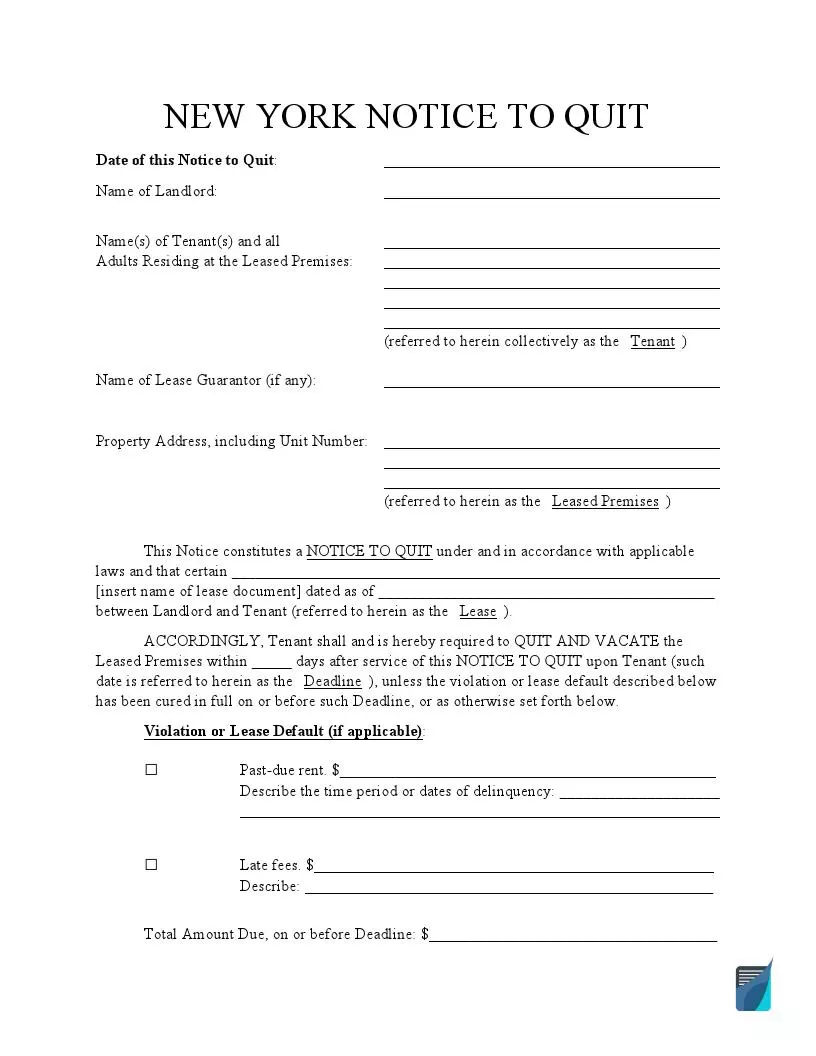
A New York eviction notice is a written warning a landlord gives a tenant before starting a court case. It names the reason the tenancy is ending. It also sets a deadline to pay the rent, cure the problem, or leave.
New York law fixes that deadline. The length depends on the reason and on how long the tenant has lived in the unit. Only a court can order a tenant out.
The notice is not a court order. It does not remove anyone by itself. A landlord who wants possession must file a case and win it. The notice is the first step.
Usually, every eviction notice template sent to renters in the United States consists of:
New York landlords, courts, and tenants also use the names notice to quit and notice to vacate for this same document. All three names refer to the eviction notice covered on this page.
New York's eviction notice rules come mainly from the Real Property Actions and Proceedings Law (RPAPL), Article 7. This law sets how much advance notice a landlord must give a tenant before filing an eviction case, and what that notice must say, depending on the reason for the eviction.[2]
The notice period depends on why the tenancy is ending. Nonpayment of rent requires a fourteen day written notice. That notice must append the further notice required under Section 231-c of the Real Property Law, stating whether the unit is subject to Article 6-A of the Real Property Law, the good cause eviction law, and if exempt, the reason.[2]
"The fourteen-day notice shall append or contain the notice required pursuant to section two hundred thirty-one-c of the real property law, which shall state the following: if the premises are or are not subject to article six-a of the real property law, the good cause eviction law, and if the premises are exempt, such notice shall state why the premises are exempt from such law, if the landlord is not renewing the lease for a unit subject to article six-a of the real property law, the lawful basis for such non-renewal, and if the landlord is increasing the rent upon an existing lease of a unit subject to article six-a of the real property law above the applicable local rent standard, the justification for such increase."
A lease violation that cannot be fixed also lets a landlord end the tenancy without a chance to cure it. A tenant removes the batteries from, or otherwise disconnects, a required smoke or fire detector after a court has issued an order of violation, and an inspection more than thirty days after service of that order still shows non-compliance.[2]
New York City's department of housing preservation and development is the office that issues that official inspection report.
"The tenant, in a city having a population of one million or more, removes the batteries or otherwise disconnects or makes inoperable an installed smoke or fire detector which the tenant has not requested be moved from its location so as not to interfere with the reasonable use of kitchen facilities, provided that the court, upon complaint thereof, has previously issued an order of violation of the provisions heretofore stated and, subsequent to the thirtieth day after service of such order upon the tenant, an official inspection report by the appropriate department of housing preservation and development is presented, in writing, indicating non-compliance herewith."
| Rent Grace Period | None |
| Notice of Non-Payment | 14 days |
| Notice of Non-Compliance | 10 days |
| State Laws | New York Consolidated Laws, RPA Chapter 81, Article 7 |
New York landlords use different eviction notices depending on the reason for ending the tenancy. Common notice types include a fourteen day notice for nonpayment of rent, a thirty day notice for a curable lease violation, a notice for a violation that cannot be cured, and a notice ending a periodic tenancy without cause.[2]
If a tenant ignores an eviction notice, the next step is court, not self-help. New York law only lets a sheriff or marshal remove a tenant, and only after a landlord wins a court case and a judge issues a warrant.[2] The steps below walk through the process from notice to move-out.
Accepting a rent payment after commencement of the special proceeding upon this ground does not terminate the proceeding or affect any award of possession to the landlord or a new lessee.[2]
If you are unsure whether to accept a payment while a case is open, ask the court clerk or a landlord-tenant attorney before you do.
New York sets a different notice period for each ground for eviction. Using the wrong one, or skipping a required attachment, can cost a landlord the case. The mistakes below all trace back to the statutes cited on this page. Check each one before you serve a notice.
A landlord who wants a tenant to move out through the court process has to file paperwork with the court, not just serve a notice. In New York, removal happens only through the special proceeding described above,[2] and in practice the landlord starts it by filing a petition.
No. New York law does not let a landlord force a tenant out through self-help. No tenant or lawful occupant of a dwelling or housing accommodation may be removed from possession except in a special proceeding.[2] A landlord cannot change the locks, shut off utilities, or remove a tenant's belongings without first winning that case in court.

General information, not legal or tax advice.
About FormsPal explains who writes and reviews these guides.
