
A New York last will and testament is a powerful estate planning instrument that an individual (testator) can use to consolidate their last wishes related to their post-death estate distribution, burial arrangements, digital assets, and legal guardians.
Creating a will is often a recommended option for everyone who wants to steer clear of disputes and confusion that might arise among their relatives. Even if you haven’t got a lot of assets, this document may turn out to be fundamental to your loved ones after your passing.
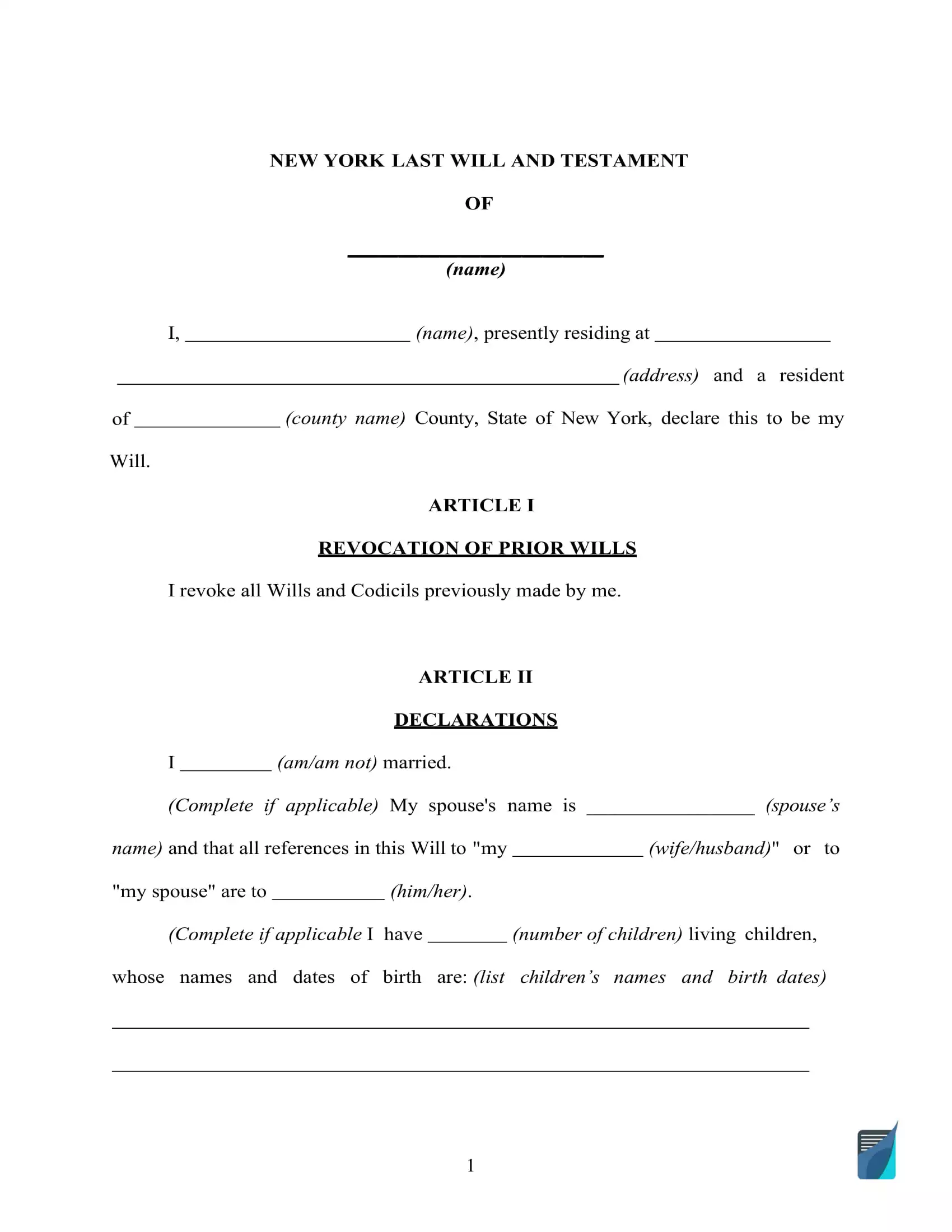
In case you are in search of a fillable and printable will template for NY, you will find one below in PDF and DOCX formats, along with the guidelines on will writing and state requirements.
A New York last will and testament template must follow the signing and witness rules set out in the state’s Estates, Powers and Trusts Law (EPTL) before a court will admit it to probate. Under this law, a will must be in writing, except for the narrow nuncupative (oral), holographic (handwritten), and electronic wills the law authorizes in limited situations.[2] The table below summarizes the core requirements and the law behind each one.
| Requirements | State laws | |
| Statutes | Estates, Powers & Trusts; Article 3 – Substantive Law of Wills | |
| Signing requirement | Two witnesses | § 3-2.1 Execution and attestation of wills; formal requirements |
| Age of testator | 18 or older | N.Y. Estates, Powers & Trusts Law (Article 3) |
| Age of witnesses | 18 or older | § 3-2.1 Execution and attestation of wills; formal requirements |
| Self-proving wills | Allowed | N.Y. SCPA 1406. Proof of will by affidavit of attesting witness |
| Handwritten wills | Recognized if meeting certain conditions | § 3-2.1 Execution and attestation of wills; formal requirements |
| Oral wills | Recognized if meeting certain conditions | § 3-2.2 Nuncupative and holographic wills |
| Holographic wills | Recognized if meeting certain conditions | |
Tip: this New York last will and testament template does not need to be notarized, but adding a notarized self-proving affidavit is a well-known way to speed up probate. Keep the signed original in a safe place and tell your executor where to find it.[1]
Writing your own will is possible if you follow the required execution and witness steps below. The Surrogate’s Court will later review the document, so getting each step right helps ensure the finished last will and testament template holds up during probate.
1. Think about your options. Before getting started, you’ll want to determine if you’d like to use the assistance of an attorney or make a will on your own. The first option is recommended if you have a lot of assets and you don’t want to miss anything important. And in the event that you would like to make the will yourself, consider if a fillable template is all that you need or you’d like to try our step-by-step document builder.
2. Indicate your information (if you are the testator). Add your full name and address (the city, county, and state of residence) to establish the testator of the will. Review the details you entered and the remainder of the passage to exclude any typos or mistakes.

3. Specify the executor of your will. Appoint the executor (personal representative) of your estate and indicate their particulars: full name and place of residence, which should preferably be in the same state the testator lives in to avoid any unnecessary hassle.
Although not mandatory, you may want to choose a backup person. This alternate executor can take over the duty if your first choice is unwilling or unable to carry out your last will and testament.

4. Appoint the guardian (optional). If you have underage or dependent children and do not want a court to pick their guardian after you die, you can appoint someone you know as a guardian for your children.
The requirements that potential guardians must fulfill might be different depending on the state. Typically, a guardian can be anybody over 18, who is not jailed, and who is of sound mind. Before selecting someone, it would be wise to consider their financial situation, location, readiness to take the duties, willingness to take care of your child if they are or might be physically impaired, and religious beliefs.

5. Indicate your beneficiaries. Now specify the people who will receive your property when you die, that is, your beneficiaries. For each inheritor, enter the following details: full name, address, and how they are related to you.
6. Allocate possessions. You can decide which beneficiary receives which piece of property. Otherwise, the assets will be divided equally among the listed beneficiaries. Assets can include money owed to you, real estate, stocks, business ownership, cash, and other personal property of value. Anything you own jointly with someone else, or that is already in a living trust, cannot be listed in your will.

7. Sign the will and have your witnesses sign it too. This law requires you to sign the will at the end of the document, either in front of your witnesses or by acknowledging to each of them that the signature is yours.[2] If you are physically unable to sign, someone else may sign the will for you, in your presence and at your direction.[2]
At least two witnesses must then attest your signature within a single thirty day period, sign their own names, and add their addresses at the end of the will.[2] In practice, choose adult witnesses who take nothing under the will.
Check the content of every paragraph carefully afterward to make sure nothing important was left out and there are no mistakes.


No, New York does not require notarization for a last will and testament. The law asks only for your signature and the signatures of at least two attesting witnesses, so an unnotarized will is still effective.[2] Adding a notarized self-proving affidavit is optional. It can speed up probate later by removing the need for witness testimony in court.[1]
Yes, but only in the limited cases the statute allows for nuncupative and holographic wills.[2] For most testators, a typed will that meets the signature and witness rules above is the safer choice.
If a person died and left a will, an interested party such as a beneficiary or relative can usually locate it at the court in the county where it was probably filed.
No, in New York, there isn’t such a requirement. However, including one could be rather useful given that it removes the demand for witnesses’ testimony at the time of probate, which speeds up the process substantially.
No. You usually cannot disinherit your spouse simply by leaving them out of your will. In practice, a surviving spouse who receives less than a set share can claim more within a limited time after an executor is appointed. Talk to a New York attorney if you are considering this.
In practice, a will that cannot be found after death is often treated as revoked, so keep the original safe. An interested party can still try to prove the lost will's contents and that it was not revoked, but doing so is often difficult, time-consuming, and costly. Ask a probate attorney about your options as soon as possible.
Last Updated: September 2026. This guide is reviewed and updated regularly to reflect current New York law. If you notice an error or outdated information, please contact us.
| Related documents | When to create one |
| Codicil | You need to make one or several minor adjustments to your last will. |
| Self-proving affidavit | You would like to save time and expense for your will’s witnesses. |
| Living will | You want to specify what medical care you prefer if you cannot communicate that by yourself. |
| Living trust | You want to skip probate by putting your property in the possession of a trust. |
This page is general information about New York last wills, not legal advice. For advice on your situation, talk to a local attorney.
