The free New York small estate affidavit on this page is the Surrogate's Court form SE-3A for voluntary administration, which you can download as a PDF. You can also create a document online with FormsPal. The Surrogate's Court Procedure Act sets a $50,000 limit on the personal property in a small estate.[2.1] The small estate rules do not apply to real property in New York owned by the person who died.[2.2]
Last Updated: October 2026. This guide is reviewed and updated regularly to reflect current New York law. If you notice an error or outdated information, please contact us.
Create a free high quality New York Small Estate Affidavit online now!
Build Your Document
Answer a few simple questions to make your document in minutes
Save and Print
Save progress and finish on any device, download and print anytime
Sign and Use
Your valid, lawyer-approved document is ready
... or download your New York Small Estate Affidavit Form as a PDF file
This section covers the rules in the Surrogate's Court Procedure Act that this page relies on: the dollar limit, the real property rule, the 30-day debtor payment rule and who may file the small estate affidavit. Section 1301 sets a $50,000 limit on the personal property in a small estate.[2.1] Section 1310(3) lets a debtor pay up to $15,000 of a debt, but not sooner than 30 days after the death.[1] The small estate affidavit itself has no waiting period after the death.[3]
Section 1301 defines a small estate in these words:
A small estate is the estate of a domiciliary or a non-domiciliary who dies leaving personal property having a gross value of $50,000 or less exclusive of property required to be set off under EPTL 5-3.1 (a).
This definition covers a person who lived in New York and one who did not. The $50,000 is counted without the property that must be set off under EPTL 5-3.1(a).[2.1]
The 30-day mark comes from Section 1310(3), which reads:
Not less than thirty days after the death of a creditor, unless otherwise provided by a designation of a beneficiary which is then in effect, it shall be lawful for the debtor to pay not more than fifteen thousand dollars of the debt
In plain words, the subsection works like this:
A creditor is a person who is owed money, and the debtor is the one who owes it.
The debtor may lawfully pay up to $15,000 of the debt after the creditor has died.
The payment may come no sooner than 30 days after the death.
A designation of a beneficiary that is in effect at that time can provide otherwise.[1]
Do not mix up the two dollar figures. The $50,000 limit is the most personal property a small estate can hold.[2.1] The $15,000 is the most a debtor may pay of the debt under Section 1310(3).[1]
The person who settles a small estate under the affidavit is called a voluntary administrator.[2.1] You qualify as voluntary administrator by filing the affidavit with the clerk of the Surrogate's Court, and no court order is needed.[3] If there is a will, the named executor has the first right to act. If there is no will, the surviving adult spouse comes first, then, in this order, a competent adult child or grandchild, parent, brother or sister, niece or nephew, or aunt or uncle.[4]
File the affidavit in the official form with a certified copy of the death certificate, and the will if there is one.[3][4] The PDF on this page, Surrogate's Court form SE-3A, is that affidavit. A person who knowingly makes a false affidavit is subject to prosecution for perjury.[5]
The small estate article does not apply to any interest in real property in this state owned by a decedent[2.2]
Time to Wait After Death
None for the small estate affidavit[3]. Not less than 30 days after the death of a creditor before a debtor may pay up to $15,000 of the debt to close family under Section 1310(3), unless a beneficiary designation then in effect provides otherwise[1]
Other New York Forms
Looking for other New York documents? We provide free templates and straightforward customization experience to anybody who wishes for having fewer to none troubles when coping with paperwork.
Create a free high quality New York Small Estate Affidavit online now!
Filling Out the New York Small Estate Affidavit
The PDF on this page is the court's official form SE-3A, the Affidavit in Relation to Settlement of Estate under Article 13, SCPA, from the New York Surrogate's Court (marked "as of 11/2019"). It runs 3 pages, and the 10 steps below follow its numbered items in order and name the page each step covers. You can print it and write the answers by hand, or fill it in with the FormsPal editor.
Form SE-3A is the affidavit for voluntary administration. Filing it with the clerk of the Surrogate's Court is how you qualify as voluntary administrator, and no court order is needed.[3] It is not the paper for a Section 1310(3) payment, where a debtor pays up to $15,000 of a debt directly, no sooner than 30 days after the death.[1]
The screenshots under each step show form SE-3A, the official New York Surrogate's Court form, filled with sample entries in blue, so you can see where each answer goes. The names, addresses, dates and amounts are examples only.
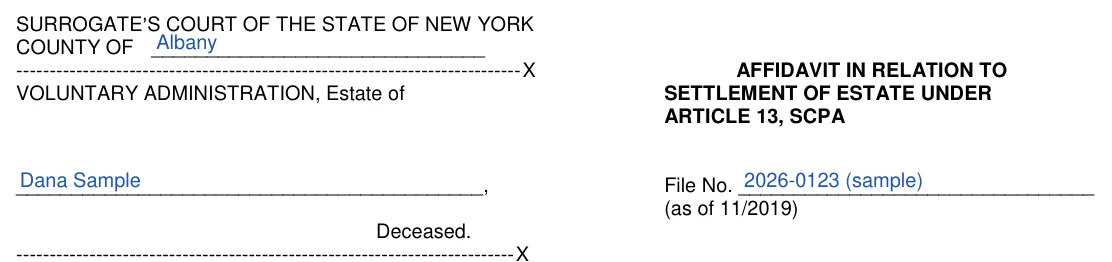
Court caption and file number (page 1). Write the name of the county whose Surrogate's Court you file in after "COUNTY OF" at the top, and the decedent's name on the line under "VOLUNTARY ADMINISTRATION, Estate of". The File No. line is for the court's file number. Leave it blank if the court has not given the estate one yet. Step 1: sample entries, not a real document.
Where you swear and your name (page 1). On the STATE OF and COUNTY OF lines, write the state and county where you sign the affidavit before the notary. Then write your full name after "I,". The instructions box beside these lines tells you to answer each question, in some places by crossing out words in parentheses and in others by writing in the information. Step 2: sample entries, not a real document.
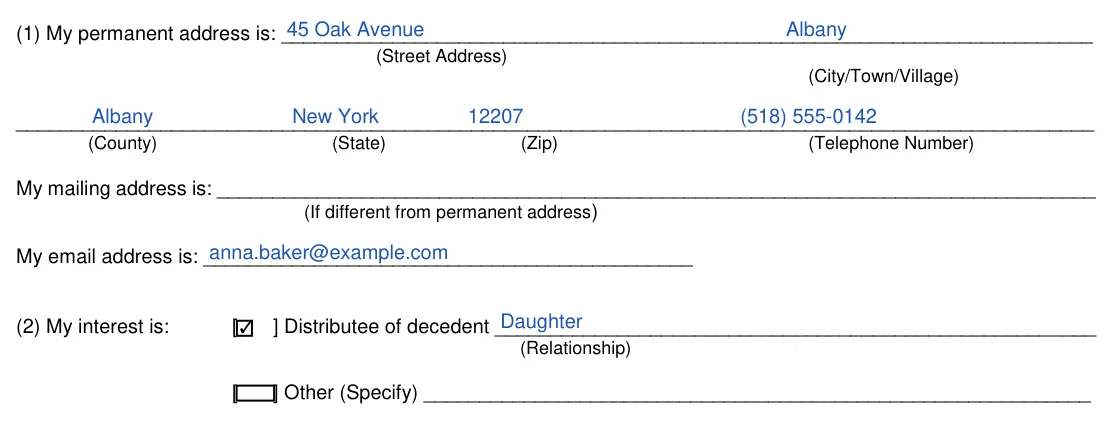
Items 1 and 2, your addresses and interest (page 1). In item 1, write your permanent street address and city on the first line, then the county, state, ZIP code and telephone number on the line below. Add a mailing address only if it is different from your permanent address, then your email address. In item 2, check Distributee of decedent and write your relationship to the decedent, or check Other and say what your interest is. Step 3: sample entries, not a real document.
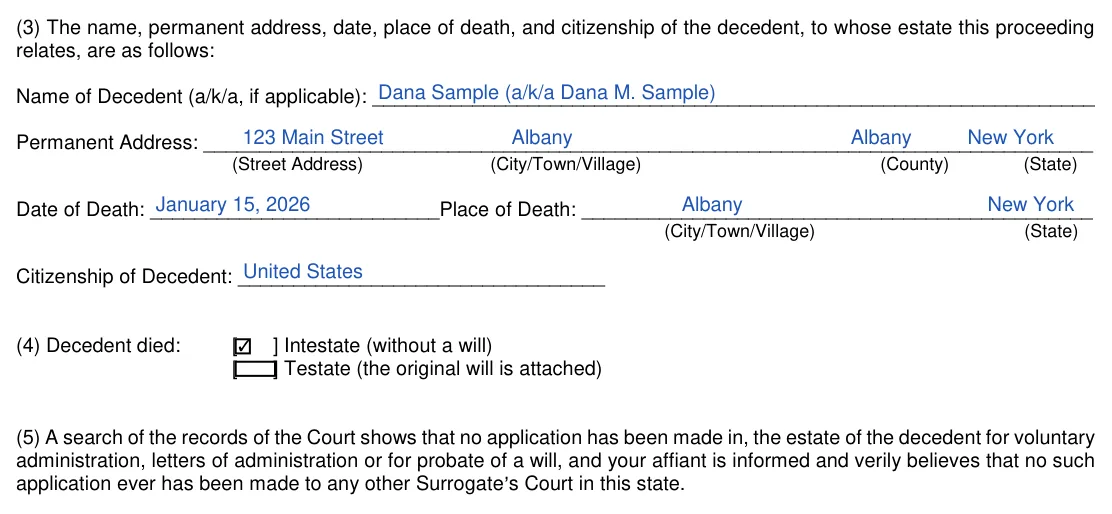
Items 3 to 5, the decedent and any will (page 1). In item 3, write the decedent's name and any other name they used (a/k/a), their permanent address with city, county and state, the date and place of death, and their citizenship. In item 4, check Intestate if there was no will, or check Testate and attach the original will. Item 5 is a printed statement: a search of the court's records shows that no application for voluntary administration, letters of administration or probate of a will has been made, and you believe none has been made in any other Surrogate's Court in New York. Make sure it is true before you sign. Step 4: sample entries, not a real document.
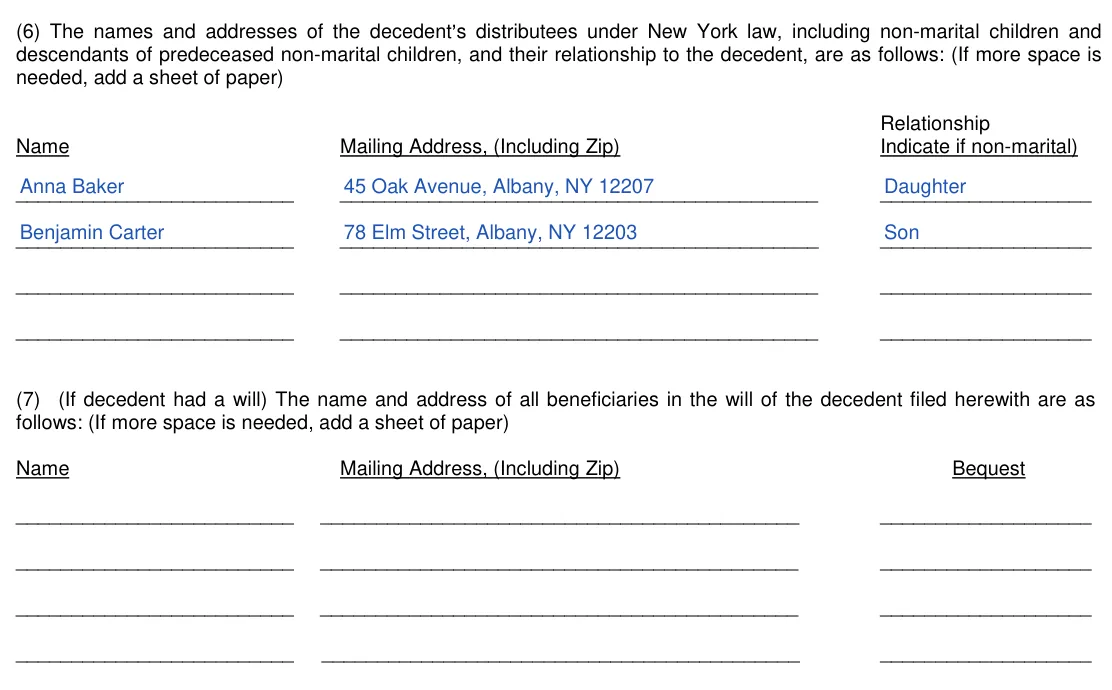
Items 6 and 7, distributees and will beneficiaries (page 2). In item 6, list the name, mailing address with ZIP code and relationship to the decedent of each of the decedent's distributees under New York law. The form says to include non-marital children and descendants of predeceased non-marital children, and to note in the relationship column when a person is non-marital. Fill in item 7 only if the decedent had a will: list each beneficiary named in the will with a mailing address and the bequest. Both items say to add a sheet of paper if you need more space. Step 5: sample entries, not a real document.
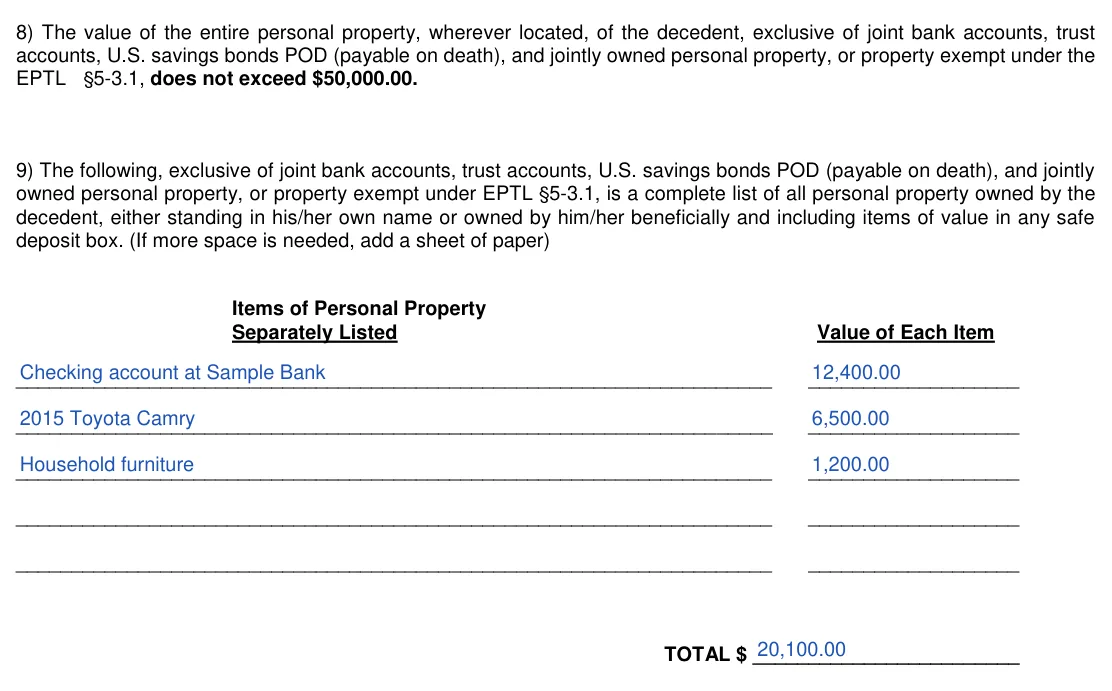
Items 8 and 9, personal property (page 2). Item 8 states that the value of the decedent's entire personal property, wherever located, does not exceed $50,000.00. That figure leaves out joint bank accounts, trust accounts, U.S. savings bonds POD (payable on death), jointly owned personal property and property exempt under EPTL 5-3.1. In item 9, list each item of personal property the decedent owned, with the same exclusions and including items of value in any safe deposit box, and its value. Write the sum on the TOTAL $ line. Step 6: sample entries, not a real document.
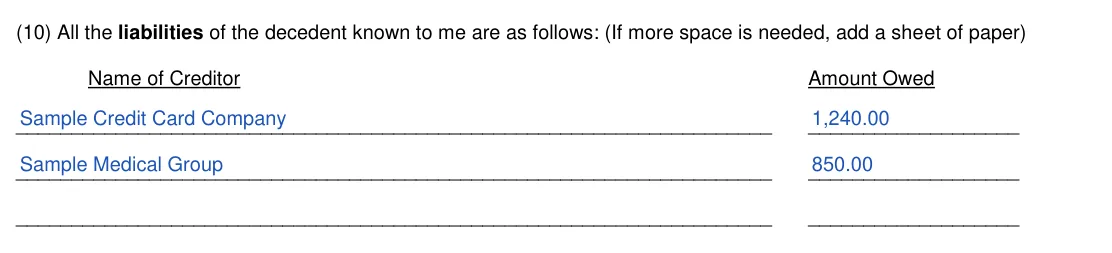
Item 10, debts (page 3). List every debt of the decedent you know about, with the creditor's name and the amount owed. Add a sheet of paper if you need more lines. Step 7: sample entries, not a real document.
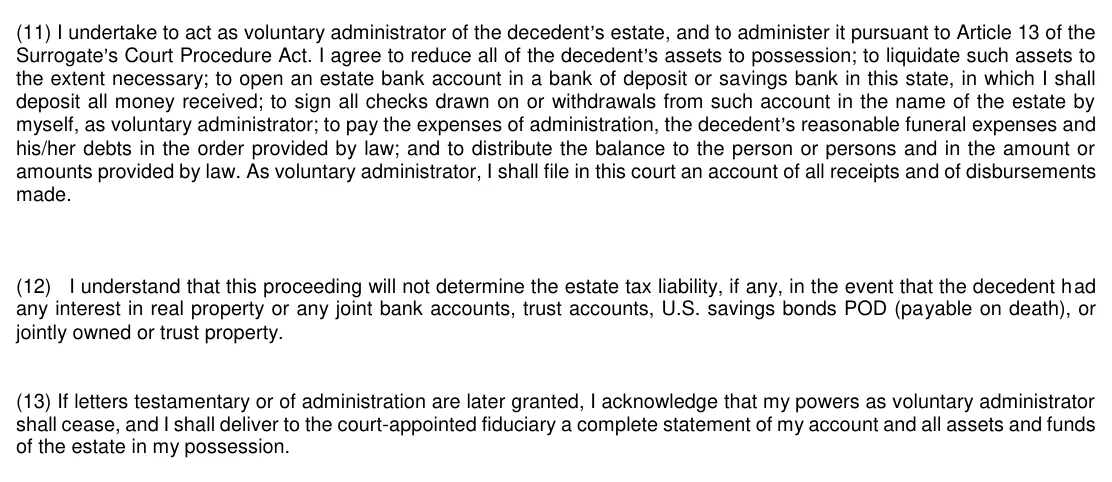
Items 11 to 13, your undertaking (page 3). These are printed promises, so read them before you sign. In item 11 you agree to act as voluntary administrator under Article 13 of the Surrogate's Court Procedure Act. You collect the decedent's assets, sell them as far as needed, and put all money you receive into an estate bank account at a bank in New York. You pay the costs of administration, reasonable funeral expenses and the decedent's debts in the order the law sets, pay out the rest to the people and in the amounts the law provides, and file an account of everything received and paid out with the court. Item 12 says this proceeding will not decide any estate tax owed if the decedent had real property, joint bank accounts, trust accounts, POD savings bonds, or jointly owned or trust property. Item 13 says your powers end if letters testamentary or of administration are granted later, and you must then give the court-appointed fiduciary a complete statement of your account and all estate assets and funds you hold. Step 8: sample entries, not a real document.
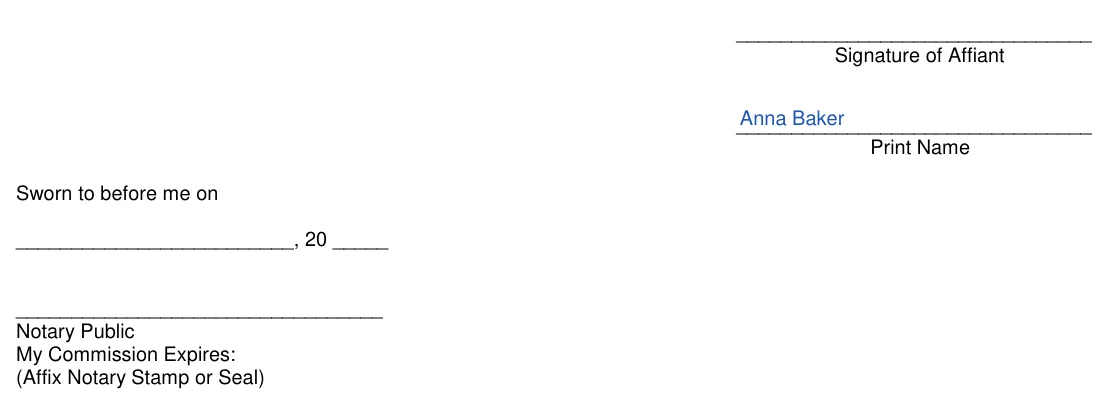
Signature and notary (page 3). Sign on the Signature of Affiant line in front of a notary public and print your name on the line below it. The notary fills in the date on the "Sworn to before me on" line, signs, adds the commission expiry date and affixes a stamp or seal. Then file the signed affidavit with the clerk of the Surrogate's Court, together with a certified copy of the death certificate.[3]Step 9: sample entries, not a real document.
Attorney block (page 3). The Signature of Attorney, Print Name, Firm Name, Tel. No. and Address of Attorney lines are for a lawyer who helps you with the affidavit. If you file it without a lawyer, leave them blank. Step 10: sample entries, not a real document.
These answers cover how New York defines a small estate, what the dollar limit is, and whether real property counts. Each answer is cited in the numbered list at the end of this page.
Do I need probate if the estate is small?
New York sets a dollar limit for the small estate rules. A small estate is one where the person who died left personal property with a gross value of $50,000 or less. Property that must be set off under EPTL 5-3.1(a) does not count toward that value.[2.1]
What is the amount for a small estate affidavit?
The limit is $50,000 in personal property, as set out in Section 1301.[2.1]
Does a New York small estate include real property?
Real property, often called real estate, has its own rule. Section 1302 says the small estate article does not apply to any interest in real property in this state owned by a decedent.[2.2]
Mara has been practicing estate planning and trust law in California since 2003, taking pride in helping clients of all backgrounds and asset profiles form a complete and customized estate plan. Her specialties are: estate planning, wills and trusts, trust and probate administration.