
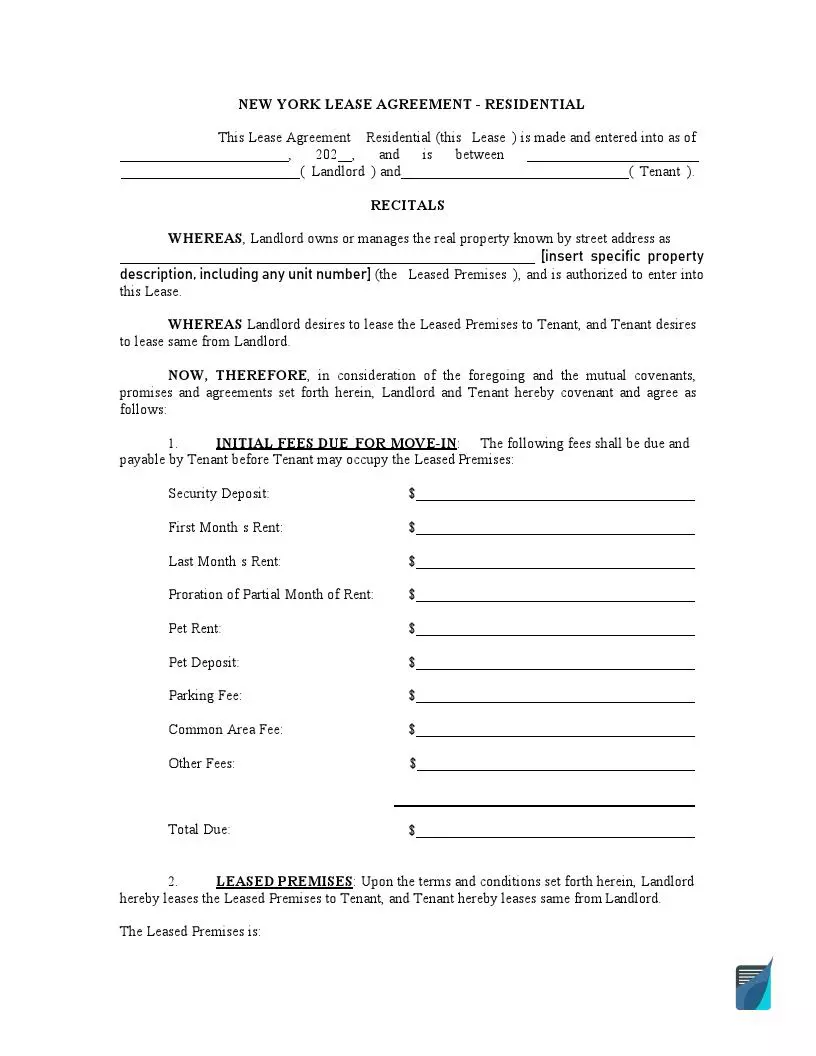
A New York lease agreement is a written contract between a landlord and a tenant. It sets the rent, describes the rental property, and states the terms both sides agree to follow under New York landlord-tenant law. The person who owns the property is the landlord, and the person renting it is the tenant. Use our form-building software below to create and download a New York lease agreement.
Last Updated: September 2026. This guide is reviewed and updated regularly to reflect current New York law. If you notice an error or outdated information, please contact us.
Build Your Document
Answer a few simple questions to make your document in minutes
Save and Print
Save progress and finish on any device, download and print anytime
Sign and Use
Your valid, lawyer-approved document is ready
Every state has its own laws and rules that regulate relations between sides when renting space. In New York, this topic is covered in the Consolidated Laws of New York, “Real Property” Part, Article 7.
Some information is also available in other articles of this part and in the following part called “Real Property Actions and Proceedings.”
Also, among the Unconsolidated Laws, there is the special Emergency Tenant Protection Act 576/74 (or ETP).
Every residential lease must state, in conspicuous bold type, whether the premises have a maintained and operative sprinkler system and, if so, the last date it was maintained and inspected (Real Property Law Section 231-a).[6.1]
A landlord who learns of a bed bug infestation in a unit must give written notice within 72 hours to the tenants of the units immediately above, below, and next to the infested unit, and must post notice of an infestation in a common area (Real Property Law Section 235-j).[7.1]
For housing built before 1978, federal law requires the landlord to give the tenant an EPA-approved lead hazard pamphlet and to disclose known lead-based paint and lead-based paint hazards, and the lease must carry the Lead Warning Statement and signed certifications (40 CFR 745.113).[8.1]
New York law requires the landlord to return the security deposit within fourteen days after the tenant moves out.[1]
If any part of the deposit is kept, the landlord must give the tenant a written, itemized list of what was kept and why. A landlord who misses the fourteen-day deadline forfeits the right to keep any part of the deposit.[1]
The security deposit cannot exceed one month's rent.[1]
A landlord who breaks these deposit rules on purpose is liable for punitive damages of up to twice the deposit amount, as well as actual damages. Any lease clause that waives these protections is void.[1]
Before the tenant moves in, the landlord must offer a joint inspection of the property to record its condition. If the tenant asks for another inspection before moving out, it must happen one to two weeks before the tenancy ends. The landlord must give at least forty-eight hours' written notice of the date and time.[1]
Count a notice period in calendar days with our deadline calculator so you never miss a deposit or notice deadline.
When the landlord deposits the security deposit in a bank, the landlord must tell the tenant in writing the bank's name and address and the amount deposited (General Obligations Law Section 7-103).[9.1]
New York gives tenants advance notice before a landlord ends a fixed-term tenancy, does not renew a lease, or raises the rent by five percent or more at renewal. How much notice is required depends on how long the tenant has lived in the unit or the length of the lease term.[2.1]
| Tenant's Occupancy or Lease Term | Notice Required Before Non-Renewal or a Rent Increase of 5% or More |
|---|---|
| Less than one year | At least thirty days |
| One year up to two years | At least sixty days |
| Two years or more | At least ninety days |
Ending the tenancy itself follows the same rule. A tenant who has lived there less than a year, with no lease of at least a year, is owed at least thirty days' written notice under Section 226-c(2)(b).[2.2]
Outside New York City, a tenant can end a monthly or month-to-month tenancy with at least one month's notice before the term expires. A landlord may do the same for a non-residential tenancy.[5]
In New York City, a month-to-month tenancy that is not residential can be ended with at least thirty days' notice before the term expires. The notice must be delivered the same way a notice of petition is served in a summary proceeding.[4]
A tenancy at will or by sufferance, however created, may be terminated by a written notice of not less than thirty days given in behalf of the landlord, to the tenant, requiring him to remove from the premises.
Popular Local Rental Lease Agreement Forms
In general, lease agreement templates look similar in all of the states. However, there are different types of rental agreements that serve different purposes. For example, while some templates are applicable for commercial lease deals, others regulate parties’ relations when renting an apartment.
In New York, there are no less than 11 possible templates of lease agreement:
In New York, there are various types of rental agreements. When you decide to create this document, pay attention to the template you are downloading.
| Document Name | New York Rental Lease Agreement Form |
| Other Names | NY Rental Lease, New York Residential Lease Agreement |
| Relevant Laws | New York Consolidated Laws, Chapter 50, Article 7 |
| Security Deposit Amount | One month’s rent |
| Security Deposit Return | Fourteen (14) days after vacation of tenant |
| Avg. Time to Fill Out | 18 minutes |
| # of Fillable Fields | 119 |
| Available Formats | Adobe PDF |
This section answers the questions landlords and tenants in New York ask most often about lease agreements. It covers security deposits, inspection rights, and notice periods for ending or renewing a tenancy. Each answer is grounded in New York statute and cited so you can verify it yourself.
Under New York law, a landlord cannot:
A landlord who breaks these rules on purpose is liable for punitive damages of up to twice the deposit amount.[1]
In New York, the security deposit cannot exceed one month's rent. Before the tenant moves in, the landlord must offer a joint inspection to record the property's condition. A tenant who asks for another inspection before moving out must get it one to two weeks before the tenancy ends. Within fourteen days after the tenant vacates, the landlord must return the deposit or explain in writing what was kept.[1]
A landlord has fourteen days after the tenant vacates the rental to return the security deposit, or to send a written, itemized statement explaining what was kept. Missing this deadline means the landlord loses the right to keep any part of the deposit.[1]
No. New York law caps a residential security deposit at one month's rent statewide, including in New York City. A landlord cannot legally ask for more, whatever the lease says.[1]
Yes, in some cases. A tenancy at will or at sufferance can only be ended with a written notice of not less than thirty days.[3] Other tenancies have their own notice periods, depending on how long the tenant has lived there and the type of tenancy.
General information, not legal or tax advice.

Other Rental Lease Agreement Forms by State
