
A New York LLC operating agreement is a written agreement of the members about the business of an LLC and the conduct of its affairs.[1] New York law says the members must adopt a written one. It may be entered into before the articles of organization are filed, when they are filed, or within ninety days after.[2] You can fill out our free single-member form online with the builder below.
Last Updated: October 2026. This guide is reviewed and updated regularly to reflect current New York law. If you notice an error or outdated information, please contact us.
Build Your Document
Answer a few simple questions to make your document in minutes
Save and Print
Save progress and finish on any device, download and print anytime
Sign and Use
Your valid, lawyer-approved document is ready
New York's Limited Liability Company Law defines an operating agreement as a written agreement of the members. It covers the business of the company and how its affairs are run.[1] Section 417 adds that the members must adopt a written operating agreement.[2]
"Operating agreement" means any written agreement of the members concerning the business of a limited liability company and the conduct of its affairs and complying with section four hundred seventeen of this chapter.
The definition has three parts. The agreement must be written, it must be made by the members, and it must comply with Section 417.
Section 417 says the members of an LLC must adopt a written operating agreement. It may contain any provisions that are not inconsistent with law or with the company's articles of organization. Those provisions relate to the following.[2]
Our form is a single-member agreement. If your LLC has more than one member, use our multi-member operating agreement instead. In practice, a clear written record of who decides what helps business owners avoid disputes later. It is also a legal document for the business, so read each line carefully before you sign.
Popular Local Operating Agreement Forms
An operating agreement is an instrument that outlines the company’s ownership, procedures, and each member’s duties and rights. Browse several other popular operating agreement forms frequently filled out by people.
New York lets the members choose when to enter into the operating agreement. It may be entered into before, at the time of, or within ninety days after the filing of the articles of organization.[2] The date it is entered into does not decide when it takes effect.
The agreement may take effect when the LLC is formed. It may instead take effect at a later time or date that the agreement itself provides.[2] The articles themselves are filed separately, and FormsPal has a general articles of organization form for reference.
An operating agreement can never take effect before the LLC is formed.[2]
A New York operating agreement may eliminate or limit the personal liability of managers to the LLC or its members for damages for breach of duty. The statute sets limits. The agreement cannot remove a manager's liability when a final adjudication establishes bad faith, intentional misconduct, a knowing violation of law, or an improper personal gain.[2]
Section 417 names two kinds of liability that a provision in the agreement cannot eliminate or limit.
Unless the operating agreement or the articles of organization provide otherwise, a New York operating agreement cannot be amended without the written consent of each member adversely affected.[2] Some provisions in the articles of organization are protected in the same way.
The protected provisions concern contributions, tax allocations and distributions. Without that written consent, no amendment may do any of the following.[2]
It is a good habit to keep each member's written consent together with the agreement. Owners who plan ahead also tend to review their business strategy at the same time. A business plan template can help with that.
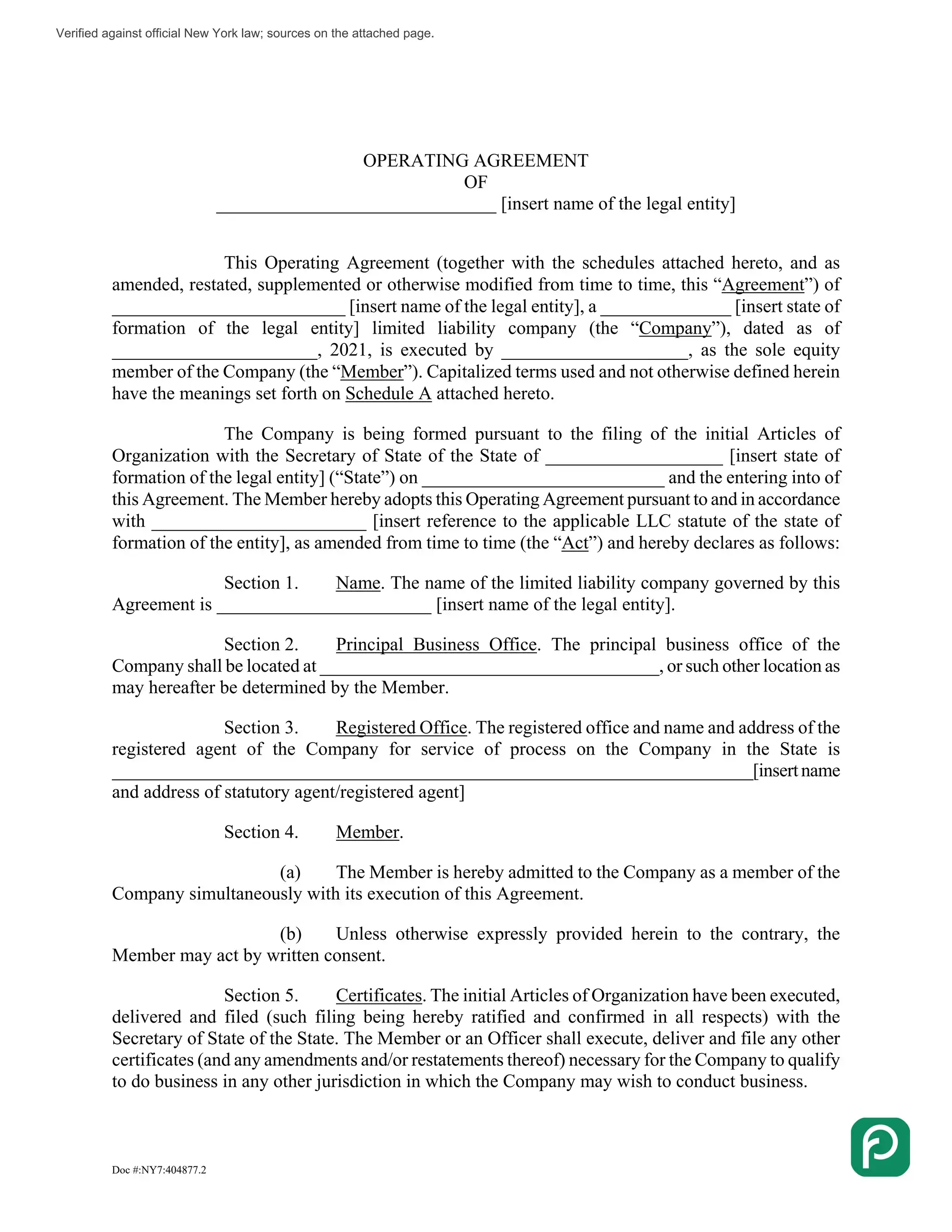
Our New York form is a single-member operating agreement. Fill it in with the builder above, then print it and sign it. Work through the parts below in the order they appear on the form. Each step names a part of the form and says what goes in it.
Keep a signed copy with your company records. If the company will hire staff, a New York non-compete agreement is another document owners often prepare. The LLC operating agreement template page lists forms for other states.
Under N.Y. Ltd. Liab. Co. Law § 204, the LLC name must contain the words "Limited Liability Company" or the abbreviation "L.L.C." or "LLC", and it must be distinguishable from the names of other LLCs and corporations on the Department of State's index.[3]
Under N.Y. Ltd. Liab. Co. Law § 301, the Secretary of State is the agent for service of process of every New York LLC, which means legal papers against the LLC may be served on it, and the articles of organization must designate the Secretary of State as that agent.[4]
An LLC's operating agreement in New York is governed by Sections 102 and 417 of the Limited Liability Company Law. Section 102 defines it.[1] Section 417 requires the members to adopt it in writing.[2]
Section 417 says the members of a New York LLC must adopt a written operating agreement. It may be entered into before, at the time of, or within ninety days after the filing of the articles of organization.[2]
Section 417 speaks of the members of a limited liability company without separating out single-member companies. The written operating agreement it requires covers the following.
Our form is written for an LLC with one member, who signs as the Member. If you will share ownership with others, the multi-member operating agreement above is the better fit.
An operating agreement is any written agreement of the members concerning the business of the LLC and the conduct of its affairs. It must comply with Section 417, which also reaches the rights, powers and responsibilities of members, managers and agents.[1] Section 417 says the members must adopt a written operating agreement, so the statute calls for one.[2]

Other LLC Operating Agreement Forms by State
General information, not legal or tax advice.
Unless noted otherwise, the sources below are from the N.Y. Ltd. Liab. Co. Law.
