
A New York divorce settlement agreement is a written document in which spouses record how they will divide property and handle support and other personal matters. Under New York law, such an agreement is valid and enforceable in a matrimonial action if it is in writing, subscribed by the parties, and acknowledged or proven in the manner required to entitle a deed to be recorded.[1] Create the FormsPal New York Marital Separation Agreement online below or download the PDF.
Last Updated: October 2026. This guide is reviewed and updated regularly to reflect current New York law. If you notice an error or outdated information, please contact us.
Build Your Document
Answer a few simple questions to make your document in minutes
Save and Print
Save progress and finish on any device, download and print anytime
Sign and Use
Your valid, lawyer-approved document is ready
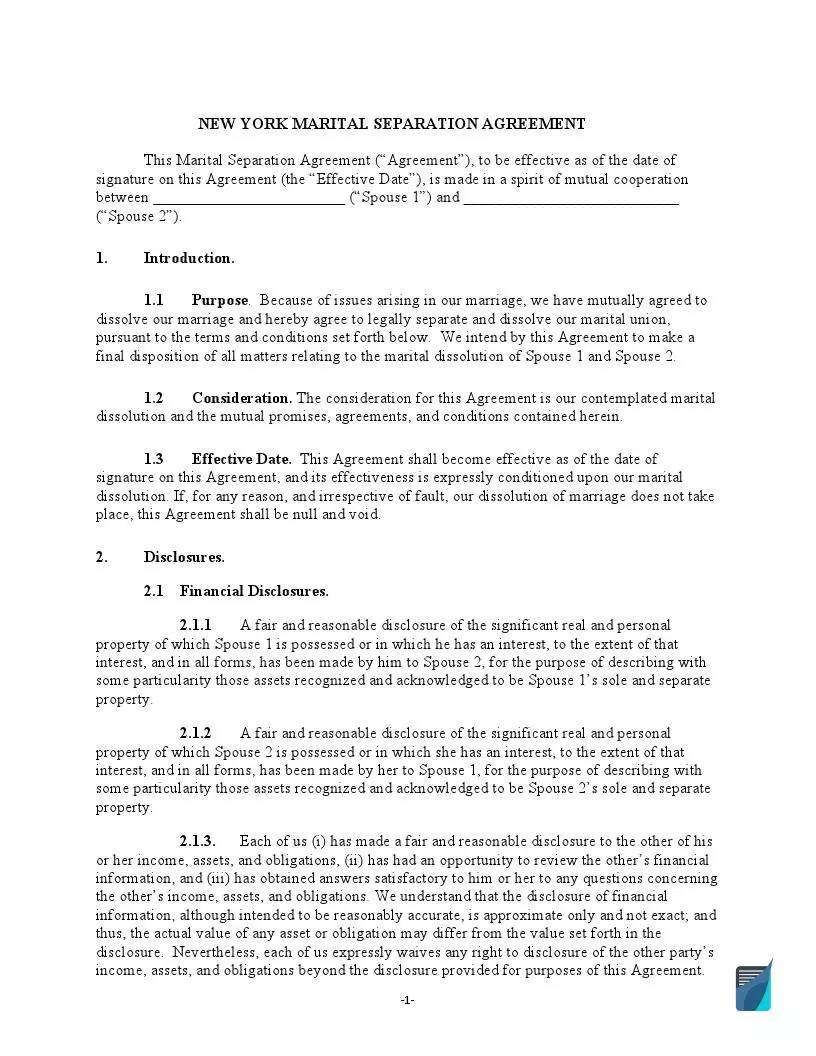
The spouses decide what goes into their own agreement. The FormsPal template runs eight pages and has 18 numbered sections, a signature page for both spouses, and a notary acknowledgment page. Every section is a blank to fill in. Spouses who are separated or ending a marriage can complete the sections that apply and leave out the rest, but read every blank before you sign.
| Part of the template | Sections | What you fill in |
|---|---|---|
| Introduction | 1.1 to 1.3 | The names of both spouses, the purpose of the agreement, and the effective date |
| Disclosures | 2 | Each spouse's separate property, the financial disclosure, and the informed consent statement |
| Children | 3.1 to 3.7 | Each child's name, date of birth, and Social Security number, where each child lives, and the custody and visitation schedules |
| Child support | 4.1 and 4.2 | Which parent pays, how much, and how often |
| Spousal support | 5.1 and 5.2 | Which spouse pays, how much, and how often |
| Residence | 6 | The address of the family home and who keeps it |
| Debts and expenses | 7 | The obligations each spouse agrees to pay |
| Personal property | 8 | The items that go to each spouse |
| Insurance | 9 | The life, health, and other policies each spouse maintains |
| Closing terms | 10 to 18 | Amendments, binding effect, severability, governing law, change of residence, other instruments, acknowledgments, confidentiality, and counterparts |
| Signatures and notary | Pages 7 and 8 | Each spouse signs, and a notary public completes the acknowledgment |
Read section 1.3 of the template before you sign. Under its own terms, the agreement takes effect on the date of signature, but only if the marriage actually ends. If the marriage does not end, the agreement is null and void.
New York's main statute for these agreements is Section 236 of the Domestic Relations Law. It says when a settlement agreement is valid, how marital property is divided, and what financial information spouses must disclose. The sections below explain each rule in plain words.[1]
Section 236 recognizes the spouses' own settlement agreement. An agreement made before or during the marriage is valid and enforceable in a matrimonial action if it meets all three conditions below.[1]
The FormsPal template has a signature page for both spouses on page 7 and an acknowledgment page for a notary public on page 8.
Section 236 lets spouses put the amount and duration of maintenance, and other terms of the marriage relationship, in their agreement. It also sets a fairness condition. The statute says:
Provision for the amount and duration of maintenance or other terms and conditions of the marriage relationship, subject to the provisions of section 5-311 of the general obligations law, and provided that such terms were fair and reasonable at the time of the making of the agreement and are not unconscionable at the time of entry of final judgment
In plain words, the terms must have been fair and reasonable when the spouses made the agreement. They must also not be unconscionable when the final judgment is entered.[1]
New York uses equitable distribution. Marital property must be distributed equitably between the parties, considering the circumstances of the case and of the respective parties. The same section adds that separate property remains such.[1]
Your agreement can name which items each spouse treats as separate property. Section 2.1 of the template has space for each spouse to describe the assets that spouse considers sole and separate property.
In all matrimonial actions and proceedings in which alimony, maintenance or support is in issue, both parties must disclose their respective financial states. No showing of special circumstances is required before the court orders that disclosure.[1]
The statute sets two deadlines for the sworn statement of net worth:
Counting days is easy to get wrong, so use our deadline calculator to find the last day. Section 2.1 of the template also records that each spouse has disclosed income, assets, and obligations to the other.
As soon as practicable after a matrimonial action is started, the court sets the date or dates the parties use to value each asset. The valuation date or dates may be any time from the date of commencement of the action to the date of trial.[1]
When you list accounts and property in the agreement, write down the date of each value.
Popular Local Marital Settlement Agreement Forms
It’s better to spell out the terms of your divorce prior to the court hearing by writing a marital settlement agreement that deals with a range of points. Listed below are some of the most commonly searched templates for marital settlement by state.
A settlement agreement works best when it answers the questions spouses would otherwise argue about later. Talk through each topic below before you fill in the form. Write down the numbers and dates both spouses agree on, and keep the wording plain so that both read it the same way.
If you have children, the agreement can say where each child lives, how custody is shared, and what each parent's visitation schedule is. Many parents set a child support amount by looking at both incomes and the time each parent spends with the children. Sections 3 and 4 of the template have blanks for these terms.
Couples often weigh a few points when they talk about spousal support. Section 5 of the template then records which spouse pays, how much, and how often.
List the family home, vehicles, accounts, and personal belongings, and say who keeps each item. Do the same for debts and name who pays them. Sections 6 to 9 of the template cover the family home, debts, personal property, and insurance. Describe each item clearly enough that a stranger could identify it.

FormsPal helps you prepare the divorce settlement agreement, not the court filings. Ask the clerk of the court where you plan to file which papers to submit and how. The steps below cover the agreement itself, from gathering information to signing.
In New York, marital property must be distributed equitably between the parties, considering the circumstances of the case and of the respective parties. A settlement agreement lets the spouses record their own division.[1]
New York law says separate property remains such. Use section 2.1 of the template to describe the assets each spouse treats as separate property.[1]
Yes, when alimony, maintenance or support is in issue. Both parties must disclose their respective financial states, and no showing of special circumstances is required before the court orders it.[1]
Yes. An agreement made before or during the marriage is valid and enforceable in a matrimonial action under three conditions. It must be in writing, subscribed by the parties, and acknowledged or proven in the manner required to entitle a deed to be recorded.[1]

Other Marital Settlement Agreement Forms by State
General information, not legal or tax advice.
