
A Florida lease agreement is a written contract between a landlord and a tenant. It sets the rent, the term, and the rules for a dwelling or a commercial space, under Title VI, Chapter 83 of the Florida Statutes. Landlords and tenants across the state use it for houses, apartments, rooms, and business locations. It is not a bill of sale, a deed, or a property management contract. On its own, it does not resolve a dispute once one party has already broken the deal.
Last Updated: September 2026. This guide is reviewed and updated regularly to reflect current Florida law. If you notice an error or outdated information, please contact us.
Build Your Document
Answer a few simple questions to make your document in minutes
Save and Print
Save progress and finish on any device, download and print anytime
Sign and Use
Your valid, lawyer-approved document is ready
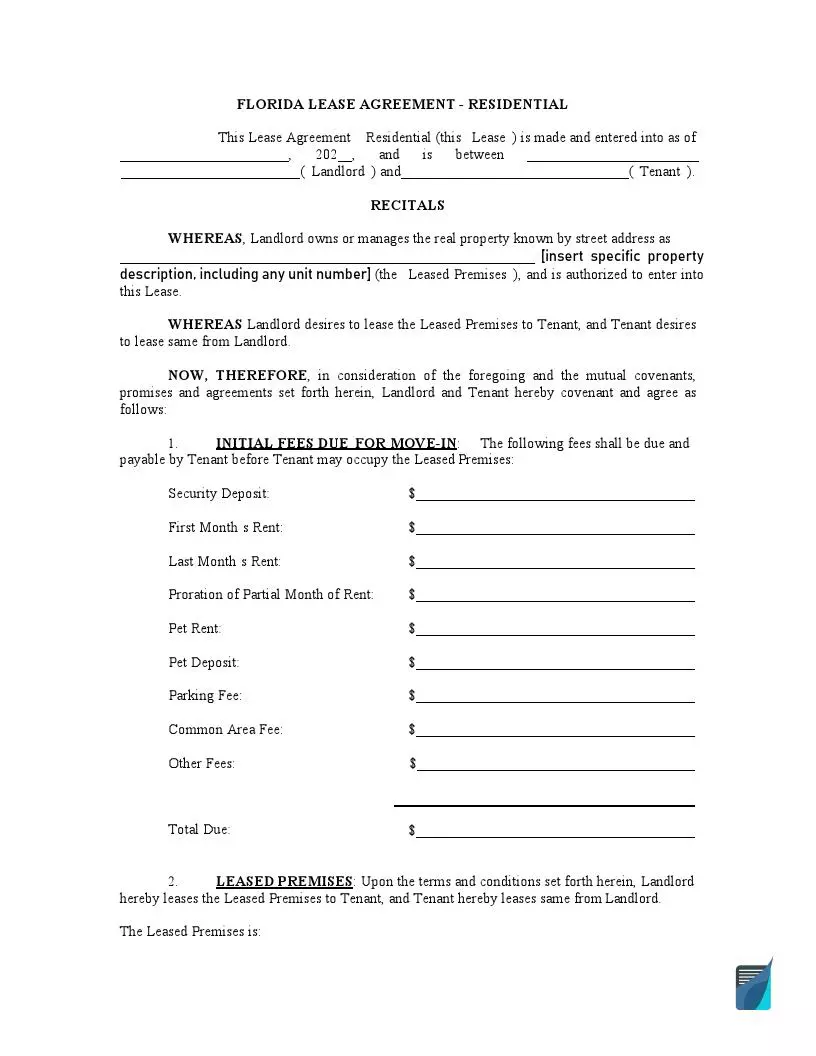
In Florida, a rental agreement may be written or, for a term of less than one year, oral (Section 83.43).[3] Putting it in writing is standard practice among Florida landlords and tenants, because it gives both sides clear proof of the rent, the term, and the rules they agreed to.
A written lease also gives each party a document to point to if a disagreement comes up later, such as who pays for a repair or when the tenancy ends. A lease for longer than one year must be in writing and signed by the party to be charged to be enforceable (Section 725.01).[4]
A Florida lease agreement can take several forms, depending on the property and the parties involved. You can generate your preferred type using templates from our latest software. The list below shows the most common types of lease agreements:
| Document Name | Florida Rental Lease Agreement Form |
| Other Names | FL Rental Lease, Florida Residential Lease Agreement |
| Relevant Laws | Florida Statutes, Title VI, Chapter 83, Part II |
| Security Deposit Return | 15 days (no claim on the deposit), or a 30-day written notice of claim followed by a further 30 days to remit any balance |
| Avg. Time to Fill Out | 18 minutes |
| # of Fillable Fields | 119 |
| Available Formats | Adobe PDF |
A complete Florida lease agreement covers the basic facts of the tenancy, so both sides can point to the same terms later. Most lease agreements name the parties, describe the property, and state the rent, and they typically include the items below.
Florida law, Title VI, Chapter 83 of the Florida Statutes, sets several rules for every residential lease in the state. These cover the landlord’s identity disclosure, the security deposit, how either party ends a tenancy, and when a landlord may enter the unit. Each rule below cites the exact statute.
Under Section 83.50, the landlord, or the person who signs the lease for the landlord, must disclose in writing, at or before the start of the tenancy, the name and address of the landlord or of a person authorized to receive notices and demands on the landlord's behalf.[5] A phone number or email address alongside it gives the tenant a faster way to reach them.
A security deposit is money a landlord holds during the tenancy to cover unpaid rent or damage beyond normal wear and tear. Florida law sets how the landlord holds it, notifies the tenant about it, and returns it once the lease ends[1].
Ask your landlord in writing for the name of the bank or company holding your deposit if you have not received that notice within 30 days of paying it.
The landlord must hold the deposit in a separate, non-interest-bearing account at a Florida bank or credit union, for the tenant’s benefit. Instead, the landlord may post a surety bond with the clerk of court. State law caps that bond at the deposits and advance rent the landlord holds, or $50,000, whichever is less. A landlord who chooses the bond must also pay the tenant 5 percent simple interest per year[1].
Whether in the lease itself or within 30 days after receiving the deposit or advance rent, the landlord must give the tenant written notice that states:
If interest is due, the landlord must pay it directly to the tenant, or credit it against that month’s rent, at least once a year. The landlord must also tell the tenant in writing within 30 days of any change in where or how the deposit is held[1].
If the landlord does not intend to impose a claim on the security deposit, the landlord must return the security deposit, together with interest if otherwise required, within 15 days after the termination of the rental agreement.
With no claim on the deposit, the landlord returns it within 15 days after the lease ends, as the statute above requires. To make a claim instead, the landlord must send the tenant written notice of it, by certified mail or email, within 30 days after the lease ends. That notice must state the reason for the claim[1].
The tenant then has 15 days after receiving that notice to object, easy to track with our deadline calculator. If the tenant does not object, the landlord may deduct the claimed amount and must send the remaining balance within 30 days after the date of the notice[1].
If the rental property is sold, or the landlord changes managers, deposits and advance rent held for tenants transfer to the new owner or agent. That transfer includes any interest earned and an accounting of each tenant’s balance[1].
Either party ends a lease that has no fixed end date by sending a termination letter. Florida law sets how much advance notice it must give, based on how often rent is paid[2]:
A quarter-to-quarter tenancy takes at least 30 days' notice before the end of the quarterly period (Section 83.57(2)).[2]
Popular Local Rental Lease Agreement Forms
Florida law, Title VI, Chapter 83 of the Florida Statutes, addresses when a landlord may enter a rented unit. Under Section 83.53(2), a landlord must give the tenant at least 24 hours' notice before entering to make repairs, and may enter for repairs only between 7:30 a.m. and 8:00 p.m. The landlord may enter at any time to protect or preserve the premises, and for other purposes with the tenant's consent, in an emergency, when the tenant unreasonably withholds consent, or when the tenant has been absent for half of the rental payment period.[6]
Under Section 83.56, a landlord must deliver a written notice before ending the lease for unpaid rent or another lease violation. For unpaid rent, that is a 3-day notice to pay or vacate, not counting Saturdays, Sundays, and legal holidays. For a lease violation the tenant can fix, the notice gives the tenant 7 days to correct it.[7] Our Florida Eviction Notice guide, linked under Other Florida Forms below, covers that process step by step.
A few simple steps before signing can prevent disputes later. Both the landlord and the tenant benefit from documenting the unit’s condition at move-in and keeping copies of every signed page, including the lease itself and any deposit receipt.
If the landlord does not intend to make a claim on the deposit, Florida law requires them to return it within 15 days after the lease ends. Interest is included if it is otherwise required[1].
A landlord who intends to make a claim on the deposit must send the tenant written notice of it within 30 days after the lease ends. That notice must go by certified mail or email, and must state the reason for the claim[1].

Other Rental Lease Agreement Forms by State
General information, not legal or tax advice.
Unless noted otherwise, the sources below are from the Fla. Stat..
