
Updated:
A Florida commercial lease agreement is a contract for renting business property. Fla. Stat. § 83.001 applies Part I of Chapter 83 to nonresidential tenancies such as this one. The lease serves Florida landlords and business tenants, especially for offices, shops and warehouses.
The guide below walks through each part of the form, the lease types, the Florida statutes that apply and the questions to settle before signing.
Key facts

Build Your Document
Answer a few simple questions to make your document in minutes
Save and Print
Save progress and finish on any device, download and print anytime
Sign and Use
Your valid, lawyer-approved document is ready
A Florida commercial lease agreement names the parties, the premises, the term and the rent, then sets who pays the building's running costs, how the tenant may use the space and what happens on a default.
The form adds the clauses that set a business lease apart from a home rental: a permitted use, a rent schedule, shared operating costs, insurance limits and broker commissions. Each one has its own part below.
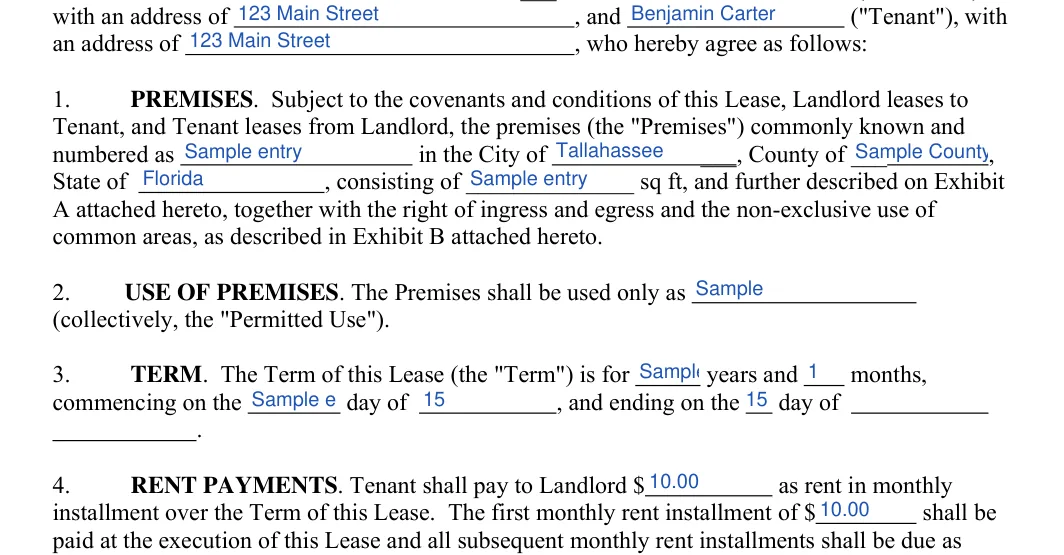
The premises description gives the street address, city, county and square footage of the space, for example a storefront in Oviedo, Seminole County, or an office suite in Miami-Dade County.
The permitted use clause names the business that may run on the premises, such as a retail shop, a medical office or a warehouse. A narrow use clause can block a later change of business, so word it to fit the tenant's plans for the whole term.
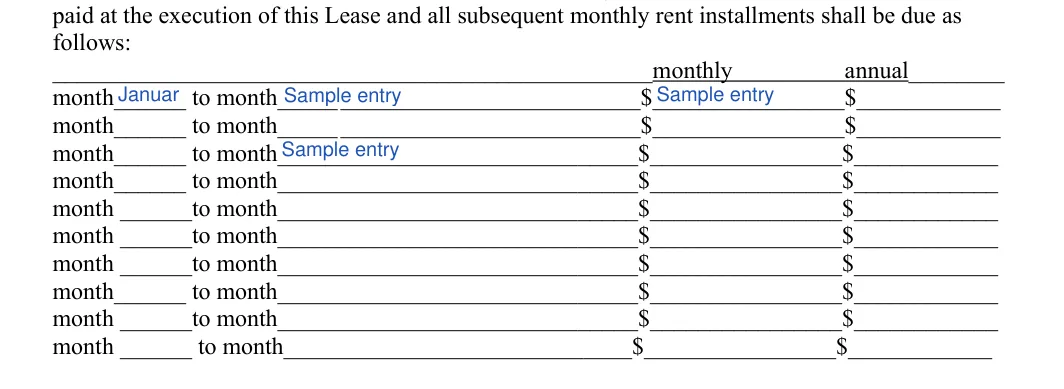
The rent schedule lists each period of the term with its monthly and annual rent, one row for each change, so both parties see every increase before signing.
The total rent for the term and the first monthly installment sit just above the schedule. The schedule and the total should add up to the same figure.
A triple net lease passes the property's running costs, such as property taxes, building insurance and maintenance, to the tenant in addition to base rent.
The form's printed sections on operating expenses, maintenance and repairs say which costs move to the tenant and how they are billed. Read them before agreeing to the rent figure, since the base rent is not the whole monthly cost.
The multiple tenancy section sets the tenant's percentage share of the building's costs from the square footage figures, with an estimate of the amount for the opening year.
A tenant in a single-tenant building leaves this section blank and pays the costs the operating expense sections assign.
The security deposit section takes the deposit amount the parties agree on, and the rest of the section is printed terms on how the landlord holds and applies the deposit.
The lease sets single limit coverage amounts for injury or death of persons and for property damage twice: once in the tenant's insurance clause and once in the landlord's.
The indemnity text that goes with each clause says which party answers for a claim that starts on the premises.
The possession section gives the date the tenant takes the space, and it refers to the Landlord Work Addendum, which lists the work the landlord finishes before the tenant moves in.
The default and remedies section ends with a late charge, written as a percent of any payment due, which the tenant pays when rent arrives late.
The real estate commission section names the landlord's broker and the tenant's broker, each with the commission amount or percent.
A triple net commercial lease makes the tenant pay base rent plus property taxes, building insurance and maintenance, while a gross lease folds those costs into one rent figure.
| Lease type | The tenant pays | The landlord pays |
|---|---|---|
| Gross lease | One rent figure | Property taxes, building insurance and maintenance |
| Modified gross lease | Rent plus the costs the parties name | The costs the lease leaves with the landlord |
| Single net lease | Base rent plus property taxes | Building insurance and maintenance |
| Double net lease | Base rent, property taxes and building insurance | Maintenance |
| Triple net lease | Base rent, property taxes, building insurance and maintenance | Only what the lease reserves to the landlord |
The form on this page is a triple net lease by its title. A tenant comparing offers should ask each landlord for the past operating expense figures, so a gross rent and a net rent can be compared on the same basis.
A Florida commercial lease falls under Part I of Chapter 83, since Fla. Stat. § 83.001 applies that part to nonresidential tenancies and all tenancies not governed by Part II.
A lease for a term of more than 1 year is created only by an instrument in writing under Fla. Stat. § 689.01.
Fla. Stat. § 689.01 also provides that no subscribing witnesses shall be required for a lease of real property.
A written lease keeps the rent schedule, the shared costs and the permitted use in one signed document that both parties can check later. Commercial lease agreements are flexible, so the written text is the only place the agreed terms are fixed.
The security deposit deadlines that Florida renters read about come from Fla. Stat. § 83.49, whose surety bond rule refers to the county where the dwelling unit is located.
The commercial form sets the deposit amount and the deposit terms in its own Security Deposit section, and the other lease agreement types cover home rentals.
| Document Name | Florida Commercial Lease Agreement Form |
| Other Name | FL Commercial Lease Agreement |
| Relevant Laws | Florida Statutes, Chapter 83, Part I (Fla. Stat. § 83.001) |
| Avg. Time to Fill Out | 17 minutes |
| # of Fillable Fields | 96 |
| Available Formats | Adobe PDF |
The Florida commercial lease agreement form is filled out section by section, from the date line at the top of the first page to the signature blocks at the end.
This guide follows the FormsPal Florida commercial lease agreement template on this page, which has 96 fillable fields on 9 pages. Type your answers in the PDF or in the PDF editor, and work through the steps in order. Each step matches one part of the form.
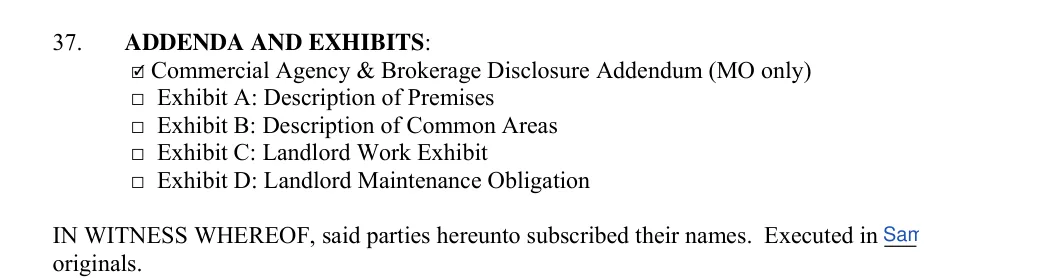
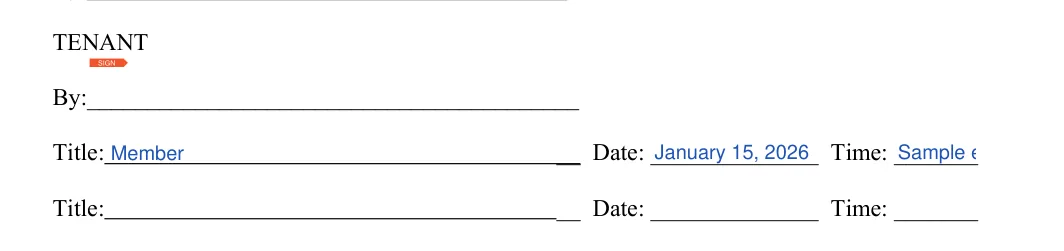
The screenshots under each step show the FormsPal Florida commercial lease agreement template filled with sample entries in blue, so you can see where each answer goes. The names, addresses, dates and amounts are examples only.














The Florida commercial lease agreement is ready to sign once every blank and every attached exhibit has been checked by both parties against the terms they agreed on.


The signing needs no witnesses, since Fla. Stat. § 689.01 provides that no subscribing witnesses shall be required for a lease of real property.
Fla. Stat. § 83.20 lists the causes for removal of a tenant of houses, lands or tenements, including a tenant under a lease for one or more years.
Fla. Stat. § 83.20 lets the breach notice give a longer time to cure the breach or surrender the premises.
Fla. Stat. § 83.20 has the rent notice served by delivery of a true copy or, if the tenant is absent from the rented premises, by leaving a copy at the rented premises.
The lease's own default and remedies section sets the late charge and the remedies the parties agreed to, so read it together with these causes. A Florida eviction notice puts a demand for rent or possession in writing.
A commercial lease is negotiated term by term, so the questions asked before signing decide the costs and limits the tenant lives with for the whole term.
The landlord's side of the negotiation looks at the tenant's business history, the insurance limits and the planned use, since damage to the premises affects the property's value for later tenants.
Landlords and business tenants who sign several leases sometimes need other paperwork as well. Examples include the Florida eviction notice, the Florida promissory note and, for a tenant that is an LLC, the Florida LLC operating agreement.
A Florida commercial lease is a negotiated contract, so its terms come from the parties rather than one fixed text. The form on this page is a general triple net lease that holds the usual sections, and the parties write any agreed change into the lease or an addendum.
A Florida commercial lease needs no subscribing witnesses, since Fla. Stat. § 689.01 provides that none shall be required for a lease of real property.
No: the deposit rules of Fla. Stat. § 83.49 are written for a dwelling unit, and Fla. Stat. § 83.001 places a nonresidential tenancy under Part I of Chapter 83, not Part II. The lease's own Security Deposit section sets the deposit amount, how the deposit is held and when it is returned.
The total rent and the first monthly installment go in Section 4. The rent schedule table sits just below it, with one row for each change in the monthly and annual amounts.
The template is a general commercial lease form. Section 2 has a line for the permitted use, so you can name the office, shop or warehouse business that will run on the premises.
The details table above lists about 17 minutes for the 96 fillable fields. Keep the premises description, the rent figures and the broker details at hand to finish faster.
Keep one signed copy for each party. Store the exhibits and addenda with the lease, and keep a scan as a backup in case a paper copy is lost.

General information, not legal or tax advice.
