Florida Small Estate Affidavit Form

A Florida small estate affidavit is a written statement that asks a court to let a decedent's personal property go to the people entitled to it without formal administration. It rests on section 735.301 of the Florida Statutes and covers personal property only, within a value limit the statute sets.[2] Other states have their own rules, listed in our small estate affidavit guide.

Last Updated: October 2026. This guide is reviewed and updated regularly to reflect current Florida law. If you notice an error or outdated information, please contact us.
Florida small estate affidavit form preview

Create a free high quality Florida Small Estate Affidavit online now!

Build Your Document

Answer a few simple questions to make your document in minutes

Save and Print

Save progress and finish on any device, download and print anytime

Sign and Use

Your valid, lawyer-approved document is ready

... or download your Florida Small Estate Affidavit Form as a  PDF file

Florida Laws and Requirements

Section 735.301 of the Florida Statutes says no administration is required and no formal proceedings are instituted for a decedent who leaves only certain personal property. The statute names three kinds of property, and the third has a value limit that depends on the decedent's expenses:[2]

  • Property exempt under section 732.402
  • Property exempt from the claims of creditors under the state constitution
  • Nonexempt property within the value limit below

The limit on the nonexempt property is not a single dollar figure. It is the sum of the preferred funeral expenses and the reasonable and necessary medical and hospital expenses of the last 60 days of the last illness.[2]

Personal property only. Section 735.301 speaks of an estate that leaves only personal property. Real property has its own rule under the small estate procedure.[2]

Any interested party may apply to the court informally, by affidavit, letter, or otherwise. If the court is satisfied that the statute applies, it may authorize the payment, transfer, or disposition of the decedent's property to the persons entitled to it. It does this by letter or other writing under the seal of the court.[2] The statute's own words are:

Upon informal application by affidavit, letter, or otherwise by any interested party, and if the court is satisfied that subsection (1) is applicable, the court, by letter or other writing under the seal of the court, may authorize the payment, transfer, or disposition of the personal property, tangible or intangible, belonging to the decedent to those persons entitled.

Fla. Stat. § 735.301

A person, firm, or corporation that pays, delivers, or transfers property under that authorization is forever discharged from liability on it.[2]

Section 735.304 covers an intestate small estate, one where the decedent left no will. Under section 735.304(1), the nonexempt property may be worth up to $20,000 plus the same funeral and medical expenses. The decedent must have been deceased for more than 1 year, and no administration of the decedent's estate may be pending in this state.[1]

For an intestate small estate under section 735.304, the affidavit must be signed and verified by the surviving spouse, if any, and the heirs at law.[3]

These rules are in Chapter 735 of the Florida Statutes, titled Probate Code: Small Estates, and the procedures that work without administration are sections 735.301 and 735.304.[3]

Florida Small Estate Affidavit Laws Details

Max. Estate Under section 735.301, nonexempt property up to the sum of preferred funeral expenses and medical and hospital expenses of the last 60 days of the last illness[2]. Under section 735.304(1), $20,000 plus those expenses[1]
Min. Time to Wait After Death More than 1 year, under section 735.304(1)[1]
Property Covered Personal property only[2]
State Laws Florida Statutes, Chapter 735
seal of florida state
Other Florida Forms
More important Florida templates available for download on our site and that can be customized in our hassle-free document constructor.
Template Preview
Create a free high quality Florida Small Estate Affidavit online now!

Filling Out the Florida Small Estate Affidavit Form

Each step below matches one part of the FormsPal template, in the order the template presents them. Gather the decedent's details, a list of their personal property, and statements or receipts for funeral and medical expenses first. You can also complete the downloaded PDF in the online PDF editor. If a field label is unclear, the chat with PDF tool lets you ask questions about the document.

The screenshots under each step show the FormsPal Florida small estate affidavit template filled with sample entries in blue, so you can see where each answer goes. The names, addresses, dates and amounts are examples only.

  1. County, In re and File No. On page 2, write the county of the circuit court on the line “IN THE CIRCUIT COURT IN AND FOR ___ COUNTY, FLORIDA.” Print the decedent's name after “IN RE:” and add the File No. if the clerk has given one.
    Florida small estate affidavit: County florida, In re and more, filled with sample entries
    Step 1: sample entries, not a real document.
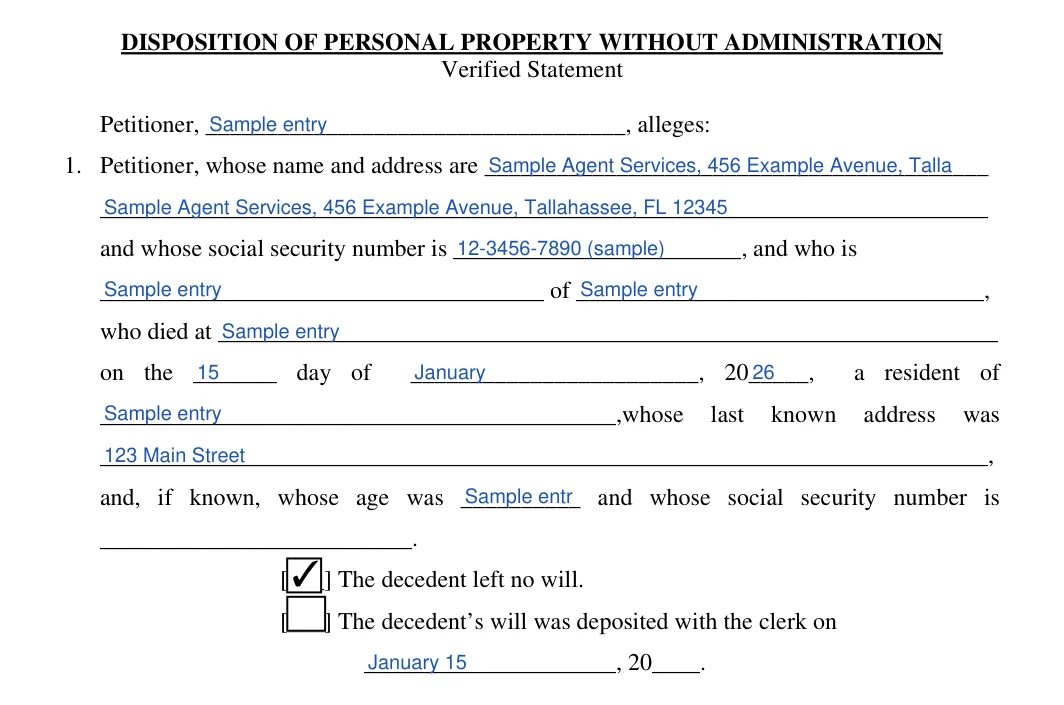
  2. Petitioner and decedent details (item 1) and will box. Still on page 2, enter your name, address, and Social Security number as petitioner, then your relationship to the decedent. Add where and when the decedent died, their residence, last known address, age, and Social Security number if known. Then tick the box that says there was no will or that the will was deposited with the clerk, with its date.
    Florida small estate affidavit: Petitioner, 1 petitioner whose name and address are and more, filled with sample entries
    Step 2: sample entries, not a real document.
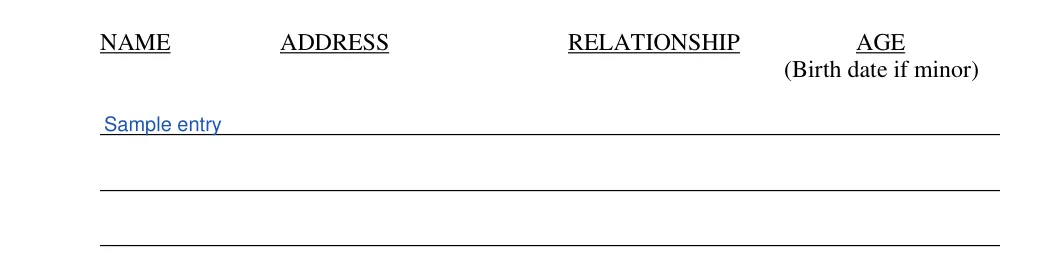
  3. Beneficiaries and surviving spouse (item 2). At the bottom of page 2, list each beneficiary and the surviving spouse, if any, with address, relationship to the decedent, and age (birth date for a minor). Use one row per person.
    Florida small estate affidavit: ADDRESS, filled with sample entries
    Step 3: sample entries, not a real document.
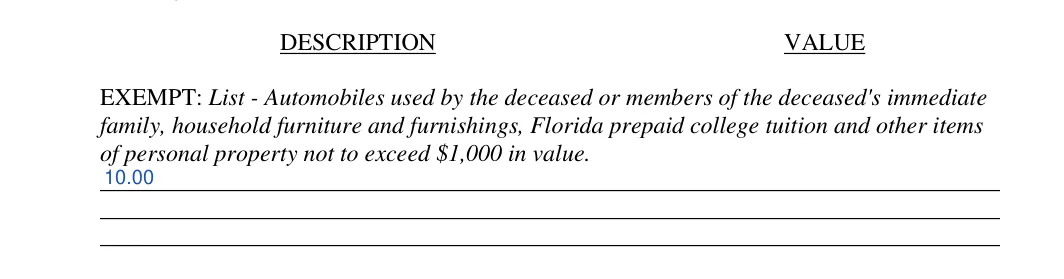
  4. Exempt property and value (item 3). On page 3, list the exempt personal property in the EXEMPT block, such as automobiles, household furniture and furnishings, and Florida prepaid college tuition. Give each item's value.
    Florida small estate affidavit: VALUE, filled with sample entries
    Step 4: sample entries, not a real document.
  5. Non-exempt property: institution and account number. In the NON-EXEMPT block, list all other personal property the decedent owned with its estimated value. For stocks, bonds, and accounts, give the institution's name and the account number.
    Florida small estate affidavit: Institution account number and other items of the deceased, filled with sample entries
    Step 5: sample entries, not a real document.
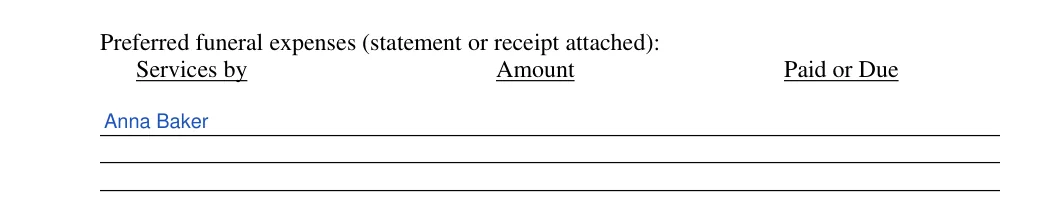
  6. Preferred funeral expenses. Enter who provided the funeral services, the amount, and whether it is paid or due. The template says the statement or receipt is attached.
    Florida small estate affidavit: Preferred funeral expenses (statement or receipt attached), filled with sample entries
    Step 6: sample entries, not a real document.
  7. Medical and hospital expenses, last 60 days. List who provided the services, the type of service, and whether each is paid or due. The template says the statement or receipt is attached.
    Florida small estate affidavit: Services by 1, Services by 2 and more, filled with sample entries
    Step 7: sample entries, not a real document.
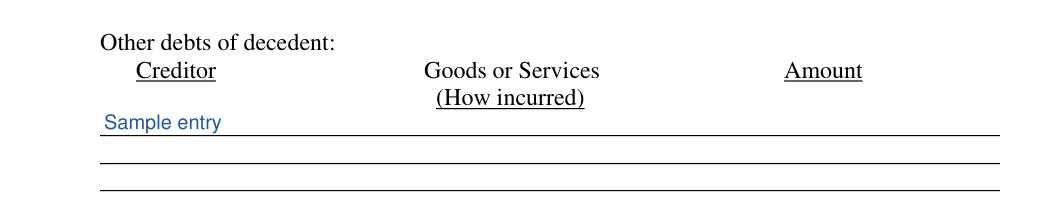
  8. Other debts of the decedent. List each other creditor, the goods or services, and how the debt was incurred, with the amount.
    Florida small estate affidavit: Other debts of decedent, filled with sample entries
    Step 8: sample entries, not a real document.
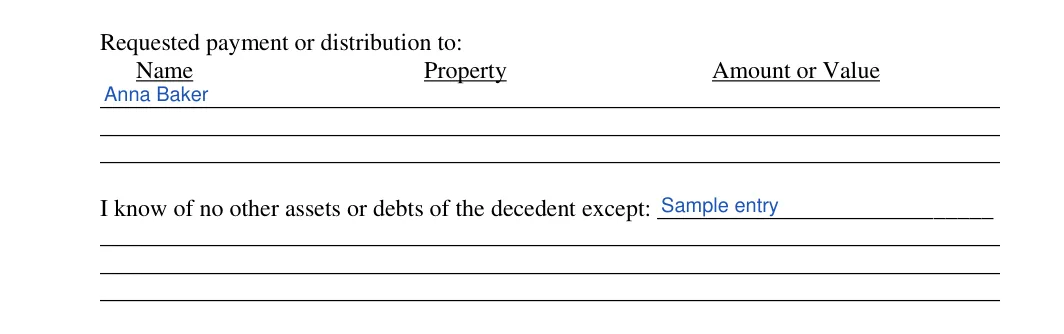
  9. Requested payment or distribution and other assets. On page 4, enter the name of each person to be paid, the property, and the amount or value. On the line starting “I know of no other assets or debts of the decedent except,” list any others, or leave it blank if there are none.
    Florida small estate affidavit: Requested payment or distribution to, filled with sample entries
    Step 9: sample entries, not a real document.
  10. Sworn and subscribed: date and identification. Fill in the day, month, and year, and tick whether you are personally known to the officer or produced identification. If you produced identification, write its type on the line.
    Florida small estate affidavit: Day, Month and more, filled with sample entries
    Step 10: sample entries, not a real document.
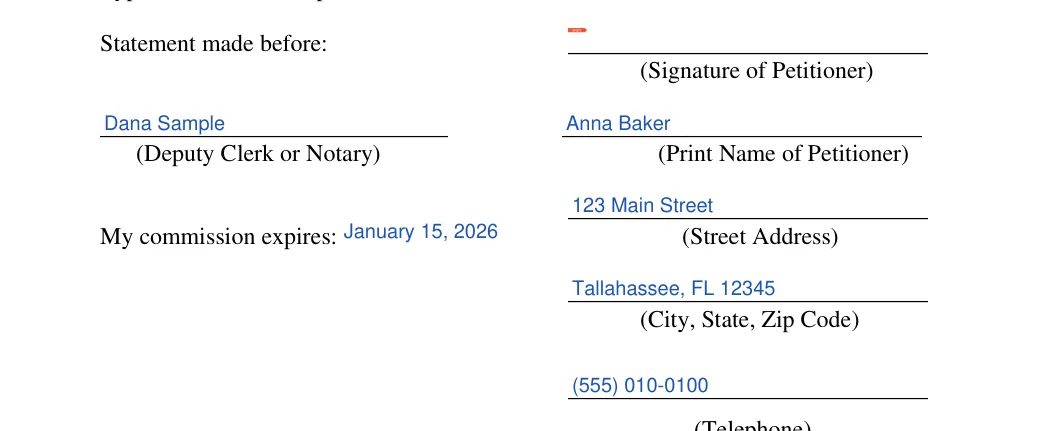
  11. Signature before the deputy clerk or notary. Sign on the “Statement made before” line in front of the deputy clerk or notary, whose name goes on their line with the commission expiry date. Then print your name, street address, city, state, zip code, and telephone number. The template says the statement may be sworn before a deputy clerk or a notary public.
    Florida small estate affidavit: Statement made before, filled with sample entries
    Step 11: sample entries, not a real document.

Have the funeral and medical statements or receipts ready before you start. The template says a statement or receipt is attached for each of those two blocks.

Frequently Asked Questions

These answers cover the questions people ask most often about small estates in Florida. Each legal point comes from the statute sections cited at the end of this page, and the form details come from the template itself.

Do I need probate if the estate is small?

Section 735.301 says no administration is required and no formal proceedings are instituted for a decedent who leaves only exempt property and nonexempt property within the limit.[2] That limit is the sum of two kinds of expenses:

  • Preferred funeral expenses
  • Reasonable and necessary medical and hospital expenses of the last 60 days of the last illness

Add the two together to get the limit for the nonexempt property.[2]

Can I use a small estate affidavit in Florida?

You can when the estate fits section 735.301. Any interested party may apply informally by affidavit, letter, or otherwise, and the court may then authorize the transfer of the decedent's property to the persons entitled to it.[2]

What is the small estate threshold in Florida?

Section 735.301 sets no single dollar figure. The nonexempt property must be worth no more than two sums added together. They are the preferred funeral expenses and the reasonable and necessary medical and hospital expenses of the last 60 days of the last illness.[2] For an intestate estate under section 735.304(1), the limit is $20,000 plus those same expenses.[1]

What is the amount for a small estate affidavit?

On the template, you list each item of personal property with its value, and you enter the funeral and the medical and hospital expenses with their amounts in separate blocks. The statutory limit those values are measured against is described in the laws section above.

How long must I wait after the death?

Under the intestate route in section 735.304(1), the decedent must have been deceased for more than 1 year.[1]

General information, not legal or tax advice.

Sources

Every legal point on this page comes from the Florida Statutes sections listed below. The numbers in square brackets in the text match the entries in this list, so you can open the statute and read the exact wording yourself.

  1. Fla. Stat. 735.304(1) (2026 edition).
  2. Fla. Stat. § 735.301.
  3. Fla. Stat. ch. 735 (Probate Code: Small Estates).
Published: Jul 17, 2022
Mara Erlach
Mara Erlach
Writer & Attorney
Mara has been practicing estate planning and trust law in California since 2003, taking pride in helping clients of all backgrounds and asset profiles form a complete and customized estate plan. Her specialties are: estate planning, wills and trusts, trust and probate administration.