
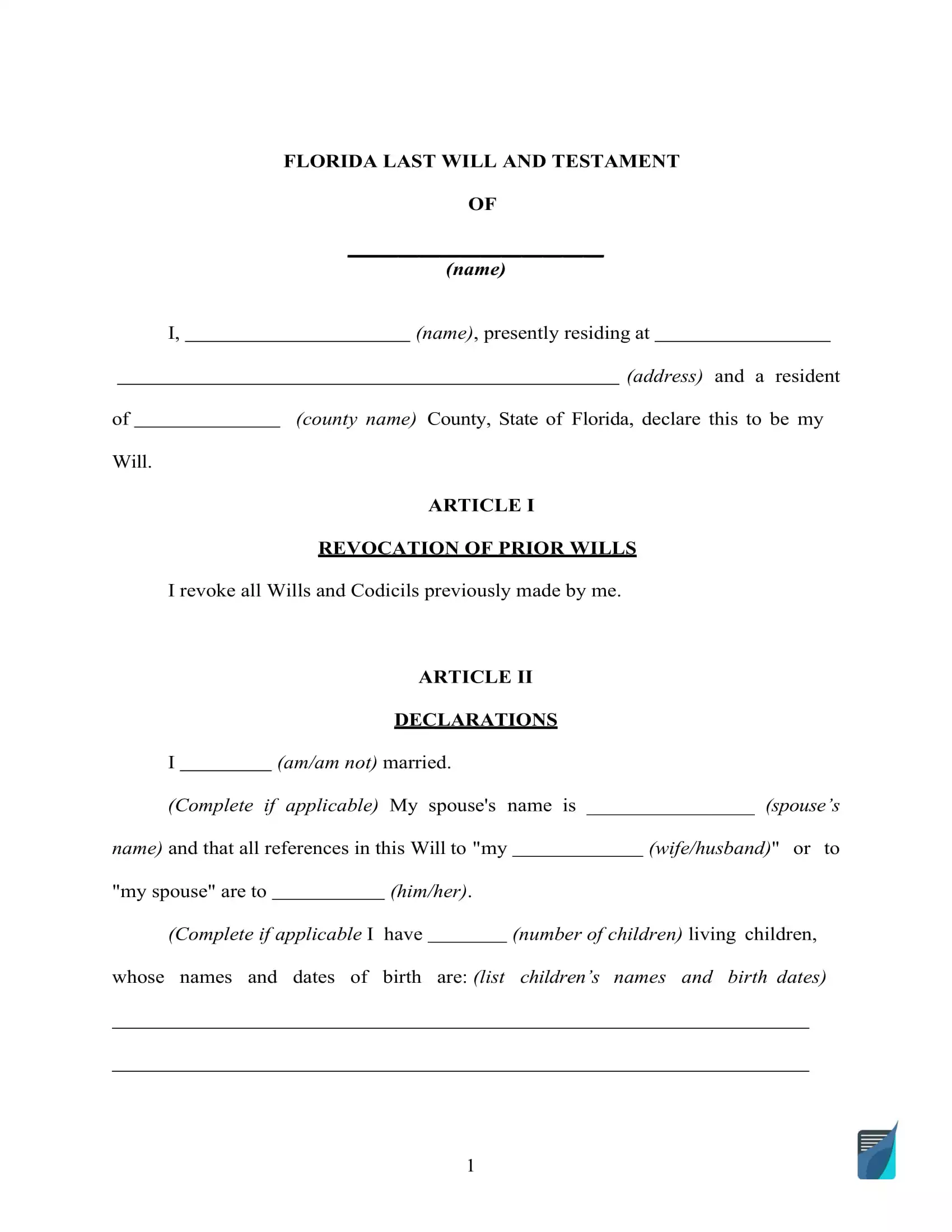
A Florida last will and testament template is a legally binding document that states your final wishes and directs how your estate is distributed after you die, in the form Florida law recognizes.
Last Updated: September 2026. This guide is reviewed and updated regularly to reflect current Florida law. If you notice an error or outdated information, please contact us.
Build Your Document
Answer a few simple questions to make your document in minutes
Save and Print
Save progress and finish on any device, download and print anytime
Sign and Use
Your valid, lawyer-approved document is ready
A thought-out and appropriately written last will and testament will be vital to your loved ones and your relations upon your death, even if you don’t possess a large number of assets.
Below, you can download a Florida last will and testament template and read the requirements, will types, and steps you need to write a valid document.
Florida wills must meet a short list of requirements to be valid. A Florida last will and testament template must be in writing and signed by a testator who is at least 18 years old or an emancipated minor. It must also be witnessed by at least two people who sign in the presence of the testator and of each other.[2]
| Requirements | State laws | |
| Statutes | Chapter 732 – Probate Code: Intestate Succession and Wills; Part V – Wills | |
| Definitions | Chapter 731 – Probate Code: General Definitions | |
| Signing requirement | Two witnesses | 732.502 Execution of wills |
| Age of testator | 18 and older or an emancipated minor | 732.501 Who may make a will |
A Florida last will and testament is also called a will, a last will, or simply a testament. Whatever name you use, the document works the same way under Florida law.
1. Think about your options. Before you start, decide if you’d like to use the services of a legal professional or prepare the entire thing on your own. In case you would like to make the will by yourself, pick the type you’ll go for: a handwritten (holographic) will, or download our free last will and testament template online.
2. Indicate your details. Add your full name and address (the city, county, and state of residence) to ascertain the testator of the last will and testament. Go through the remaining portion of the section, including the details you’ve entered and the “Expenses and Taxes” subsection.

3. Establish the executor (or executrix). Now it is time to decide on the executor of your last will, the person responsible for carrying out what you lay out in this document (learn more about what an executor does). To do that, enter the executor’s full name and residence details (city, county, and state). Choosing someone who lives in your state can help you avoid the extra paperwork some states require for an out-of-state executor.
As a precaution, you can also name a substitute executor. That way, if the person you first name cannot serve, a second, dependable person is already named in the will.

4. Choose the guardian (optional). You are able to specify a trusted person as a guardian in case you’ve got minor or dependent children that must be taken care of. If you do not name a guardian, the court appoints one for a minor child on the petition of a parent, relative, or other interested person, and when it does, it must consider any person you designated as guardian in your will (Fla. Stat. 744.3021, 744.312).[3.1]

5. Specify your beneficiaries. At this point, indicate those people to whom you leave your estate, that is, your beneficiaries. Fill out their full names, places of residence, and your connection to them (e.g., spouse, child, friend).
6. Designate possessions. Write down your assets and describe how you wish to distribute them among your beneficiaries, if you have something in mind apart from dividing the property evenly.
Cash, stocks, realty, business ownership, money owed to you, and other items of financial value can all be listed in the will. Some assets pass outside your will: life insurance with a named beneficiary goes to that beneficiary, and property held as tenants by the entirety or with an express right of survivorship goes to the surviving owner. Insurance payable to your estate, and joint property held as tenants in common, can pass under your will (Fla. Stat. 222.13, 689.15).[4.1]

7. Continue with the witnesses signing the document. Florida law requires at least two witnesses to sign a last will for it to be valid. The witnesses must sign in your presence and in each other’s presence.[2] Consider choosing witnesses who are likely to still be available later, in case the will is ever contested in court.
After you review every page, you and the two witnesses each write your full name and address. Florida law requires your signature to appear at the end of the will.[2]

Florida does not list a notary among the signing requirements: the will must be in writing, signed by you at the end, and signed by two attesting witnesses (Fla. Stat. 732.502). To make the will self-proving, you and your two witnesses sign the self-proof before a notary or other officer authorized to administer oaths, who completes a certificate attached to the will (Fla. Stat. 732.503).[5.1]

Florida wills require the testator to be of sound mind and at least 18 years old, or an emancipated minor.[1.1] This is called testamentary capacity. Sound mind means you understand what a will does and the effect of signing one.
Florida is not a community property state, so you have some freedom in how you leave property to a spouse. You can leave a spouse out of the will, but your surviving spouse can claim an elective share of 30 percent of your elective estate, and your homestead cannot be left away from a surviving spouse or minor child (Fla. Stat. 732.201, 732.2065, 732.4015).[1.3]
Yes, you can amend or revoke your will as long as you are not bound by a contract, such as a separation agreement, that says otherwise. Under Florida law, a will (other than an electronic will) can be revoked by burning, tearing, canceling, defacing, obliterating, or destroying it with the intent to revoke it. This can be done by the testator, or by someone else in the testator’s presence and at the testator’s direction.[1.2]
A lost or destroyed will can still be probated if its terms are proved: by two disinterested witnesses, or by one disinterested witness if you have a correct copy (Fla. Stat. 733.207).[6.1] It is common practice to keep the signed original in a safe, known place, such as a fireproof safe or with your attorney, and to tell your executor where to find it.
| Related documents | Times when you may need to have one |
| Codicil | You want to slightly change your last will without writing a new document from scratch. |
| Self-proving affidavit | You wish the probate to be easier when it’s necessary. |
| Living will | You want to be sure that, if you’re incapacitated, you are treated exactly how you’d like to. |
| Living trust | You would like to skip probate by putting your assets in the possession of a trust. |
General information, not legal or tax advice.
