
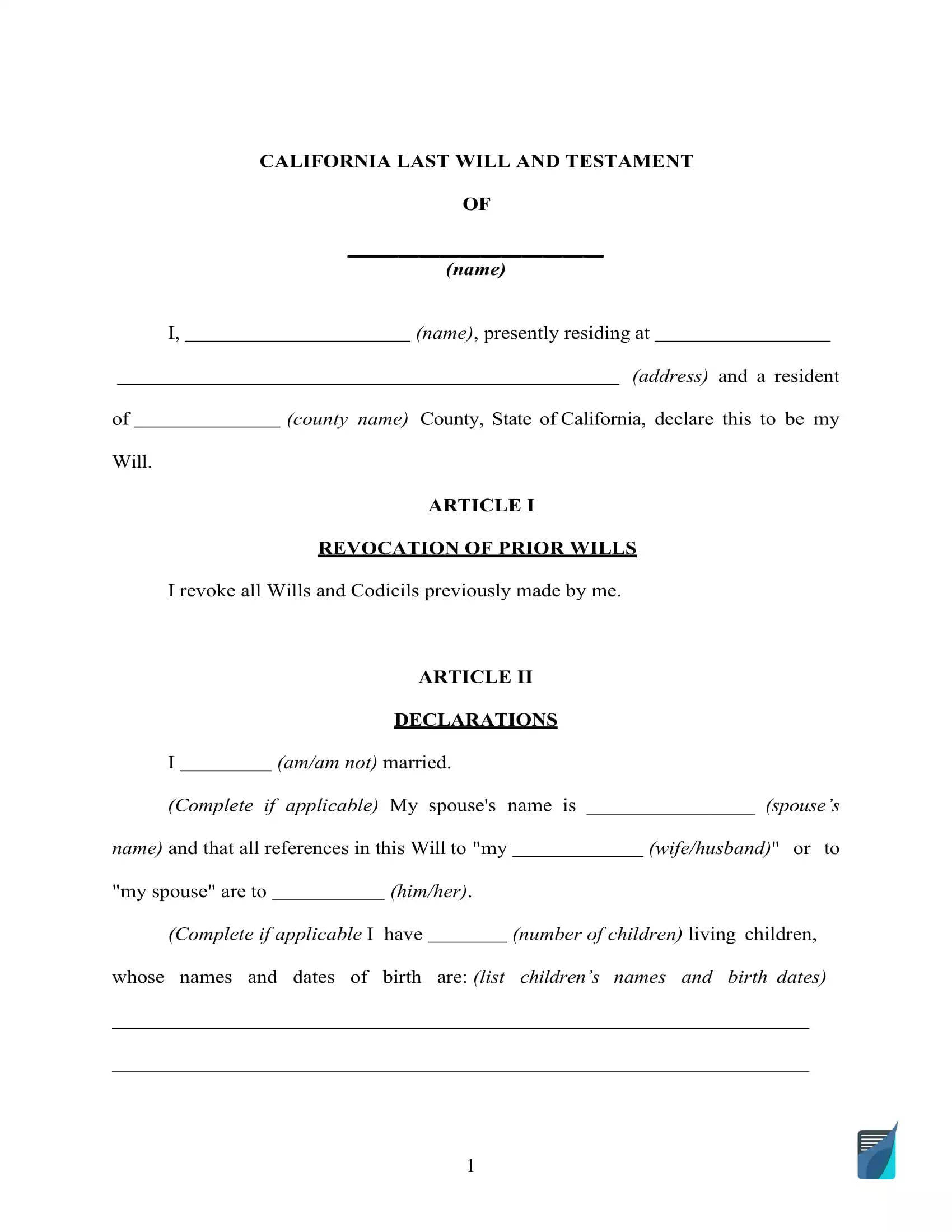
A California last will is a written document stating how a person (the testator) wants their property and assets distributed after death, valid only when it is signed and witnessed the way California law requires.[3]
As a precaution, it’s highly recommended to create a last will. Even when you don’t have a lot of assets or don’t think your time is near, a last will could help your family upon your passing.
Below, we offer a free downloadable California last will and testament form and answers to certain common doubts you could have concerning this important document.
Build Your Document
Answer a few simple questions to make your document in minutes
Save and Print
Save progress and finish on any device, download and print anytime
Sign and Use
Your valid, lawyer-approved document is ready
California last will law requires a written document, signed by the testator, and witnessed under Cal. Prob. Code § 6110.[3] The state also recognizes a handwritten (holographic) will when the signature and the material provisions are in the testator’s own handwriting.[1.1] It also honors a will made validly in another state if its execution followed the law of the testator’s domicile, place of abode, or nationality at that time.[1.3] A self-proving affidavit inside the will, incorporating the attestation clause, lets the witnesses skip testifying in court.[2]
Last Updated: September 2026. This guide is reviewed and updated regularly to reflect current California law. If you notice an error or outdated information, please contact us.
| Requirements | State laws | |
| Statutes | Division 6 – Wills and Intestate Succession | |
| Definitions | Division 1 – Preliminary Provisions and Definitions | |
| Signing requirement | Two witnesses | CHAPTER 2. Execution of Will. 6111 |
| Age of testator | 18 and older | CHAPTER 1. General Provisions. 6100 |
| Age of witnesses | CHAPTER 2. Execution of Wills. 6112 | |
| Self-proving wills | Allowed | ARTICLE 2. Proof of Will. 8220 |
| Handwritten wills | Recognized if meeting certain conditions | CHAPTER 2. Execution of Wills. 6111 |
| Oral wills | Not recognized | CHAPTER 2. Execution of Wills. 6111 |
| Holographic wills | Recognized if meeting certain conditions | CHAPTER 2. Execution of Will. 6111 |
These are the seven parts of the FormsPal California last will template, in the order they appear in the document. Complete each part, then sign the will together with your witnesses.


Tip: Name an executor who lives in California when possible. An out-of-state executor can add extra procedural steps during probate.
A California will becomes valid once it satisfies the signing and witnessing rules in Cal. Prob. Code § 6110.[3] At least two witnesses, present at the same time, must either watch the testator sign the will or hear the testator acknowledge the signature or the will, and each witness must understand that the document is the testator’s will.
Under Cal. Prob. Code § 6110, a California will must be in writing.[3] It must also be signed, either by the testator or by someone else acting in the testator’s name, in the testator’s presence, and at the testator’s direction, then attested by the required witnesses.
Yes. Cal. Prob. Code § 6110 allows another person to sign a California will for the testator,[3] as long as it is done in the testator’s name, in the testator’s presence, and at the testator’s direction. This option helps testators who cannot physically sign their own name.
Yes. Cal. Prob. Code § 6110 requires attestation by the witnesses.[3] Each witness must either watch the testator sign the will or have the testator acknowledge the signature or the will to them, and each must understand that the instrument they are signing is the testator’s will.
Yes. Cal. Prob. Code § 6110 requires that both witnesses be present at the same time when the will is signed or acknowledged.[3] Signing later, or separately from the testator, does not satisfy this requirement, so plan to have the testator and both witnesses together for the signing.
A will in California is valid without a notary certification, since Cal. Prob. Code § 6110 requires only the testator’s signature and two witnesses, not notarization.[3] You will not need a notary public to make your last will self-proving either, because California’s self-proving affidavit process relies on the witnesses’ own signed statement instead.[2]
IMPORTANT: Even though notarization is not required for last wills in California, it usually helps facilitate the probate process.
To be able to create your last will and modify it (to be testamentary capable), you must match specific requirements relating to your legal and mental capabilities first.
To have testamentary capacity, you generally need to meet two conditions:
In California, there is such a thing as community or marital property. It implies that all of the properties and assets collected or increased while in the marriage ought to be evenly shared between the two spouses, and this makes it almost implausible to disinherit your marriage partner.
Possibly, this is one of the reasons we have the following statistics. As per Census.gov, in 2018 in California, the divorce rate was 6.7 per 1,000 women over 15 years old. It is lower than the US nationwide rate during the same period.
Just the possessions you control (your personal property) are subject to will disinheritance when it comes to your spouse.
The only way for you to disinherit your marriage partner will be to enter into a prenuptial contract with him or her prior to marriage.
It’s legal in California to disinherit any other members of the family in the will. That concerns your children and other relatives; simply add disinheritance provisions to your last will and testament.
Yes, a person who wrote a will is permitted to alter or cancel it at any time. The only case that might disallow you to do it is when it is forbidden under a contract you concluded.
Solely per your instruction and with you present can another person sign your last will and testament (See Point 3). It’s possible to give a special directive through a number of methods, which include speaking, a positive answer to a query, or body gestures.

| Related documents | Instances when you could need to have one |
| Codicil | You would like to slightly change your last will without making a new document from scratch. |
| Self-proving affidavit | You want to save time and money for your witnesses. |
| Living will | You would like to make certain your end-of-life treatment is carried out in line with your wishes. |
| Living trust | You want to skip probate by placing your property in a trust. |
FormsPal also provides a free last will and testament template for each state listed below. Choose a state to open its own last will and testament form, along with the witness and signing rules that apply there.
This page is general information about California last wills, not legal advice. For advice on your situation, talk to a California attorney.
Unless noted otherwise, the sources below are from the California Family Code, published by the California Legislative Information.
