
Updated:
A California power of attorney is a document that names your agent. Cal. Prob. Code § 4121 requires a date, a signature, and a notary or two qualified witnesses. The forms below cover finances, health care, a child, property, taxes and vehicles.
Key facts
Build Your Document
Answer a few simple questions to make your document in minutes
Save and Print
Save progress and finish on any device, download and print anytime
Sign and Use
Your valid, lawyer-approved document is ready
The California power of attorney forms below cover nine tasks, from durable and medical powers to tax, vehicle and revocation forms, and each entry lists the form's other names and its signers. Pick the entry that matches the job you want your agent to handle.
A durable, general, limited or real estate power of attorney in California is either acknowledged before a notary public or signed by at least two witnesses who satisfy the requirements of Section 4122 (Cal. Prob. Code § 4121).
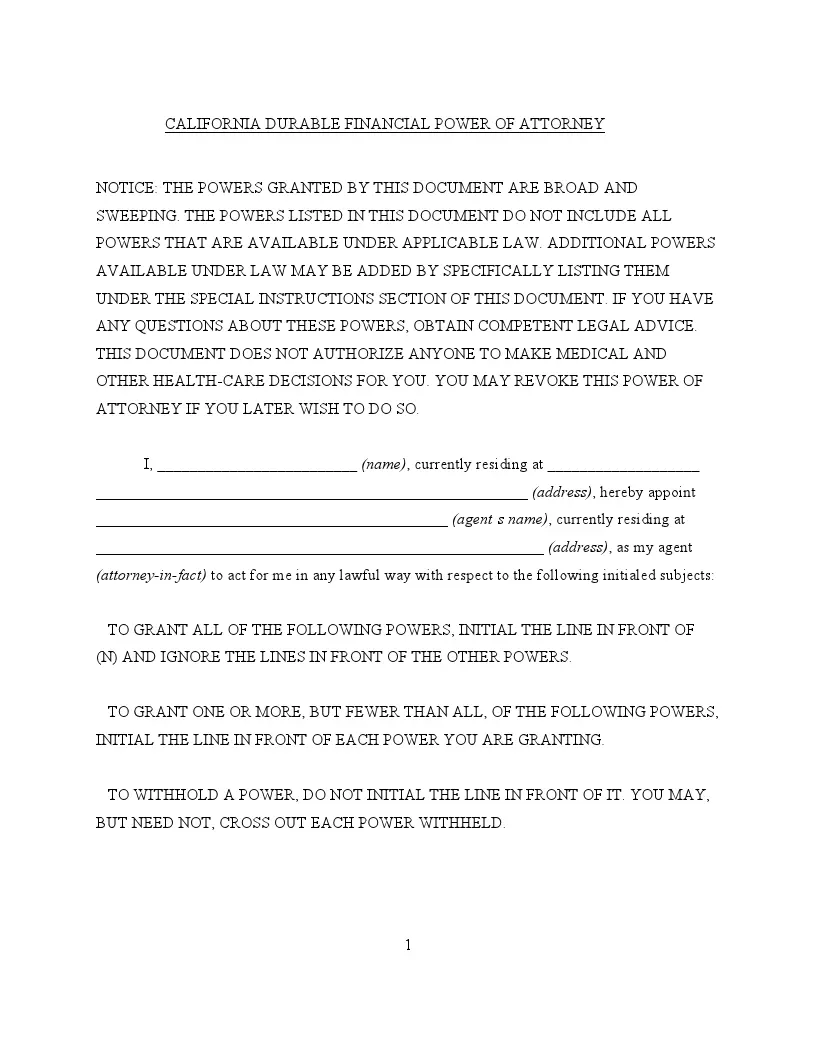
Durable power of attorney form in California gives an agent authority over the principal's finances that continues if the principal later loses capacity. The durable power uses the wording set out in Cal. Prob. Code § 4124, so the agent can keep paying bills and managing accounts through a serious illness.
| Also Known As | California DPOA |
| Signing Requirements | Notary or Two (2) Witnesses |
| Download | PDF Template |

Medical power of attorney in California is called the Advance Health Care Directive form. The directive names a relative, a friend or another person you choose to make health care decisions when you cannot make them yourself.
| Also Known As | Health Care POA or MPOA |
| Signing Requirements | Notary or Two (2) Witnesses |
| Download | PDF Template | Advance Health Care Directive |

General power of attorney gives an agent broad powers over the principal's property and finances, for example letting a spouse manage bank accounts and pay bills. A general power of attorney ends at the principal's death, except as to specific authority a statute permits the agent to use after death (Cal. Prob. Code § 4152).
| Also Known As | General (Financial) POA |
| Signing Requirements | Notary or Two (2) Witnesses |
| Download | PDF Template |

Limited power of attorney hands an agent one task or a short list of tasks, such as signing the papers for a single sale, and no other powers.
| Also Known As | Special POA |
| Signing Requirements | Notary or Two (2) Witnesses |
| Download | PDF Template |

Child power of attorney in California lets a parent authorize in writing an adult into whose care the child has been entrusted to consent to the child's medical care, dental care or both (Cal. Fam. Code § 6910). The entry also links the Petition for Appointment of Guardian for Minor(s), a separate court filing used for a guardianship. For school enrollment and medical consent, see the caregiver's authorization affidavit below.
| Also Known As | Minor POA |
| Signing Requirements | Parent(s) granting the power, on the form's signature lines |
| Download | PDF Template | Petition for Appointment of Guardian for Minor(s) |

Real estate power of attorney form lets a property owner name an agent to sell, buy, rent or manage real property while the owner is unavailable. Cal. Prob. Code § 4121 makes the power of attorney valid with a notary or two witnesses; that section says nothing about recording a deed the agent signs, so ask the county recorder before choosing witnesses over a notary.
| Also Known As | Limited Real Estate POA |
| Signing Requirements | Notary or Two (2) Witnesses (Cal. Prob. Code § 4121); a notary is advised when the agent will sign a deed |
| Download | PDF Template |

State tax power of attorney, form FTB 3520 in California, names an agent or accountant to handle the principal's California tax matters. The agent deals with the Franchise Tax Board on the principal's behalf.
| Also Known As | Tax POA |
| Signing Requirements | Principal |
| Download | FTB 3520 |

Vehicle power of attorney, form REG 260 from the California Department of Motor Vehicles, lets a vehicle owner name a person to handle vehicle tasks such as registration or a title certificate.
| Also Known As | DMV POA |
| Signing Requirements | Principal Only |
| Download | PDF Template | REG 260 |

Revocation power of attorney cancels a power of attorney the principal signed earlier. The revocation puts the cancellation in writing, the method of Cal. Prob. Code § 4151 that no power of attorney can limit, and a copy goes to every agent.
| Also Known As | POA Termination Form |
| Signing Requirements | Notarization is Advised |
| Download | PDF Template |
Power of attorney rules differ from one state to the next. Other popular state pages:

Other California forms people often use alongside a power of attorney:
A power of attorney is a written authorization in which the principal names another person, the agent, to act in the principal's name on money, property or other matters. The California Probate Code calls the agent the attorney-in-fact.
The powers can be broad, as in a general power, or limited to one task. Two choices shape every form: whether the power lasts through the principal's incapacity, and when it starts.
A durable power of attorney stays in force after the principal loses capacity, because it contains the words "This power of attorney shall not be affected by subsequent incapacity of the principal." (Cal. Prob. Code § 4124).
A power of attorney without durable wording is a non-durable power, whatever the scope of its powers. A principal who wants an agent to manage money during a long illness picks the durable form.
A springing power of attorney takes effect at a later time than its signing, on a date or an event its own terms name; the principal's incapacity is the common event.
For that case, Cal. Prob. Code § 4124 gives the words "This power of attorney shall become effective upon the incapacity of the principal."
The right power of attorney depends on what you want your agent to do: money, health care, a child, property, taxes or a vehicle. Match your task to a row in the table below, then open its entry above.
| Your task | Type |
|---|---|
| Give someone financial powers that last through incapacity | Durable power of attorney |
| Let someone handle everyday finances | General power of attorney |
| Hand off one specific matter | Limited power of attorney |
| Name someone to make health care decisions | Medical power of attorney (Advance Health Care Directive) |
| Let someone look after your child | Child power of attorney, or a caregiver's authorization affidavit |
| Sell or rent a property | Real estate power of attorney |
| Deal with California tax matters | State tax power of attorney (FTB 3520) |
| Get a title or register a vehicle | Vehicle power of attorney (REG 260) |
| Replace or stop an agent | Revocation of power of attorney |
Each entry in the list above shows its own signers. Check the entry for the power of attorney you pick before you sign, and ask an attorney if you are not sure.
A California power of attorney form asks for the principal, the agent, the powers granted, and when those powers start and end, and every line that applies should be filled in before signing.
A California power of attorney is signed either by the principal or in the principal's name by another adult in the principal's presence and at the principal's direction (Cal. Prob. Code § 4121).
The signing steps for a durable, general, limited or real estate power of attorney under Cal. Prob. Code § 4121:
The power of attorney is either acknowledged before a notary public or signed by at least two witnesses who satisfy the requirements of Section 4122 (Cal. Prob. Code § 4121). The power of attorney also contains the date of its execution (Cal. Prob. Code § 4121).
The tax form FTB 3520 and the DMV form REG 260 follow their own forms, and each entry above lists its signers.
The Advance Health Care Directive is California's medical power of attorney: it names an agent to make health care decisions when you cannot make them yourself.
Cal. Prob. Code § 4673 sets these signing elements for an advance health care directive:
The people who may not act as a witness to an advance health care directive include those listed in Cal. Prob. Code § 4674:
Unless an exception in subdivision (b) applies, the supervising health care provider and an employee of the health care institution where the patient is receiving care may not make health care decisions as the agent (Cal. Prob. Code § 4659).
A caregiver's authorization affidavit lets a caregiver 18 years of age or older enroll a child in school and consent to school-related medical care, when the caregiver completes items 1 to 4 of the affidavit and signs it (Cal. Fam. Code § 6550).
A caregiver who is a relative and completes items 1 to 8 gains the same rights to authorize medical and dental care that guardians have under Probate Code section 2353, when the relative signs the affidavit (Cal. Fam. Code § 6550). The affidavit sits beside the child power of attorney as a separate route.
The affidavit carries these rules and limits when a caregiver uses it:
A parent, guardian or relative caregiver may also authorize in writing an adult into whose care the child has been entrusted to consent to medical care, dental care or both, when the child is in that adult's care (Cal. Fam. Code § 6910).
A California power of attorney, or the authority of its agent, ends when one of the events listed in Cal. Prob. Code § 4152 happens. The death of the principal ends the power of attorney; the removal, resignation, incapacity or death of the agent ends that agent's authority:
When an agent or third person has no notice of an event that ends the power of attorney, that person is protected from liability as provided in Chapter 5, starting at Section 4300 (Cal. Prob. Code § 4152).
A written revocation ends a California power of attorney, and Cal. Prob. Code § 4151 does not let the power of attorney limit revocation by a writing. A principal may also revoke it in accordance with its own terms (Cal. Prob. Code § 4151).
An agent or third person who does not have notice of the revocation is protected from liability as provided in Chapter 5, starting at Section 4300 (Cal. Prob. Code § 4151). The notice to each agent and office matters as much as the signature.
A power of attorney gives your agent authority to act in your name, so the agent should be someone you trust, can reach easily and who knows your wishes. Talk with the person before you sign, so the role does not come as a surprise.
Ask these questions about the person you have in mind:
A health care agent has an added limit: see who cannot be your health care agent in the section above.
A power of attorney usually fails over small oversights, and a short check once the form is filled in saves your agent and your family time later. Compare this list with your own plan:
California's power of attorney rules sit in the Probate Code, with the Family Code covering a child's caregiver. The table lists the sections this page relies on.
| Section | What it covers |
|---|---|
| Cal. Prob. Code § 4121 | Signature, date, and a notary or two witnesses for a power of attorney |
| Cal. Prob. Code § 4124 | The wording for a durable power and for a springing power |
| Cal. Prob. Code § 4151 | How a principal revokes a power of attorney |
| Cal. Prob. Code § 4152 | When a power of attorney or an agent's authority ends |
| Cal. Prob. Code § 4659 | Who may not act as a health care agent, unless subdivision (b) applies |
| Cal. Prob. Code § 4673 | Signing an advance health care directive |
| Cal. Prob. Code § 4674 | Who may not witness an advance health care directive |
| Cal. Fam. Code § 6550 | What a caregiver's authorization affidavit allows, and when it stops working |
| Cal. Fam. Code § 6552 | The affidavit's declaration and warning text |
| Cal. Fam. Code § 6910 | Written consent for a child's medical or dental care |
The official forms named on this page are FTB 3520 for California tax matters, REG 260 for vehicle tasks at the DMV, and the Advance Health Care Directive for medical decisions.
No, a notary is one of two options: the power of attorney is either acknowledged before a notary public or signed by at least two witnesses who satisfy the requirements of Section 4122 (Cal. Prob. Code § 4121).
Yes, another adult may sign in the principal's name, but only in the principal's presence and at the principal's direction (Cal. Prob. Code § 4121).
None of the Probate Code sections cited on this page sets a fee for making a power of attorney. Costs come from a notary's charge or an attorney's help, if you use them.
The principal can override it by revoking it in writing, a right the power of attorney cannot limit (Cal. Prob. Code § 4151). For a caregiver's authorization affidavit, a parent's contrary decision on medical or dental care supersedes the caregiver's, unless it jeopardizes the child's life, health or safety (Cal. Fam. Code § 6550).
Dissolution or annulment of the marriage of the agent and the principal ends the spouse agent's authority, as provided in Section 4154, which sets the details (Cal. Prob. Code § 4152).
If your situation is complex or you are not sure which power of attorney fits, ask an attorney. FormsPal provides templates and general information, not legal advice. An attorney can also explain how your choices fit your own family and property.
General information, not legal or tax advice.
