
Updated:
A California medical power of attorney names your health care agent. The agent makes health care decisions for you if you cannot make them yourself. California has its own signing, witness and agent rules, explained below in plain words.
Key facts

Build Your Document
Answer a few simple questions to make your document in minutes
Save and Print
Save progress and finish on any device, download and print anytime
Sign and Use
Your valid, lawyer-approved document is ready
Need a different document? Browse all our California power of attorney forms, or read about the medical power of attorney form in general.
A California medical power of attorney is a written appointment of a health care agent: it names the person who makes medical decisions for you when you are unable to make them yourself.
The document goes by several names. People also call it a healthcare power of attorney, a health care proxy or a medical POA. The person who signs it is the principal.
The California form on this page also holds an advance directive, which is a statement of your wishes about end-of-life care. The directive tells your agent what you want, so the agent's decisions match your own.
The document involves two or three people: the principal who signs it, the agent who decides, and an optional backup.
A living will sets out your treatment wishes only, while a medical power of attorney names a person who decides for you when you cannot decide yourself.
The California form on this page does both jobs. Part I names the agent, and Part II holds your wishes about end-of-life care. A separate California living will suits people who want their wishes in a document of their own.
A California medical power of attorney needs a signature, a date, and either a notary or two witnesses, under Cal. Prob. Code § 4673.[2]
Cal. Prob. Code § 4674 limits who may act as a witness.[3] Cal. Prob. Code § 4659 limits who may act as an agent, except as that section provides.[1] The sections below put each rule in plain words.
The document must be signed by the principal, or in the principal's name by another adult in the principal's presence and at the principal's direction (Cal. Prob. Code § 4673). It must also contain the date of its execution (Cal. Prob. Code § 4673).[2]
The document must be either acknowledged before a notary public or signed by at least two witnesses (Cal. Prob. Code § 4673).[2] Either one is enough under that section; both are not required. A patient in a skilled nursing facility faces a further witness rule in Cal. Prob. Code § 4675, so check that section before relying on a notary alone.
A notary acknowledgment is a notary public's signed and sealed statement that the principal appeared and signed. The form on this page carries an acknowledgment block on its last page.
Cal. Prob. Code § 4674 bars, among others, these people from acting as a witness to the document:[3]
Cal. Prob. Code § 4674 sets further witness qualifications that this list does not cover, so read the full section before you choose your witnesses.[3] A patient in a skilled nursing facility faces a further witness rule in Cal. Prob. Code § 4675; ask the facility or a lawyer before you sign there.
Cal. Prob. Code § 4659 bars, among others, these people from making health care decisions as your agent, except as subdivision (b) of that section provides:[1]
Pick someone you trust and talk with them before you name them. That is common practice, not a legal requirement.
| Document Name | California Medical Power of Attorney |
| FormsPal Template Title | California Medical Power of Attorney with Advance Directive |
| Relevant Law | Cal. Prob. Code § 4673 (signing), Cal. Prob. Code § 4674 (witnesses) and Cal. Prob. Code § 4659 (agents, except as it provides)[1][2][3] |
| Signing Requirements | Signed and dated, then acknowledged before a notary or signed by at least two witnesses (Cal. Prob. Code § 4673)[2] |
| Who Can’t Be the Agent? | Among others, the supervising health care provider or an employee of the health care institution where the principal is receiving care, except as the statute provides (Cal. Prob. Code § 4659)[1] |
| Who Can’t Be the Witness? | Among others, the principal's health care provider or an employee, and the operator or an employee of a community care facility or a residential care facility for the elderly (Cal. Prob. Code § 4674)[3] |
| Avg. Time to Fill Out | 8 minutes |
| # of Fillable Fields | 21 |
| Available Formats | Adobe PDF |
Popular Local Medical POA Forms
Health care POA forms are among the most widely downloaded ones in the USA. The following are some of the more asked durable POA documents.
The California Medical Power of Attorney with Advance Directive has three numbered parts, a signature line and a final acknowledgment page. What each part says comes from the printed text of the template, not from California law. Review all of it before you sign.
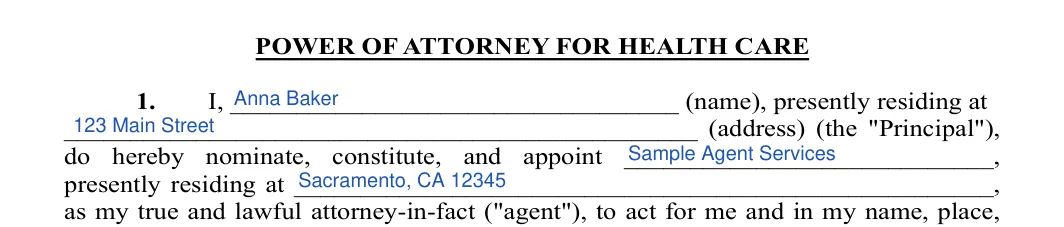
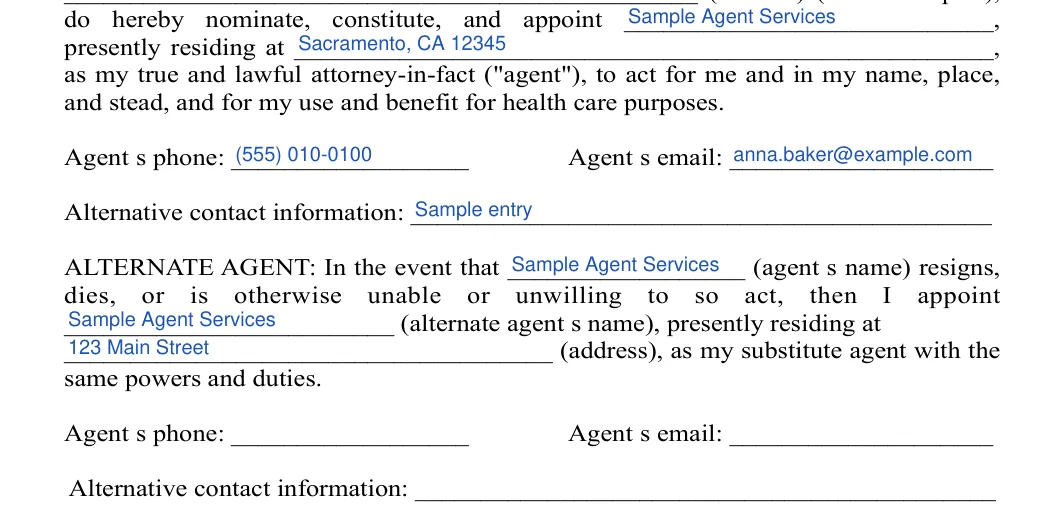
Part I, Power of Attorney for Health Care, names your agent with the agent's phone and email, and it has room for one alternate agent.
A list of powers follows, lettered A to J. The powers cover consent to medical care, access to medical records, pain relief and personal care. Part I also holds a HIPAA release, a permission under the federal health privacy rules that lets your agent see your medical records.
Part II, Advance Health Care Directive, sets out your wishes about end-of-life care and about relief from pain.
The printed wording asks your providers to withhold or withdraw all treatments other than those needed to keep you comfortable under the conditions it lists. Part II is a serious statement about end-of-life care, so check that it matches what you want. If it does not, ask a lawyer for advice or talk to your doctor before you sign.
Part III, General Provisions, gives standard terms for the whole document, and the date and signature lines come right after them.
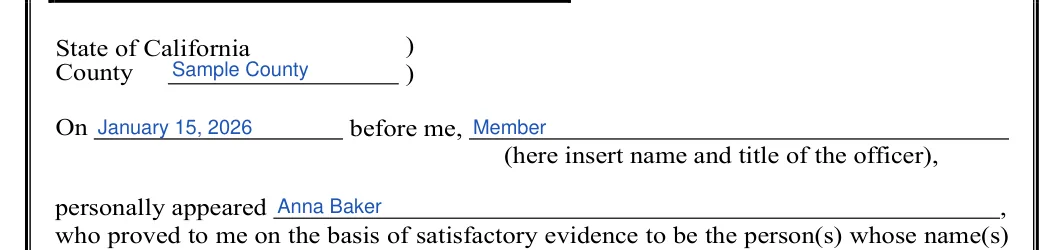
The last page is an acknowledgment block with the county, the date, the officer's name and title, and a signature and seal.
The template also covers an agent who is unable to act. In that case it says one document must be attached, such as a signed resignation, a physician's statement, a court order or a death certificate.
The document works best when your agent, your doctor and your family know what you want before you sign it. These questions are common practice, not legal requirements.
The California form has 21 fillable fields, and the five steps below follow it from page 1 to page 7. Each step names the part it covers.
The screenshots under each step show the FormsPal California medical power of attorney template filled with sample entries in blue, so you can see where each answer goes. The names, addresses, dates and amounts are examples only.
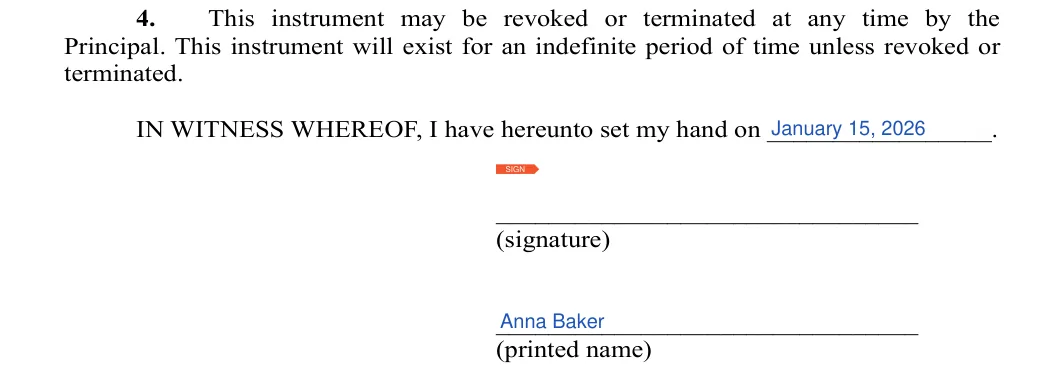

The document needs a signature, a date, and either a notary or at least two witnesses (Cal. Prob. Code § 4673), and the witnesses must meet the qualifications of Cal. Prob. Code § 4674. A patient in a skilled nursing facility faces a further witness rule in Cal. Prob. Code § 4675. The steps below cover what happens around the form.
The FormsPal template has no lines for witness names or signatures, only the acknowledgment on page 7. If you prefer two witnesses to a notary, ask a lawyer for legal advice on how to record their signatures before you sign.
Most problems with the document come from skipped steps, not from the blanks on the template. These are the mistakes to watch for, based on the rules earlier on this page.

Other Medical POA Forms by State
The answers below cover the questions people search most about this document in California, each settled by the form or by a cited section.
A medical POA is a medical power of attorney: a document that names an agent to make health care decisions for you when you cannot make them yourself.
Yes, in everyday use a durable power of attorney for health care, a healthcare power of attorney and a medical power of attorney name the same kind of document. The California Probate Code calls it a power of attorney for health care.
No, the form on this page covers health care decisions only. Money, bank accounts and property need a separate document, such as a California durable power of attorney or a California general power of attorney.
The quickest route is to fill in the form, sign and date it, and have it acknowledged before a notary public or signed by at least two witnesses (Cal. Prob. Code § 4673). A notary needs one appointment, while two witnesses need two eligible people at hand. A patient in a skilled nursing facility faces a further witness rule in Cal. Prob. Code § 4675, so check that section before relying on a notary alone.
No, this form names an agent for your own health care. For a minor, a caregiver's authorization affidavit authorizes a caregiver 18 years of age or older who completes items 1 to 4 of the affidavit and signs it to enroll a minor in school and consent to school-related medical care (Cal. Fam. Code § 6550(a)).[5] A parent or guardian may also authorize in writing an adult into whose care a minor has been entrusted to consent to medical care or dental care for the minor (Cal. Fam. Code § 6910).[6]
Ask a lawyer before you cancel or replace it: the Probate Code sections cited on this page cover signing, witnesses and agents, not how to revoke a health care document. If you sign a new one, give the new copy to everyone who held the old one and tell them which one to follow.
The PDF needs a signature, a date, and either a notary or at least two witnesses (Cal. Prob. Code § 4673), with the witness qualifications of Cal. Prob. Code § 4674 and, for a patient in a skilled nursing facility, Cal. Prob. Code § 4675.
General information, not legal or tax advice. Talk to a lawyer or your doctor about your own situation.
Unless noted otherwise, the sources below are from the California Probate Code, published by the California Legislative Information.
