
Updated:
A Texas medical power of attorney (MPOA) names your health care agent. The MPOA needs your signature before two witnesses or a notary (Tex. Health & Safety Code § 166.154). Texans sign one to plan ahead, especially before surgery or a serious illness.
This page sets out the Texas signing and agent rules in plain words, then walks through each part of the FormsPal form with sample entries. For other documents, see our Texas power of attorney forms, or read about the medical power of attorney form in general.
Key facts

Build Your Document
Answer a few simple questions to make your document in minutes
Save and Print
Save progress and finish on any device, download and print anytime
Sign and Use
Your valid, lawyer-approved document is ready
A Texas medical power of attorney is a written appointment of a health care agent, the person who makes medical decisions for the principal if the principal can no longer make them. The principal is the person who signs the document. The agent is the person the document names.
The MPOA lets the agent make any health care decision the principal could make if competent, unless the document sets an express limitation on that authority (Tex. Health & Safety Code § 166.152). A limit written into the form therefore narrows the agent's power. The same section bars an agent from consenting to voluntary inpatient mental health services, convulsive treatment, psychosurgery or abortion (Tex. Health & Safety Code § 166.152).
The same document goes by other names. Searchers and other states call it a health care power of attorney, an HCPOA or a health care proxy. The Texas statute calls it a medical power of attorney.
A medical power of attorney covers health care decisions, and a durable power of attorney covers money and property. The Texas statutory durable power of attorney form tells the principal that it does not authorize anyone to make medical and other health-care decisions (Tex. Est. Code § 752.051). People who search for a "durable power of attorney for health care" in Texas need the MPOA. For money matters, see our Texas durable power of attorney page.
A medical power of attorney names a person, while a living will records treatment wishes. Some people also add a Texas living will, which is a separate document. The FormsPal template puts both ideas in one file: Part I names the agent and Part II holds the advance directive.
A Texas MPOA gives the agent authority only if the attending physician certifies in writing that the principal is incompetent, based on the physician's reasonable medical judgment, and files that certification in the principal's medical record (Tex. Health & Safety Code § 166.152).
Signing the form does not hand over any decision on that day. Until the physician's certification, the principal keeps making their own health care choices.
The principal's objection also counts later: treatment may not be given to or withheld from the principal if the principal objects, whether or not the MPOA is in effect and whether or not the principal is competent at the time (Tex. Health & Safety Code § 166.152).
A Texas MPOA requires a signature before two witnesses or a notary, and it names an agent outside the barred care roles, unless an exception for relatives applies (Tex. Health & Safety Code §§ 166.153 and 166.154). The sections below put each rule in plain words.
The medical power of attorney must be signed by the principal in the presence of two witnesses who qualify under section 166.003, at least one of whom must also meet that section's stricter test (Tex. Health & Safety Code § 166.154). The witnesses must sign the document, except when the principal uses a notary instead (Tex. Health & Safety Code § 166.154).
The principal, in lieu of signing in the presence of the witnesses, may sign the medical power of attorney and have the signature acknowledged before a notary public (Tex. Health & Safety Code § 166.154).
Each witness must be a competent adult when the document is witnessed (Tex. Health & Safety Code § 166.003). At least one of the two witnesses must be a person who is not on the list below, which applies when the MPOA is signed before witnesses (Tex. Health & Safety Code § 166.003):
The other witness only has to be a competent adult, so that witness may hold one of the listed roles (Tex. Health & Safety Code § 166.003).
If the principal is physically unable to sign, another person may sign the medical power of attorney with the principal's name in the principal's presence and at the principal's express direction (Tex. Health & Safety Code § 166.154(c)).
The agent can be any trusted person, except someone in a barred care role. A person may not exercise the authority of an agent while the person serves in one of these roles (Tex. Health & Safety Code § 166.153):
Pick someone you trust and talk with them before you name them. That is common practice, not a legal requirement.
| Document Name | Texas Medical Power of Attorney Form |
| State Form Name | Texas Medical Power of Attorney |
| Relevant Law | Tex. Health & Safety Code §§ 166.152, 166.153 and 166.154 |
| Signing Requirements | Two witnesses, or a notary public instead (Tex. Health & Safety Code § 166.154) |
| Who Can’t Be the Agent? | Health care providers, residential care providers, and their employees unless they are relatives (Tex. Health & Safety Code § 166.153) |
| Who Can’t Be the Witness? | A person who is not a competent adult; and for at least one witness, your agent, a relative, an heir, your attending physician or the physician's employee, among others (Tex. Health & Safety Code § 166.003) |
| Avg. Time to Fill Out | 8 minutes |
| # of Fillable Fields | 21 |
| Available Formats | Adobe PDF |
Popular Local Medical POA Forms
HCPOA forms are some of the most frequently downloaded ones within the USA. Listed below are probably the most asked durable power of attorney documents.
A Texas MPOA lets the agent make any health care decision you could make if you were competent, unless the document sets an express limitation (Tex. Health & Safety Code § 166.152).
The statute itself bars some decisions in every Texas MPOA. Under Tex. Health & Safety Code § 166.152, an agent may not consent to voluntary inpatient mental health services, convulsive treatment, psychosurgery, abortion, or neglect of the principal through the omission of care primarily intended to provide for the principal's comfort.
The agent's access to medical information follows from that authority. Subject to any limitations in the MPOA, an agent may, for the purpose of making a health care decision, request, review, and receive any information, oral or written, regarding the principal's physical or mental health, including medical and hospital records (Tex. Health & Safety Code § 166.157).
The MPOA does not reach money and property. A separate durable power of attorney handles those matters.
The FormsPal template, titled Medical Power of Attorney with Advance Directive, has three numbered parts and a notary page. The medical power of attorney must be in substantially the form set out in Tex. Health & Safety Code § 166.164, and this template does not follow that form's wording: it adds an advance directive, has no witness lines and ends with a notary block. Compare the template with the statutory form, or ask a lawyer, before you sign. The list below describes the template's own printed text.
Part II is a serious statement about end-of-life care, so check that it matches what you want. If it does not, talk to a lawyer or your doctor before you sign.
A medical power of attorney works best when the agent and the doctor know the principal's wishes. These questions are common practice, not legal requirements.
This page covers health care decisions only. For other kinds of authority, browse our Texas general power of attorney page.
The Texas MPOA form has 21 fillable fields, and the four steps below follow it from the first page to the last. Each step names the part of the form it covers.
The screenshots under each step show the FormsPal Texas medical power of attorney template filled with sample entries in blue, so you can see where each answer goes. The names, addresses, dates and amounts are examples only.
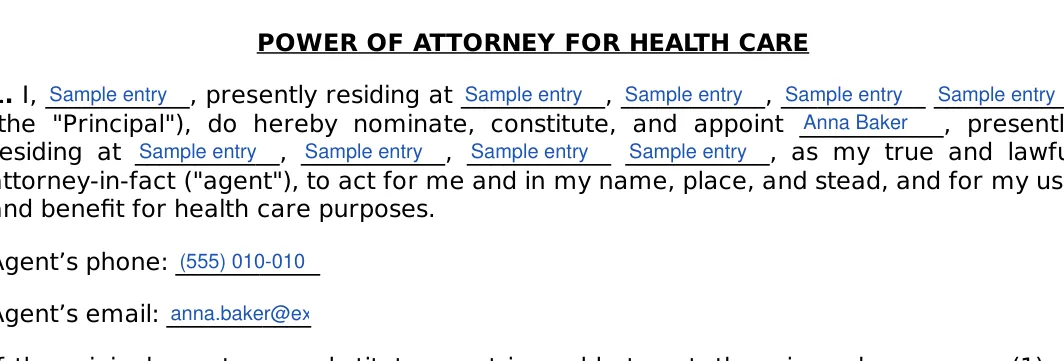

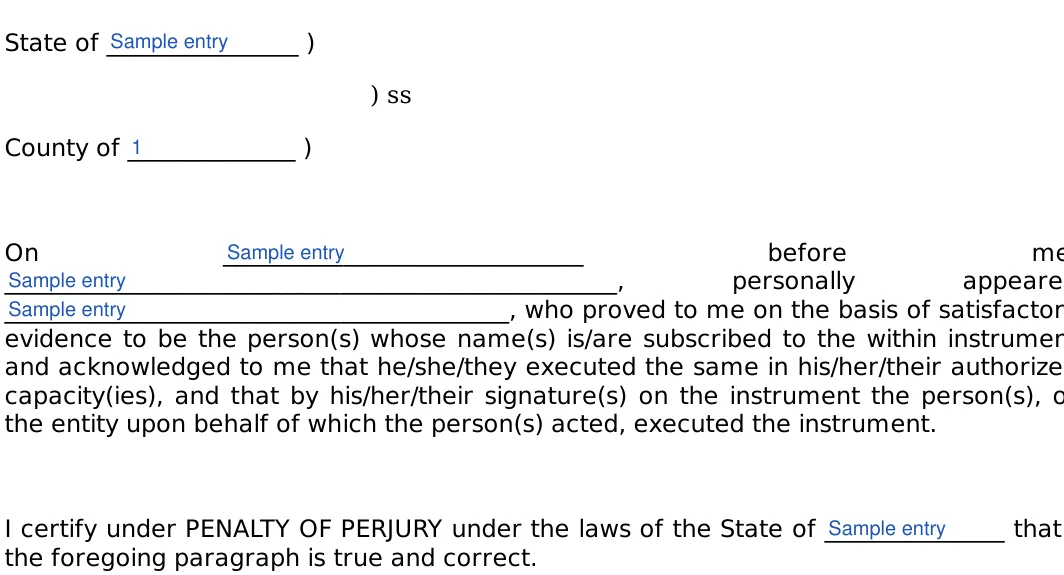

A Texas MPOA is signed by one of two routes: before two witnesses, or, if the principal skips the witnesses, with the signature acknowledged before a notary public (Tex. Health & Safety Code § 166.154). The steps below follow either route.
The FormsPal template has no lines for the witnesses’ names or signatures, only a printed note under your signature line that repeats the two-witness rule. Ask a lawyer or the notary how to record the witnesses’ signatures before you sign.
A Texas MPOA ends when the principal revokes it, either by oral or written notification at any time to the agent or a licensed or certified health or residential care provider, or by any other act showing a specific intent to revoke, regardless of competence or mental state (Tex. Health & Safety Code § 166.155).
Signing a new MPOA also revokes the old one, if the principal executes a subsequent medical power of attorney (Tex. Health & Safety Code § 166.155). To change agents, the principal signs a new form with the same witness or notary steps.
An agent's authority under a medical power of attorney is revoked if the agent's marriage to the principal is dissolved, annulled, or declared void unless the medical power of attorney provides otherwise (Tex. Health & Safety Code § 166.155).
Most problems with a Texas MPOA come from skipped signing steps, not from the blanks on the form. The list below checks each mistake against Tex. Health & Safety Code §§ 166.003, 166.153 and 166.154, where a rule applies only in the situation it names.

Other Medical POA Forms by State
No, a Texas MPOA needs notarization only if the principal chooses it in place of two qualified witnesses (Tex. Health & Safety Code § 166.154). Either route completes the signing.
No, the MPOA covers health care decisions, unless the principal also signs a separate durable power of attorney for money and property. The Texas statutory durable form itself says it does not authorize medical and other health-care decisions (Tex. Est. Code § 752.051), so the two documents work side by side.
No, treatment may not be given to or withheld from the principal if the principal objects, even while the MPOA is in effect (Tex. Health & Safety Code § 166.152).
Yes, an HCPOA, a health care power of attorney and a health care proxy form all describe the document Texas calls a medical power of attorney. The name on the form matters less than its signing, which follows the Texas witness or notary rules.
A divorce ends a spouse agent's authority, unless the medical power of attorney provides otherwise (Tex. Health & Safety Code § 166.155). The principal can sign a new MPOA to name a different agent.
The original belongs somewhere safe and easy to reach, with copies for the agent and the doctor. That is common practice, not a legal requirement.
A printed Texas MPOA still needs the same signing as one filled in online: two witnesses, or a notary public instead (Tex. Health & Safety Code § 166.154).
General information, not legal or tax advice. Talk to a lawyer or your doctor about your own situation.
