
Updated:
A Texas power of attorney is a document appointing your agent. Under Tex. Est. Code § 751.0021, a durable form survives incapacity only when its text says so. The forms below cover money, property, health care, a child, a vehicle and taxes.
Key facts
Build Your Document
Answer a few simple questions to make your document in minutes
Save and Print
Save progress and finish on any device, download and print anytime
Sign and Use
Your valid, lawyer-approved document is ready
A Texas durable power of attorney is a written grant of authority that keeps working when the principal becomes disabled or incapacitated, but only if it carries the wording Tex. Est. Code § 751.0021 describes. Searchers often call it a financial power of attorney, because it covers property and money.
The document qualifies as durable only when it contains one of these phrases, or similar words that clearly show the agent's authority continues despite the principal's later disability or incapacity (Tex. Est. Code § 751.0021):
A power of attorney without that wording is not a durable power of attorney under the same section. The other forms on this page, such as a general power of attorney or a limited one, are used where that continuing authority is not needed.
A Texas durable power of attorney takes effect on incapacity only if it uses the second phrase above, often called a springing power of attorney; the first phrase makes it effective when signed (Tex. Est. Code § 751.0021).
Unless the document defines incapacity itself, the principal counts as disabled or incapacitated when a physician certifies in writing, at a date later than the signing, that a medical examination found the principal mentally incapable of managing financial affairs (Tex. Est. Code § 751.00201).
The statutory form is effective immediately unless the principal directs otherwise, and if neither alternative (A) nor (B) is crossed out, the form treats alternative (A) as chosen (Tex. Est. Code § 752.051).
Each Texas POA template below fits one job: durable, medical, general, limited, minor child, real estate, tax, vehicle or revocation. The card under each form names its other names and how it is signed.
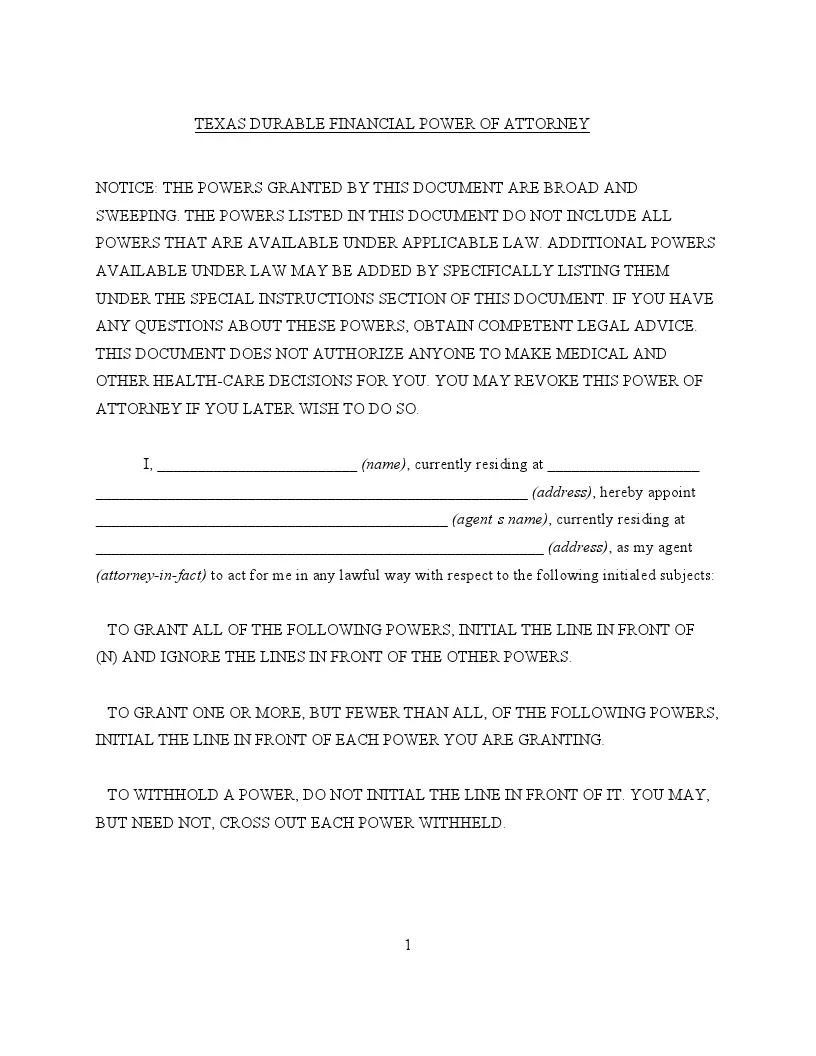
Texas Durable power of attorney form is a financial POA that stays in effect after the principal's incapacity only when it contains the wording of Tex. Est. Code § 751.0021. The statutory version also states that it does not authorize anyone to make medical and other health care decisions, which applies only to that form (Tex. Est. Code § 752.051).
| Also Known As | Texas DPOA, Statutory Durable POA |
| Signing Requirements | Notary Public |
| Download | PDF Template | Statutory Form (DOC) |

Texas Medical power of attorney names an agent to make health care decisions for you. The medical section below explains how it is signed and who can act as its agent.
| Also Known As | Health Care POA or MPOA |
| Signing Requirements | Notary Public or Two Witnesses, where the principal chooses the notary in place of the witnesses (Tex. Health & Safety Code § 166.154) |
| Download | PDF Template | Designation of Health Care Agent |

Texas General power of attorney form can be used to select a member of the family or a trustworthy friend to manage your financial matters. A general form without the durability wording is not a durable power of attorney, so it is not written to keep working after incapacity.
| Also Known As | Generic Financial POA |
| Signing Requirements | Notary Public |
| Download | PDF Template |

Texas Limited power of attorney gives an agent authority for one task or a short period, such as selling real estate while you are away. The form lists exactly which acts the agent may perform.
| Also Known As | Special POA |
| Signing Requirements | Notary |
| Download | PDF Template |

Texas Child power of attorney form lets a parent or both parents authorize an adult caregiver to act for the child (Tex. Fam. Code § 34.002); it does not appoint a guardian, which only a court does. The state's own version is the authorization agreement for a nonparent adult caregiver, covered in the child section below.
| Also Known As | Minor POA |
| Parties | Parent or both parents and an adult caregiver, where Form 2638 is used (Tex. Fam. Code § 34.002) |
| Download | PDF Template | Form 2638: Nonparent Authorization |

Texas Real Estate power of attorney is an official document that allows you to specify who can make decisions regarding real estate on your behalf. That might include care, sale, refinancing, rent, or real estate leasing. Where it is a durable power of attorney used to sign an instrument that is recorded, it is recorded with the county clerk too (Tex. Est. Code § 751.151).
| Also Known As | Limited Real Estate POA |
| Signing Requirements | Notary |
| Download | PDF Template |

Texas State Tax power of attorney (Form 01-137) names a representative of the taxpayer's choice to act for the taxpayer before the Texas Comptroller on the tax matters the form lists. The form's own instructions say what the representative may do and how the form is signed.
| Also Known As | Texas Comptroller POA |
| Download | Form 01-137 | Form 10-341 |

Texas Vehicle power of attorney (Form VTR-271) is used to appoint a representative who would aid you in registering your new car, obtaining a title, or helping with other matters in the Texas DMV.
| Also Known As | DMV POA |
| Signing Requirements | Grantor Only |
| Download | PDF Template | Form VTR-271 (for Eligible Motor Vehicle Transactions) |

Texas Revocation power of attorney form is usually used if you want to eliminate the agent’s right to act on your behalf. Provide all your agents with a signed copy of this form to notify them about the POA termination.
| Also Known As | POA Termination Form |
| Signing Requirements | Notarization is Advised |
| Download | PDF Template |
The Texas statutory durable power of attorney is the financial power of attorney form written into Tex. Est. Code § 752.051, where the principal grants each power by initialing its line. The form only covers property, money and benefits: its notice states that it does not authorize medical and other health care decisions.
The statutory form lists these powers as lines (A) to (N), and only an initial on line (O) grants all of them at once (Tex. Est. Code § 752.051):
The form withholds any power whose line is left without initials, and the principal only may, but does not need to, cross out each power withheld (Tex. Est. Code § 752.051).
The statutory form's special instructions set agent compensation, co-agent action and gifts, and the gift power applies only when the principal initials it, while compensation and co-agent action have a default when nothing is initialed (Tex. Est. Code § 752.051).
The statutory form names successor agents who act alone and in the order named if an agent dies, becomes incapacitated, resigns, refuses to act or is removed by court order, or if the principal's marriage to the agent is dissolved, unless the document says otherwise (Tex. Est. Code § 752.051).
The statutory form says that if the principal wants the agent to sign home equity loan documents, the power of attorney must be signed at the office of the lender, an attorney at law, or a title company (Tex. Est. Code § 752.051).
A Texas power of attorney fits the job it is written for: money, health care, a child, a vehicle or one transaction. Some forms cover money and property, one covers health care decisions, and others are built for a single task such as registering a car or filing state taxes.
The Texas statutory durable power of attorney is filled out in the order of its blanks, following the instructions printed in capital letters inside the form, where Tex. Est. Code § 752.051 sets them out.
A Texas durable power of attorney is signed by the adult principal and acknowledged before a notary or another authorized officer, where Tex. Est. Code § 751.0021 sets both steps.
The medical power of attorney has its own signing method, described in the medical section below. For any other form on this page, follow the signing requirements listed in its template card above.
A Texas durable power of attorney for a real property transaction is recorded with the county clerk when the transaction needs an instrument to be recorded, such as a deed, deed of trust, mortgage, lien or mineral lease (Tex. Est. Code § 751.151).
Where that applies, the durable power of attorney must be recorded in the office of the county clerk of the county in which the property is located not later than the 30th day after the date the instrument is filed for recording (Tex. Est. Code § 751.151).
A Texas durable power of attorney makes the agent a fiduciary as to the principal, but only when acting as agent under the document, with a duty to inform and to account for actions taken (Tex. Est. Code § 751.101).
A Texas durable power of attorney ends when the principal dies, and the agent's authority also ends when the principal revokes it or when the agent dies, becomes incapacitated, is no longer qualified or resigns (Tex. Est. Code §§ 751.131, 751.132).
Unless the durable power of attorney otherwise provides, the agent's authority may be exercised until it terminates, notwithstanding a lapse of time since the document was signed (Tex. Est. Code §§ 751.131, 751.132).
The statutory form also lists, as ending events, the divorce or annulment of the principal's marriage to the agent, unless the document provides otherwise, and the appointment and qualification of a permanent guardian of the principal's estate, unless a court order provides otherwise (Tex. Est. Code § 752.051).
A revocation of power of attorney is the written notice that ends an agent's authority when the principal decides to take it back, which Tex. Est. Code §§ 751.131, 751.132 list as an ending event.
The statutory form states that termination is not effective as to a third party until the third party has actual knowledge of it, which is why the copies matter only when they reach the right hands (Tex. Est. Code § 752.051).
A Texas medical power of attorney and a child authorization agreement follow signing and term rules of their own, set out in the Health and Safety Code and the Family Code rather than in the durable power of attorney sections above.
A Texas medical power of attorney is signed by the principal in the presence of two witnesses who qualify under Section 166.003, and the witnesses sign the document, unless the principal instead signs and has the signature acknowledged before a notary public (Tex. Health & Safety Code § 166.154).
A person may not exercise the authority of an agent while serving as the principal's health care provider or residential care provider, or as an employee of either, unless the person is a relative of the principal (Tex. Health & Safety Code § 166.153).
A Texas authorization agreement lets a parent or both parents authorize an adult caregiver to act for a child, and only one authorization agreement may be in effect for a child at any time (Tex. Fam. Code § 34.002).
An authorization agreement is void if it is executed while a prior authorization agreement remains in effect (Tex. Fam. Code § 34.002).
The agreement does not give the adult caregiver the right to authorize an abortion on the child or emergency contraception for the child, even where it grants other medical authority (Tex. Fam. Code § 34.002).
The agreement lasts six months from the date the parties enter into it and renews automatically for six-month terms, unless it states an earlier expiration date, it is terminated under Section 34.008, or a court authorizes its continuation under Section 34.008(b) (Tex. Fam. Code § 34.0075).
A durable power of attorney, yes: it is acknowledged before a notary or another officer who takes acknowledgments, where Tex. Est. Code § 751.0021 applies. A medical power of attorney uses two qualified witnesses or, if the principal prefers, a notary public (Tex. Health & Safety Code § 166.154).
No, the statutory durable power of attorney states that it does not authorize anyone to make medical and other health care decisions, which only a medical power of attorney covers (Tex. Est. Code § 752.051).
A Texas durable power of attorney does not lapse with time alone: unless the document otherwise provides, the agent's authority continues until an ending event such as the principal's death or revocation (Tex. Est. Code §§ 751.131, 751.132).
Yes, the statutory durable power of attorney allows co-agents, who may act independently unless the principal provides otherwise, and successor agents who serve in the order named (Tex. Est. Code § 752.051).
The principal is the person who creates the power of attorney and grants the authority. The agent, also called an attorney-in-fact, is the person the principal names to act for them. Choose an agent you trust, because the agent acts for you within the powers the document gives.
Keep the signed original in a safe place and give your agent a copy. Tell the people and organizations that will deal with your agent, such as your bank, that the document exists.
Power of attorney documents are used in every state. Find out more about other sample POA forms often filled out by our users.

More Texas forms that our users often fill out are listed here.
General information, not legal or tax advice.
