
Updated:
A Michigan power of attorney is a written appointment of an agent. To be durable, it needs a notary's acknowledgment or two witnesses' signatures (Mich. Comp. Laws § 556.205). This page sorts Michigan's financial, medical, child, vehicle and tax forms and their signing rules.
Key facts
Build Your Document
Answer a few simple questions to make your document in minutes
Save and Print
Save progress and finish on any device, download and print anytime
Sign and Use
Your valid, lawyer-approved document is ready
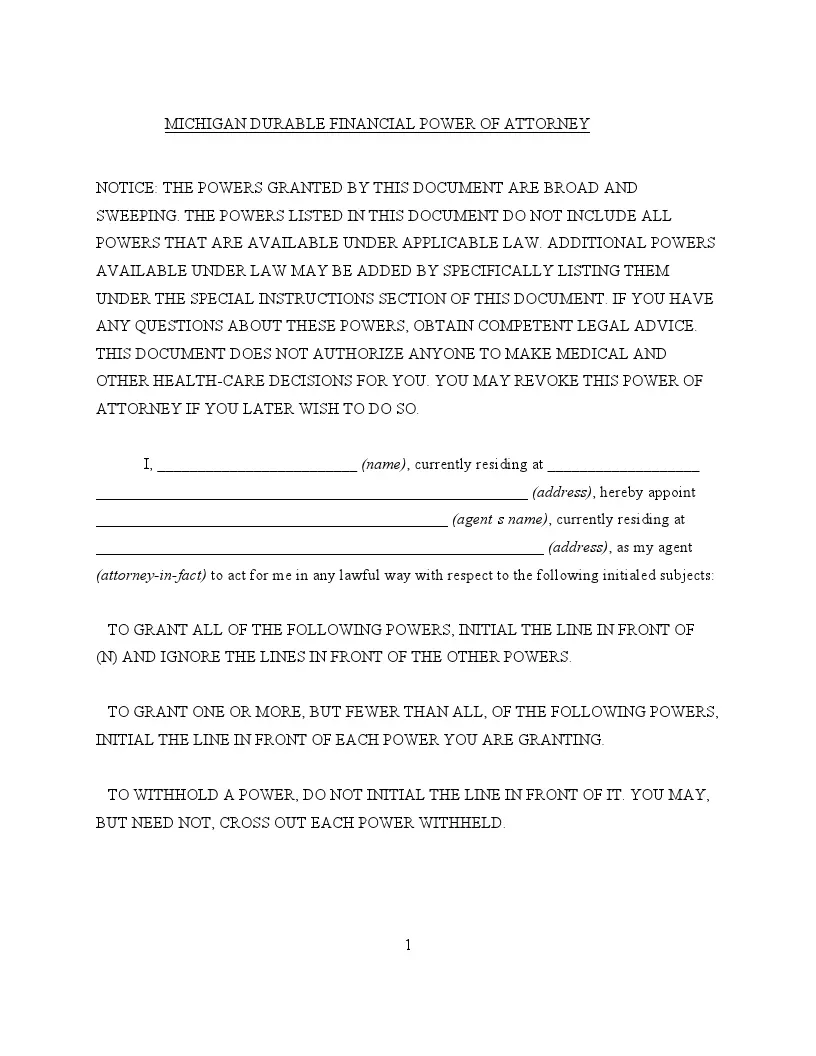
A Michigan financial power of attorney gives an agent authority to make decisions concerning the principal's property, including money, within the subjects the document lists (Mich. Comp. Laws § 556.401). The Michigan Statutory Form Power of Attorney in that section is the state's own model of this document (Mich. Comp. Laws § 556.401).
The financial power of attorney names the principal, the agent, the subjects the agent may act on, and any special instructions. The agent's authority over each listed subject is defined in the uniform power of attorney act (Mich. Comp. Laws § 556.401).
A durable power of attorney keeps the agent's authority in place while the principal is alive but incapacitated (Mich. Comp. Laws § 556.401). A power of attorney signed with a notary's acknowledgment or two witnesses, as section 556.205(2) or (3) describes, is durable unless it expressly says the principal's incapacity ends it (Mich. Comp. Laws § 556.204).
A power of attorney that is not durable ends when the principal becomes incapacitated (Mich. Comp. Laws § 556.210).
The Agent's Acknowledgment is a signed statement of duties that the agent under a durable Michigan power of attorney executes before acting under it (Mich. Comp. Laws § 556.401). Michigan publishes an optional template for it in Mich. Comp. Laws § 556.402.
The acknowledgment template lists these agent duties (Mich. Comp. Laws § 556.402):
An agent who violates the uniform power of attorney act or acts outside the granted authority may be liable for the damages caused and to civil or criminal penalties (Mich. Comp. Laws § 556.402).
The Certification as to the Validity of Power of Attorney and Agent's Authority is an optional template that an agent, or an attorney at law for the agent or the principal, uses to certify facts about a power of attorney (Mich. Comp. Laws § 556.403). The certifier signs it under penalty of perjury and states, to the certifier's knowledge, that the principal is alive and has not revoked the power or the agent's authority (Mich. Comp. Laws § 556.403).
Each Michigan power of attorney type covers a different job: money and property, health care, a child's care, real estate, taxes or a vehicle. Pick the goal that fits you, then open its card below.
Durable power of attorney form lets a Michigan resident name an agent to manage finances and related matters, and the agent's authority continues if the resident becomes incapacitated. For a Michigan power of attorney to be durable, the principal acknowledges it before a notary public or signs it in the presence of two witnesses, who also sign it (Mich. Comp. Laws § 556.205).
| Also Known As | Michigan DPOA |
| Signing Requirements | Notary Public or Two (2) Witnesses |
| Download | PDF Template |

Medical power of attorney names a patient advocate to exercise powers concerning your care, custody, and medical or mental health treatment decisions (Mich. Comp. Laws § 700.5506). Michigan law requires this form, called a patient advocate designation, to be signed in the presence of two witnesses, who also sign it (Mich. Comp. Laws § 700.5506).
| Also Known As | Health Care POA or MPOA |
| Signing Requirements | Two (2) Witnesses |
| Download | PDF Template | Michigan Durable Power of Attorney for Health Care |

General power of attorney lets someone you choose manage your finances and (or) estate together with you. Under Michigan law, a power of attorney that you acknowledge before a notary public, or sign in the presence of two witnesses who also sign it, is durable unless it expressly says that your incapacity ends it (Mich. Comp. Laws § 556.204).
| Also Known As | Generic Financial POA |
| Signing Requirements | Notary or Two (2) Witnesses Are Advised |
| Download | PDF Template |

Limited power of attorney covers specific matters and timeframes, such as handing certain powers over your finances or property to someone for a month or two. A power of attorney intended only for a specified, limited purpose ends when that purpose is accomplished (Mich. Comp. Laws § 556.210).
| Also Known As | Special POA |
| Signing Requirements | Notary Public or Two (2) Witnesses Are Recommended |
| Download | PDF Template |

Child power of attorney lets a parent or guardian delegate powers over a minor child's care, custody, or property to a temporary caregiver. In Michigan, the delegation lasts no more than 180 days and cannot include the power to consent to the child's adoption (Mich. Comp. Laws § 700.5103).
| Also Known As | Minor POA |
| Signing Requirements | Notary Public or Two (2) Witnesses Are Advised |
| Download | PDF Template | Michigan Power of Attorney (for Minor Child or Children) |

Real estate power of attorney lets an appointed agent complete several actions with your real property (rent, lease, sell, and so on).
| Also Known As | Limited Real Estate POA |
| Download | PDF Template |

State tax power of attorney (Form 151 in Michigan) lets you assign a representative who will file taxes and communicate with the local Department of Treasury for you.
| Also Known As | Tax POA |
| Signing Requirements | Grantor Only |
| Download | Form 151 |

Vehicle power of attorney (Form TR-128 in Michigan) lets residents delegate specific paperwork related to their vehicles to agents. These agents can apply to the local Secretary of State (SOS) to register vehicles on behalf of owners, receive title certificates, and complete some other operations.
| Also Known As | SOS POA |
| Signing Requirements | Vehicle Owner Only |
| Download | PDF Template | Form TR-128 |

Revocation power of attorney is the form a principal signs to end an agent's appointment. Under Michigan law, a power of attorney ends when you revoke it, but the end is not effective against your agent or another person who acts in good faith under it without knowing that it ended (Mich. Comp. Laws § 556.210).
| Also Known As | POA Termination Form |
| Signing Requirements | Notarization or Two (2) Witnesses Are Advised |
| Download | PDF Template |
A Michigan power of attorney form needs the principal, the agent, the powers granted, and any special instructions written in before anyone signs it. The steps below follow that order.
A Michigan power of attorney is effective only when the principal signs it, or when another individual, directed by the principal and in the principal's conscious presence, signs the principal's name (Mich. Comp. Laws § 556.205).
A signature on a Michigan durable, limited, or general power of attorney is presumed genuine if the principal acknowledges it before a notary public or another individual authorized by law to take acknowledgments (Mich. Comp. Laws § 556.205).
If another individual signs the principal's name, the power of attorney is durable only when signed in the presence of two witnesses, whether or not it is also acknowledged before a notary (Mich. Comp. Laws § 556.205).
A Michigan patient advocate designation is valid only when it is in writing, signed, dated, executed voluntarily, and executed in the presence of 2 witnesses, who also sign it (Mich. Comp. Laws § 700.5506).
The designation is made by an individual 18 years of age or older who is of sound mind, and it names a patient advocate who is 18 years of age or older (Mich. Comp. Laws § 700.5506). A witness shall not sign it unless the patient appears to be of sound mind and under no duress, fraud, or undue influence (Mich. Comp. Laws § 700.5506).
A witness shall not be the patient's spouse, parent, child, grandchild, sibling, presumptive heir, known devisee at the time of the witnessing, physician, or patient advocate (Mich. Comp. Laws § 700.5506). A witness also shall not be an employee of the patient's life or health insurance provider, of a health facility treating the patient, of a home for the aged where the patient resides, or of a community mental health services program or hospital providing mental health services to the patient (Mich. Comp. Laws § 700.5506).
Before it is used, the designation must be made part of the patient's medical record with the attending physician, the treating mental health professional, the facility where the patient is located, or the mental health program or hospital providing services, as applicable (Mich. Comp. Laws § 700.5506).
A Michigan child power of attorney lets a parent or guardian delegate powers over a minor child's care, custody, or property to another person for a period not exceeding 180 days (Mich. Comp. Laws § 700.5103).
The child power of attorney cannot delegate the power to consent to the child's adoption or to release the child for adoption (Mich. Comp. Laws § 700.5103).
If a parent or guardian is serving in the United States armed forces and is deployed to a foreign nation, and if the power of attorney so provides, the delegation lasts until the thirty-first day after the deployment ends (Mich. Comp. Laws § 700.5103).
If a guardian of a minor delegates a power this way, the guardian shall notify the court within 7 days after the power of attorney is executed and give the court the agent's name, address, and telephone number (Mich. Comp. Laws § 700.5103).
A Michigan power of attorney ends when any of these events occurs, as listed in Mich. Comp. Laws § 556.210:
An agent's authority also ends when an action is filed to dissolve or annul the agent's marriage to the principal, or for their legal separation, unless the power of attorney provides otherwise (Mich. Comp. Laws § 556.210).
A revocation ends the power of attorney, but the end is not effective as to the agent or another person who, without actual knowledge of it, acts in good faith under the power (Mich. Comp. Laws § 556.210). An act done that way binds the principal and the principal's successors, unless it is otherwise invalid or unenforceable (Mich. Comp. Laws § 556.210).
A Michigan power of attorney is the document that lets another person act for you on money, property, health care or a child's care. A power of attorney that is not durable ends if you become incapacitated, so a durable form is the one that covers that event (Mich. Comp. Laws § 556.210).
A durable, general, or limited power of attorney covers financial matters. Choose a limited form when the authority is for a specific matter or a short period. Choose a durable or general form for broader management of your finances and estate.
A Michigan financial power of attorney is durable if it is either acknowledged before a notary or signed before two witnesses who also sign it, so a notary is one of two options (Mich. Comp. Laws § 556.205). A patient advocate designation is executed in the presence of 2 witnesses (Mich. Comp. Laws § 700.5506).
A Michigan agent handles the principal's money only within the authority the power of attorney grants. The agent's duties include acting in good faith and keeping reasonable records of receipts, disbursements, and transactions (Mich. Comp. Laws § 556.402).
A Michigan POA does not lapse with time: unless the document provides otherwise, the agent's authority lasts until it terminates, however long ago the power was signed (Mich. Comp. Laws § 556.210).
A second Michigan power of attorney leaves the first one in force unless the second says that the earlier power, or all other powers, are revoked (Mich. Comp. Laws § 556.210).
POA templates are some of the most frequently used ones in the USA. Here are some of the more requested power of attorney forms.

Other fillable Michigan templates readily available for download on our site and that can be modified in our simple document constructor.
General information, not legal or tax advice.
