
A Michigan vehicle bill of sale is a written record of a vehicle sale. It names the seller and buyer, describes the vehicle and states the price and the date of the sale. Download the free template as a PDF or fill it out online, then keep a signed copy for your records.
Last Updated: October 2026. This guide is reviewed and updated regularly to reflect current Michigan law. If you notice an error or outdated information, please contact us.
Build Your Document
Answer a few simple questions to make your document in minutes
Save and Print
Save progress and finish on any device, download and print anytime
Sign and Use
Your valid, lawyer-approved document is ready
| Document Name | Michigan Vehicle Bill of Sale Form |
| Other Names | Michigan Car Bill of Sale, Michigan Automobile Bill of Sale |
| DMV | Michigan Office of Secretary of State |
| Title Transfer Deadline | Within 15 days from the date of the sale[2] |
| Avg. Time to Fill Out | 7 minutes |
| Form Length | 4 pages |
FormsPal has Michigan bill of sale templates for a motor vehicle, a boat, a firearm and general personal property. Each card below says what the form records and offers a free PDF download. For other kinds of property, browse all bill of sale forms.
Michigan bill of sale for a motor vehicle records the sale of a car, truck or other vehicle between two parties. It lists the seller, the buyer, the vehicle, the price and the date of the sale.
| Alternative Name | Car Bill of Sale |
| Seller’s Signature | Signature line on the form |
| Buyer’s Signature | Signature line on the form |
| Notarization | Acknowledgment page on the form |
| Download | PDF Template |

A Michigan boat bill of sale records the change of ownership when a boat is sold. It lists the boat, the seller, the buyer, the price and the date of the sale.
| Alternative Name | Vessel Bill of Sale |
| Seller’s Signature | Signature line on the form |
| Buyer’s Signature | Signature line on the form |
| Notarization | Check the form |
| Download | PDF Template |

Michigan bill of sale for a firearm records a gun transfer between two parties. It lists the firearm, the seller, the buyer, the price and the date of the transfer.
| Alternative Name | Gun Bill of Sale |
| Seller’s Signature | Signature line on the form |
| Buyer’s Signature | Signature line on the form |
| Notarization | Check the form |
| Download | PDF Template |

Michigan general bill of sale records the sale of any kind of personal property, such as tools or equipment. It gives both sides a written record of a private sale.
| Alternative Name | Generic Bill of Sale |
| Seller’s Signature | Signature line on the form |
| Buyer’s Signature | Signature line on the form |
| Notarization | Check the form |
| Download | PDF Template |
Michigan has no statute that requires a bill of sale, and no statute requires one to be notarized. One Michigan statute does define a “record of the sale”. Here is its text:[1]
Maintain a record of the sale for not less than 18 months. As used in this subdivision, "record of the sale" means either a photocopy of the reassigned title or a form or document that includes the name, address, driver license number, and signature of the person to whom the vehicle is sold and the purchase price and date of sale of the vehicle.
In plain words, a record of the sale is either a photocopy of the reassigned title or a form or document. It shows the name, address, driver license number and signature of the person the vehicle is sold to. It also shows the purchase price and the date of sale.
Our template has lines for the buyer’s name, address, signature, the price and the date of the sale. It has no line for a driver license number.
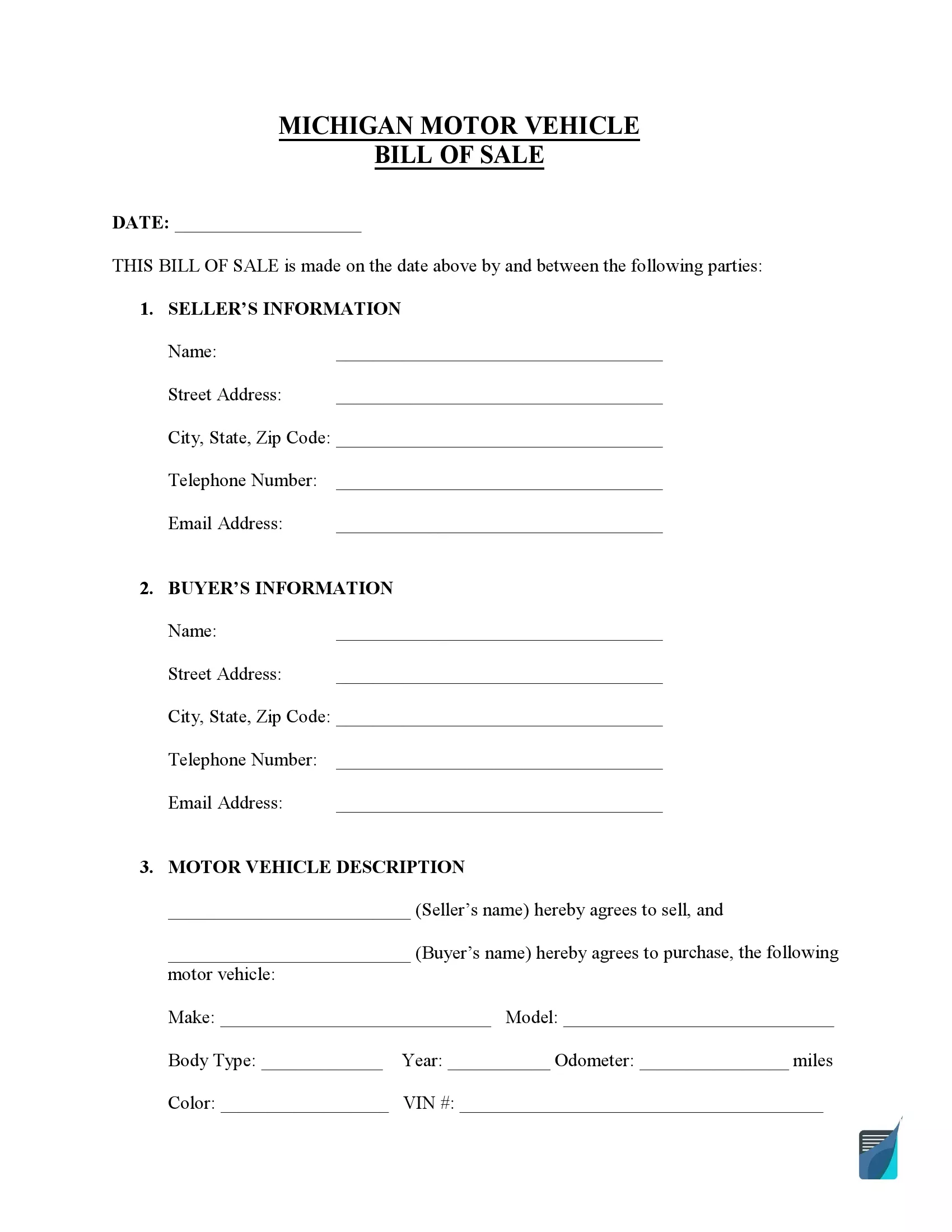
The steps below follow the Michigan motor vehicle bill of sale template on this page. They run from the date on page 1 to the acknowledgment on page 4. The form names two parties, the seller and the buyer. Fill in each part in the order the form shows it.
You can create the form online, print the PDF and write it by hand, or fill in the PDF with our PDF editor.
Step 1: Date
Enter the date of the bill of sale on the DATE line at the top of page 1.
Step 2: Seller’s Information
Enter the seller’s name, street address, city, state, zip code, telephone number and email address.


Step 3: Buyer’s Information
Enter the same details for the buyer: name, street address, city, state, zip code, telephone number and email address.

Step 4: Motor Vehicle Description
Write the seller’s and the buyer’s names in the sentence at the top of this part. Then fill in these fields:


Step 5: Purchase Date and Price
On page 2, enter the purchase date and the total purchase price in U.S. dollars.

Step 6: How the Price Is Paid
Tick one box: all at once on the purchase date, a trade-in by the buyer, a deposit with the balance due later, or a gift with no payment. For a trade-in, fill in the buyer’s vehicle. For a deposit, fill in the amount, its date and the date the balance is due.
Step 7: Payment Method and Taxes
Select cash, check (add the check number), cashier’s check or money order. Then tick whether taxes are included in the purchase price.
Step 8: Miscellaneous Provisions
On page 3, read the paragraphs before you sign. This part has nothing to fill in. The seller confirms ownership and no liens. The sale is as is, and the form is the only agreement between the two parties.
Step 9: Signatures
Both parties and the witness each sign, print their name and date their line on page 3. The parties are the seller and the buyer.
Step 10: Acknowledgment
Page 4 holds an acknowledgment for a notary. If you want the form notarized, sign before the notary. The notary fills in the rest, and the completed page is sealed.
After a private sale, the buyer must take the signed title to the Secretary of State and have it transferred into their own name. The Michigan Secretary of State says to transfer the title within 15 days from the date of the sale.[2] You can count the days with our deadline calculator.
The Michigan Secretary of State lists these points for the transfer:[2]
Bring your completed and signed vehicle bill of sale too, as a record of the price and the date. The state can change its list, so check the current requirements before you go.
To drive the vehicle on public roads in Michigan, it must be registered with a license plate and tab, have an assigned title and be insured with Michigan No-Fault insurance, so bring proof of valid No-Fault insurance when you register it.[2]
Michigan collects 6% sales tax on the full purchase price or the fair market value of the vehicle, whichever is greater.[2]
Selling a boat instead? See our Michigan boat bill of sale page.
Used to prove the ownership of the vehicle or vessel when the title is lost, destroyed, or stolen.

It discloses the vehicle’s odometer reading and should be attached to your bill of sale.

Used to inspect whether an assembled vehicle is eligible for titling.

Use this form if you want to appoint another person to register your purchased vehicle.

The seller must obtain parental permission to sell a vehicle to a minor.

Form TR-207 is the Secretary of State bill of sale for a trailer, watercraft, snowmobile or ORV.

Used to certify that the watercraft ownership is transferred to the buyer and that the watercraft is free of all liens.

Used when one buyer purchases multiple firearms on the same purchase date.

A bill of sale records the sale, and the title transfer follows its own steps. The answers below cover who signs, the lien, the odometer statement, the sale price and the title deadline for a private vehicle sale in Michigan.
If there is more than one owner on the title, all the owners must sign it before it can be transferred into the buyer’s name.[2] Our bill of sale template has signature lines for both parties and a witness.
If there is a lien on the vehicle, the Michigan Secretary of State lists the lien termination statement or the title signed by the lienholder.[2] The lienholder is the lender that holds the lien. Our template also has a line where the seller confirms that the vehicle has no liens.
The seller must complete the odometer statement.[2] Our template has a line for the odometer reading in miles. The Relevant Official Forms list above also includes the state’s Odometer Mileage Statement.
Michigan has no statute that prescribes what a bill of sale must contain. A seller who keeps a written record of the sale instead of a photocopy of the reassigned title must include the buyer’s name, address, driver license number and signature, the purchase price and the date of sale (MCL 257.240(2)(b)).[1] Our template has a line for each of these except the driver license number.
The Michigan Secretary of State says to transfer the title within 15 days from the date of the sale.[2]

Other Michigan Forms
General information, not legal or tax advice.


