
A Michigan eviction notice is a written notice a landlord serves on a tenant to end the tenancy for nonpayment of rent, drug-related activity, or without cause.[2][1] In practice, landlords also use one for other lease violations, and the notice comes before any eviction case in court. The notice states the ground for eviction and the number of days the tenant has to pay, fix the problem, or move out.
Last Updated: September 2026. This guide is reviewed and updated regularly to reflect current Michigan law. If you notice an error or outdated information, please contact us.
Build Your Document
Answer a few simple questions to make your document in minutes
Save and Print
Save progress and finish on any device, download and print anytime
Sign and Use
Your valid, lawyer-approved document is ready
There are several types of eviction notice templates, and Michigan law sets a different notice period for each ground. Use our form-building software below to complete the correct Michigan eviction notice for your situation.
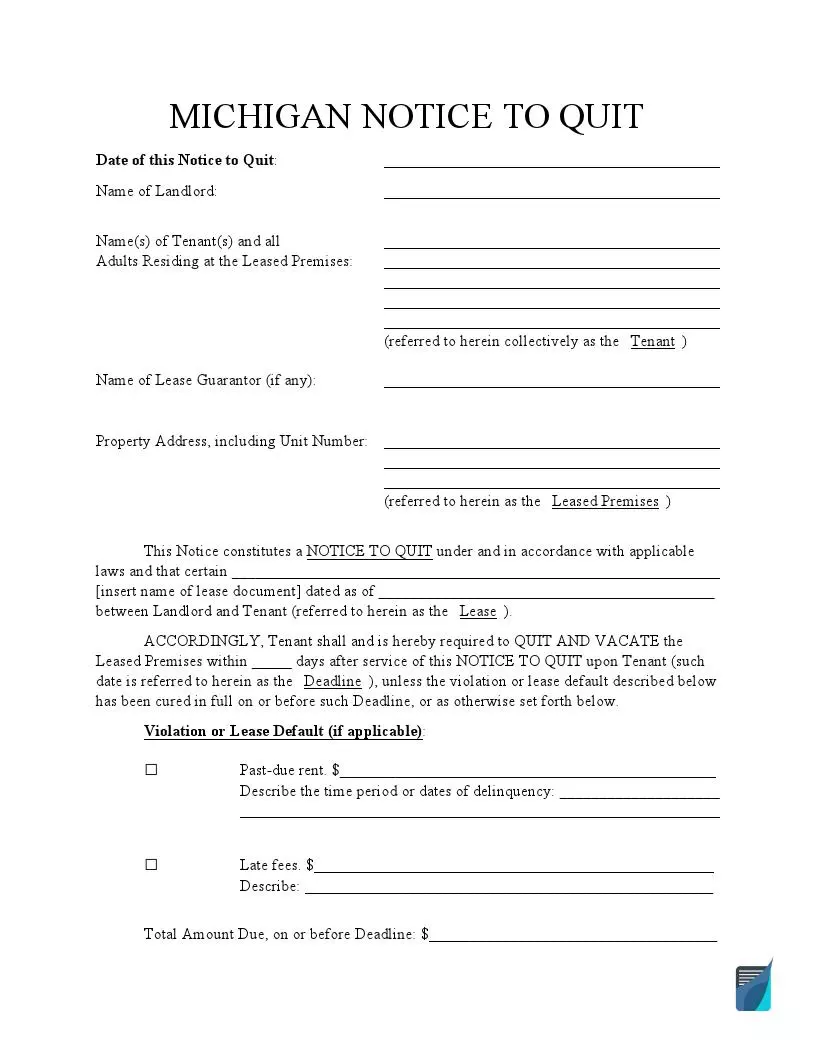
In practice, a completed notice lists the names of the landlord and tenant, the rental property address, the reason for the notice, and the date the tenant must respond by.
A Michigan eviction notice is also called a "notice to quit" or a "notice to vacate." All three names refer to the same document.
Michigan's eviction rules come from two main sources. Section 554.134 of the Revised Statutes of 1846 covers notice periods for ending a tenancy, and Chapter 57 of the Revised Judicature Act of 1961 covers the court process a landlord follows to remove a tenant. Notice periods range from 24 hours to 1 month depending on the reason for eviction.
| Rent Grace Period | Not specified |
| Notice of Non-Payment | 7 days |
| Notice of Non-Compliance | 7 days |
| No-Cause (Month-to-Month) | 1 month |
| State Laws | Michigan Compiled Laws, Sections 554.131 to 554.139 |
Michigan law recognizes several eviction notice grounds, each with its own required notice period.[2] A landlord chooses the notice type that matches the reason for eviction, whether that is unpaid rent, a lease violation, drug-related activity on the property, physical injury or threats, property damage, or ending a tenancy without cause. The notice period ranges from 24 hours to 1 month depending on the ground.
7-Day Notice to Quit (for Non-Payment)
This notice can help if a renter did not pay rent on time. The tenant must get written notice at least 7 days before an eviction for nonpayment of rent.[2]
1-Month Notice to Quit (for Month-to-Month Lease Agreements)
If a landlord wants to end a month-to-month tenancy without cause, Michigan law requires at least 1 month of advance notice before the tenant must move out.[1]
24-Hour Notice to Quit (for Illegal Drug-Related Issues)
If a tenant, a household member, or another person under the tenant's control has unlawfully manufactured, delivered, possessed with intent to deliver, or possessed a controlled substance on the property, a landlord may act on this ground. The notice gives the tenant 24 hours to leave, and it applies only if a formal police report has been filed alleging the conduct.[2]
7-Day Notice to Quit (for Non-Compliance)
If a tenant has broken any condition of a lease agreement and the situation cannot be improved, a landlord may send this kind of notice, giving the tenant no less than seven days.
7-Day Notice for Property Damage or a Health Hazard
If a tenant willfully or negligently causes a serious and continuing health hazard, or extensive and continuing physical damage to the property, discovered no earlier than 90 days before the case is filed, the landlord may demand possession. The tenant then has 7 days to move out or to substantially restore or repair the property.[2]
7-Day Notice for Physical Injury or Threats
If the tenant, a household member, or a person under the tenant's control has caused or threatened physical injury to someone on property owned or operated by the landlord, the landlord may serve a written notice to quit. The tenant then has 7 days to leave once the notice has been served.[2]
As a landlord in Michigan, you may need to start an eviction case after the notice period ends and the tenant has not paid, fixed the problem, or moved out. Here is a brief guide to the steps you take to evict a tenant.
Choose the notice form that matches your reason for eviction, complete it, and serve it on the tenant.
When you have sent a notice to a renter, he or she should react somehow: either improve the situation if it is possible or leave the leased property. In practice, if you get no response once the notice period ends, the next step is filing with the court.
In practice, after the filing the tenant receives a summons. He or she will be able to respond and submit to the court one of the legal forms used in such cases.
There are cases when a renter does not respond to the notice or the summons. In practice, the court then rules, and a ruling for the landlord orders the tenant to leave. In practice, once possession is ordered and the tenant has not moved out, the landlord asks the local sheriff to enforce the order.
Filing an eviction case in Michigan district court requires completing and submitting several official forms, each used for a different stage of the case, from the initial notice to quit through the final order of eviction. The state court system publishes these forms, and each one has an official DC form number you can reference when you file.
This form is required for the completion of eviction if a tenant does not leave after the court has decided so. An owner should show this document to the sheriff. This application in Michigan is also referred to as the DC 107 Form.
If a renter was accused of ruining something in the property or there is a threat to health, he or she may complete this form to answer in the court. This template is officially named DC 111b.
It is a document that a renter receives if an owner files with the court. This form is officially called DC 104 in Michigan.
For replying in the court about the payment delay, a renter has to submit this form. In Michigan, another name of the template of this form is DC 111a.
With this form, an owner starts the trial in the court. In Michigan, another name of this form's template is DC 102c.
It is one of the forms that a renter should use to respond to accusations in court. This form is also known as DC 111c.
A no-cause termination in Michigan, such as ending a month-to-month tenancy, requires at least 1 month of advance notice under state law. If rent is paid more often than every 3 months, for example weekly or monthly, the notice period only needs to match the interval between rent payments.[1] Either the landlord or the tenant may end the tenancy this way.
Yes. A landlord may only use the physical-injury ground for eviction if the police department with jurisdiction has been notified that the person, on property owned or operated by the landlord, caused or threatened physical injury to someone. Two exceptions apply. The ground does not apply if the person injured or threatened is the tenant or a household member, or if using it would violate federal housing regulations.[2]
No. A tenant or occupant of housing operated by a city, village, township, or other unit of local government is not treated as holding over unless the tenancy has been terminated for just cause. That just cause must follow the lawful rules of the local housing commission or state law.[2] This just-cause protection applies in addition to the standard notice-to-quit grounds.
No. A tenant of a mobile home park is not treated as holding over unless the tenancy or lease agreement is terminated for just cause under Michigan's mobile home law, Chapter 57a.[2] This protection works alongside the standard notice-to-quit grounds covered above, and it does not remove the landlord's right to evict for nonpayment of rent or a lease violation.
Michigan law does not allow a landlord to force a tenant out without going through the court process. A landlord may not take possession by forcible entry, hold possession by force after a peaceable entry, or take possession by trespass without a lease, court order, or other legal right to the property.[2] Changing the locks, shutting off utilities, or removing a tenant's belongings outside of a court-ordered eviction is unlawful self-help.

General information, not legal or tax advice.
Unless noted otherwise, the sources below are from the Mich. Comp. Laws.
