
An Ohio eviction notice is a written notice a landlord serves on a tenant to end the tenancy for nonpayment of rent, a lease violation, or without cause, before filing an eviction case in court.[1] The eviction notice template is drafted for the landlord’s interests, not the tenant’s, and it starts the deadline the tenant has to fix the problem or move out.
Last Updated: September 2026. This guide is reviewed and updated regularly to reflect current Ohio law. If you notice an error or outdated information, please contact us.
Build Your Document
Answer a few simple questions to make your document in minutes
Save and Print
Save progress and finish on any device, download and print anytime
Sign and Use
Your valid, lawyer-approved document is ready
A landlord may send this notice for unpaid rent, a violation of the lease, or to end a month-to-month tenancy without giving a reason. The notice sets a deadline. If the tenant does not act by then, the landlord can file the eviction case in court.[1]
An Ohio eviction notice is also called a notice to quit, a notice to vacate, or a pay or quit notice. All of these names refer to the same document.
Ohio eviction law requires a landlord to give the tenant written notice before filing an eviction case in court. For most Ohio evictions the landlord must give the tenant at least three days written notice to leave before starting the court case. The notice can be delivered by certified mail with return receipt requested, handed to the tenant in person, or left at the tenant’s home or at the rental property.[1]
Several sources govern the eviction process in Ohio, including:
Ohio law also bars a landlord from denying or making housing unavailable because of race, color, religion, sex, military status, familial status, ancestry, disability, or national origin.[4] In practice, a tenant who reports unsafe housing conditions to a housing authority is protected from retaliation.
| Rent Grace Period | Not specified |
| Notice of Non-Payment | 3 days |
| Notice of Non-Compliance | 3 days |
| No-Cause Notice (Month-to-Month Tenancy) | 30 days |
| State Laws | Ohio Revised Code, Chapter 1923 |
A landlord may not force a tenant out by self-help. Ohio law bars a landlord from cutting off utilities, changing the locks, threatening the tenant, or taking any other action to recover the rental unit outside of the eviction notice and court process the law sets out.[2]
A landlord who locks out a tenant, shuts off utilities, or removes belongings without a court order is not following Ohio law, even if the tenant is behind on rent or violated the lease.
Ohio law also requires a notice to recover residential premises to contain specific warning language, printed or written conspicuously:
You are being asked to leave the premises. If you do not leave, an eviction action may be initiated against you. If you are in doubt regarding your legal rights and obligations as a tenant, it is recommended that you seek legal assistance.
An eviction notice in Ohio must be in writing and must carry the conspicuous statutory wording the law prescribes.[1] The three day notice under that section applies whatever the reason for the eviction, and ending a month to month tenancy takes a separate thirty day notice.[3]
30-Day Notice to Terminate a Month-to-Month Tenancy
Either the landlord or the tenant may use this notice to end a month-to-month tenancy without stating a reason. It is not an eviction notice on its own because it does not allege a lease violation. It simply tells the other party the tenancy will end in at least 30 days.[3]
3-Day Notice to Quit for Non-Compliance
This notice tells the tenant which part of the lease was broken and gives the tenant three days to fix the problem or move out.[1] Common examples include an unauthorized pet, unauthorized occupants, or a condition that threatens the health or safety of other residents. The notice should describe the violation in as much detail as possible.
3-Day Notice to Quit for Non-Payment of Rent
A landlord uses this notice when rent is late or unpaid. It should state the amount owed, the deadline to pay, and how to pay it. The tenant has three days to pay in full or move out.[1]
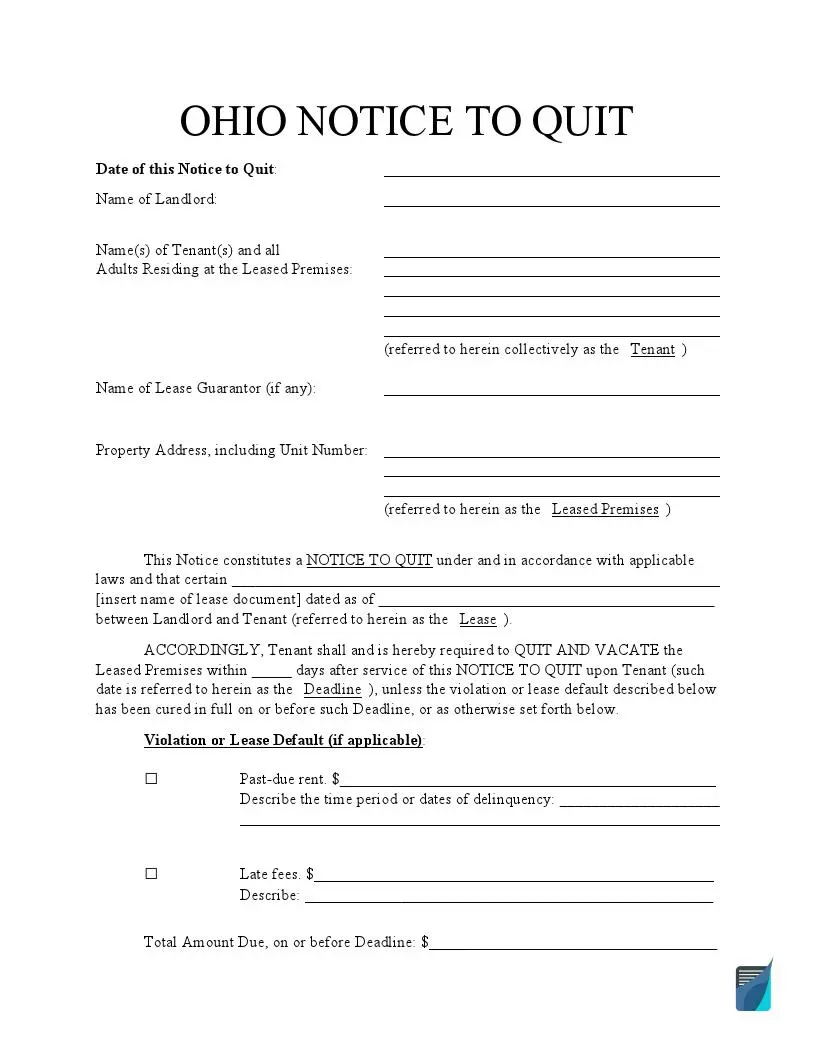
This is an exact preview of the Ohio eviction notice generated by FormsPal. It matches the printable PDF version, including the statutory warning language Ohio law requires on a notice to recover residential premises, and the blank fields a landlord fills in before delivering it to the tenant.

OHIO
Pursuant to Ohio Revised Code 1923.04
TO: |
, Tenant; |
, Tenant |
|
, Tenant, |
And all other occupants |
The purpose of this letter is to demand that you vacate (LEAVE) the premises now in your
possession located at, in
_______________ Township, ____________________ County, Ohio on or before THE THIRD
DAY AFTER THE SERVICE OF THIS NOTICE. Premises means the structure, or living unit that you have been renting as well as any lot of land included in the rental agreement.
This demand is based upon the reason(s) checked below:
Failure to pay rent and other obligations: |
$ |
, rent |
|
$ |
, rent |
|
$ |
, other |
YOU ARE BEING ASKED TO LEAVE THE PREMISES. IF YOU DO NOT LEAVE, AN EVICTION ACTION MAY BE INITIATED AGAINST YOU. IF YOU ARE IN DOUBT REGARDING YOUR RIGHTS AND OBLIGATIONS AS A TENANT, IT IS RECOMMENDED THAT YOU SEEK LEGAL ASSISTANCE.
, 20____ |
, Landlord |
|
, Address |
|
, Phone |
|
|
|
|
Ohio law sets out the steps a landlord must follow to evict a tenant, and it bars removing the tenant without going through them.[2] The process starts with a written notice and, if the tenant does not comply, moves to a filing in eviction court.[1]
Ohio eviction cases use several court forms in addition to the eviction notice itself. The landlord starts with a complaint, the court issues a summons, and, if the landlord wins, the court issues a writ of execution ordering the tenant to leave.
It’s the main eviction document without which the eviction process can’t be completed lawfully.
The Complaint Form contains accusations of the owner on the renter’s behavior in relation to the owner’s property. All possible details must be given.
In this form, the owner states the fact of issuing the lawsuit against the renter.
The last owner’s warning to the renter is saying he has to leave the owner’s property as soon as possible if he doesn’t want to have problems with the law.

General information, not legal or tax advice.
Unless noted otherwise, the sources below are from the Ohio Rev. Code Ann..
