
A Missouri eviction notice is a written notice a landlord serves on a tenant to end a tenancy for nonpayment of rent, a lease violation, or without cause, before the landlord can file an eviction case in court. A landlord commonly sends this notice when:
Last Updated: October 2026. This guide is reviewed and updated regularly to reflect current Missouri law. If you notice an error or outdated information, please contact us.
Build Your Document
Answer a few simple questions to make your document in minutes
Save and Print
Save progress and finish on any device, download and print anytime
Sign and Use
Your valid, lawyer-approved document is ready
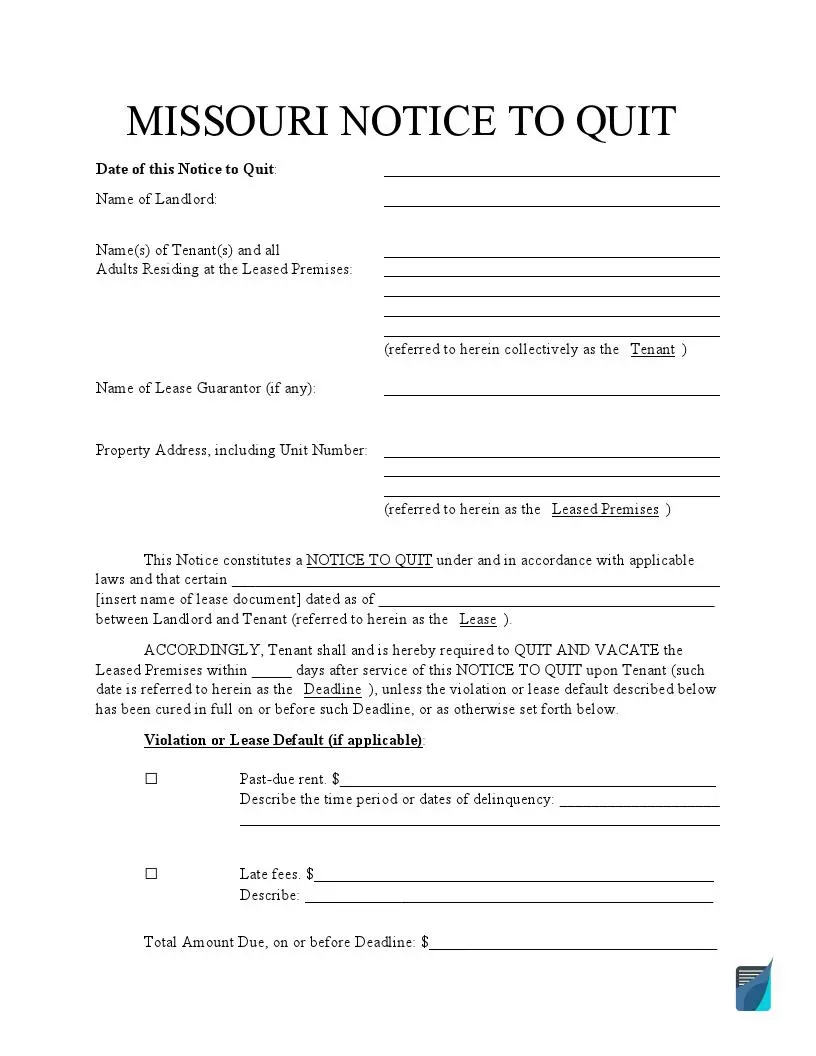
Every eviction notice includes a similar set of details, though exact requirements vary by state and county.
Missouri eviction law lives mainly in Chapter 535 and Chapter 441 of the Missouri Revised Statutes. To evict for nonpayment, a landlord must first demand the rent before filing a sworn statement with the court.[4] To evict for a lease violation covered by Section 441.020 or 441.030, the landlord must give the tenant ten days' written notice before retaking the property.[1] To end a tenancy without cause, including a month-to-month or no-lease rental, the landlord must give the tenant one month's written notice.[2]
Missouri law sets no grace period for late rent. Once rent is in default on the date the parties agreed and the landlord has demanded it, the landlord may file a rent and possession case without first giving the one-month notice used for no-cause terminations (Mo. Rev. Stat. §§ 535.010, 535.020).[5]
| Notice for Lease Violation | 10 days |
| Notice for No-Cause Termination | 1 month |
| Self-Help Eviction by Landlord | Not allowed |
| State Laws | Missouri Revised Statutes, Chapter 441 |
This document goes by several names, including notice to vacate and notice to quit. For a nonpayment case, some landlords call it a 3-day or 5-day notice, based on how much time they choose to give the tenant to pay before filing in court.
Missouri landlords use three common eviction notices, based on why the tenancy is ending. A no-cause notice, sometimes called a 30-day notice, gives the tenant one month.[2] A lease-violation notice gives the tenant ten days.[1] A notice for unpaid rent tells the tenant that payment is due before the landlord files in court.[4]
To evict a tenant in Missouri, the landlord first serves the required notice, then files a sworn statement with an associate circuit judge in the county where the property is located if the tenant does not comply. The court clerk then issues a summons naming the tenant and every other occupant of the property, requiring them to appear and show why the landlord should not regain possession.[4]
Follow these steps to evict a tenant in Missouri:
After a judgment for the landlord in a rent and possession case, the court issues an execution and the officer delivers possession within five days of receiving it. A tenant who applies for a trial de novo or appeals must post a bond covering damages, costs, and rent due within ten days of the judgment to stay the eviction while the appeal is pending (Mo. Rev. Stat. §§ 535.040, 535.110).[6]
No. Missouri law does not allow a landlord to remove a tenant or the tenant's belongings from the property without going through the courts first. A landlord who locks a tenant out, removes doors, or shuts off utilities without judicial process and a court order can be held liable for forcible entry and detainer. Missouri statutes describe forcible entry and detainer in Chapter 534, and a landlord found liable under it can face legal consequences for retaking the property this way.[3]
Changing the locks, removing doors, or cutting off water or power to force a tenant out is not allowed unless a court has issued an order and the eviction has gone through the legal process.[3]
When a Missouri eviction case goes to court, the paperwork usually includes a petition that starts the case and a writ that enforces the judgment. The petition must state the lease terms and the rent owed, and it may also include other unpaid amounts owed under the lease, other than property damage.[4]
Writ of Possession. If the court rules for the landlord, this form directs the sheriff to remove the tenant from the property. In a rent and possession case the officer must deliver possession to the landlord within five days of receiving the execution, and in an unlawful detainer case the execution to restore possession cannot issue until ten days after the judgment (Mo. Rev. Stat. §§ 535.040, 534.350).[7]

General information, not legal or tax advice.
Unless noted otherwise, the sources below are from the Mo. Rev. Stat..
