
A Missouri last will and testament is a document containing the last directions of its creator (called the testator). This legal instrument outlines how and by whom the testator’s assets will be allocated in the event of their death.
To be valid in this state, a last will must be signed by the testator in the presence of two competent witnesses, who should also sign the document afterward.[2] You have the option to notarize the document and make the will self-proving, which removes the need for witness testimony during probate.[1.1]
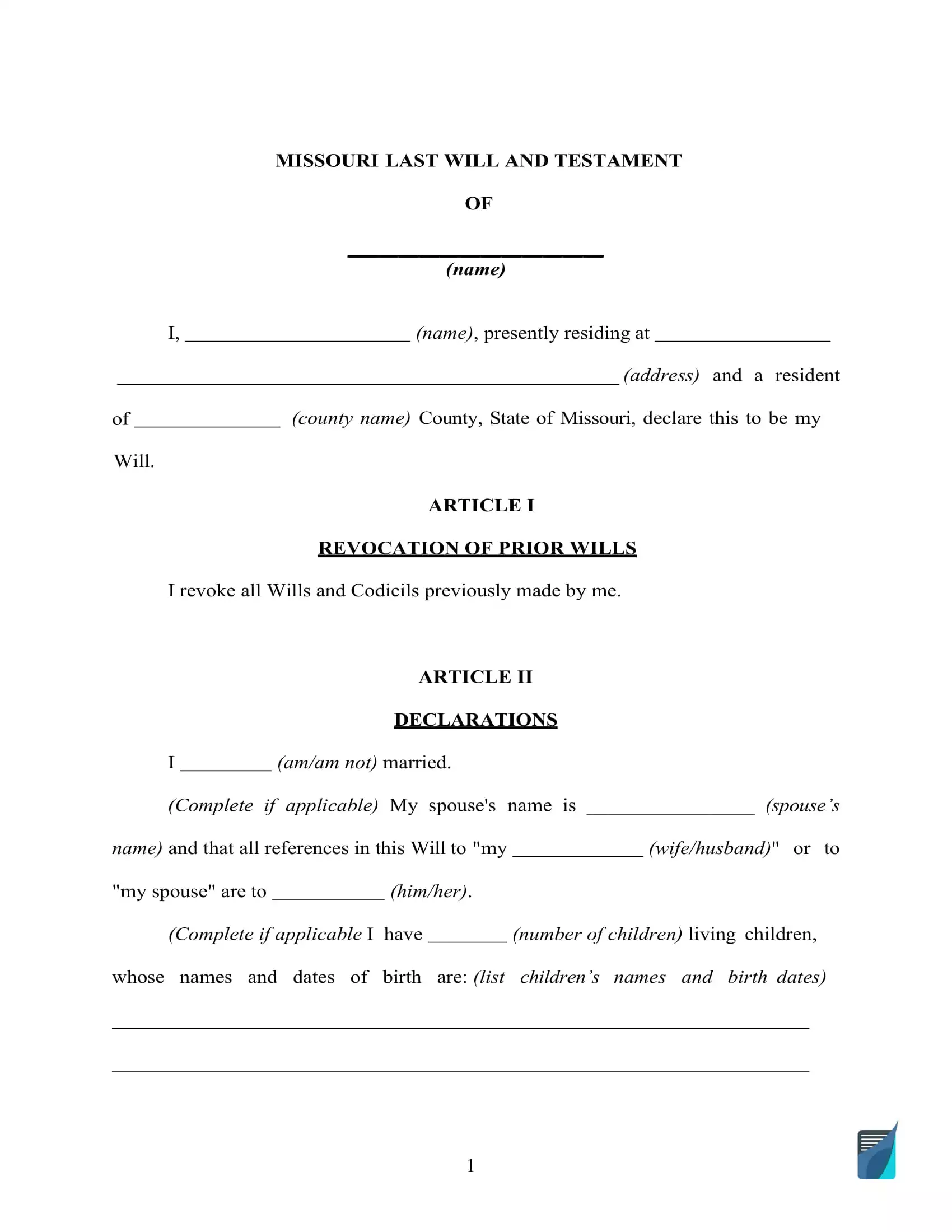
Here, we provide you with a fillable Missouri will template that you can download as a PDF or a DOC file. Additionally, you will find answers to some of the frequently asked questions, along with relevant laws and will requirements for this state.
A Missouri last will and testament is sometimes called simply a "will" or a "last will." Many people pair it with a living will and a power of attorney to form a more complete Missouri estate plan.
Build Your Document
Answer a few simple questions to make your document in minutes
Save and Print
Save progress and finish on any device, download and print anytime
Sign and Use
Your valid, lawyer-approved document is ready
This overview of Missouri wills sets out the rules for creating a valid document, including who can make a will, how many witnesses must sign it, and whether notarization is required. The table below summarizes the state statutes for signing, witnessing, self-proving affidavits, and other requirements under the Missouri Probate Code.
Last Updated: September 2026. This guide is reviewed and updated regularly to reflect current Missouri law. If you notice an error or outdated information, please contact us.
| Requirements | State laws | |
| Statutes | Chapter 474 – Probate Code – Intestate Succession and Wills | |
| Definitions | 472.010. Definitions | |
| Signing requirement | Two witnesses | 474.320. Will form, execution, attestation |
| Age of testator | 18 or older (or emancipated minor) | 474.310. Who may make will |
| Age of witnesses | 18 or older | 474.330. Who may witness will — effect of interest in will |
| Self-proving wills | Allowed | 474.337. Written will self-proved, how |
| Handwritten wills | Recognized if witnessed according to the state's requirements | 474.320. Will form, execution, attestation |
| Oral wills | Recognized if meeting certain conditions | 474.340. Nuncupative wills |
| Holographic wills | No statutes | |
| Depositing a will | Possible with the probate division of any circuit court in a Missouri county | 474.510. Deposit of will in court in testator’s lifetime |
1. Think about your alternatives. Think about whether you want to write the whole document by hand, known as a holographic will, or work with a fillable will template available in PDF and DOC formats. You can also use our builder to create a personalized document by answering a series of simple questions. If your estate is quite large, you can also consult with a law firm beforehand.
2. Indicate your details. Establish the testator and their particulars: full legal name and address (city, county, and state). Go over the information you wrote along with the rest of the content to see if everything is correct.

3. Designate the executor. This is the time to select the executor (personal representative) of your will. This person will be responsible for paying any outstanding debts and making sure your beneficiaries get what you bequeathed them. Specify the executor’s full legal name, as well as their residential information (city, county, and state).
Be sure to appoint somebody who lives in the same state as you do. If you don’t, there will be extra red tape in the process as a consequence of special regulations this state has relating to out-of-state executors. It could happen that your main representative will be unable to carry out your will due to an illness, death, disinclination, or other factors. To be on the safe side, you can decide on another executor by indicating the same details you did for the primary one.
Restrictions regarding executors in Missouri:
(For more details see 473.117)
Some US states make it illegal for anyone with a felony conviction to serve as an estate executor. Missouri does not: a person convicted of a crime in this state is qualified to serve as executor after completing their prison sentence in full and meeting all conditions of parole.

4. Choose the guardian (optional). In practice, naming a guardian in the will keeps that choice from falling to a court.

5. Specify your beneficiaries. At this stage, you should indicate people who will receive your assets. Enter their full names, places of residence, and your relationship with them (spouse, child, friend).
6. Allocate your property accordingly. Write down your assets and explain how you want to distribute them among your inheritors. Shared assets and your life insurance can’t be put into your will.

7. Sign the will and have it witnessed. Missouri Revised Statutes stipulate that at least two witnesses have to sign a will for it to be viewed as legally binding.[2] Only someone who is of 18 years or older and is not among your beneficiaries (not mandatory but preferable due to some possible complications) could be picked as a witness.
It might be wise to name a witness who’s younger than you to be sure they will be there after you depart this life. After a thorough review of each paragraph in your will, all parties involved (you and your two witnesses) must fill out their names and full addresses and sign the will.


These are the questions readers ask most often about Missouri wills, including notarization, holographic wills, testamentary capacity, and a spouse's right to an inheritance. Each answer below reflects current Missouri rules, and cites the relevant statute where the fact pack verifies one.
In Missouri, a holographic will (fully handwritten by the testator) is valid only if witnessed by two competent adults and signed by the testator. So, it is better to go for a typewritten will in the end because holographic wills are prone to dispute. In practice, they are easier to contest than properly drafted ones.
The testator must fulfill testamentary capacity prerequisites in order to create and modify their will, including being of sound mind. The latter indicates that there aren’t any kinds of psychiatric disorders (dementia, senility, insanity, etc.) that prevent you from realizing fully the aftermaths of your doings. To be testamentary capable you have to:
No, Missouri does not require a self-proving affidavit. You can add one when you sign the will or later.[1.1][1.2] Attaching one is still useful. The testator and both witnesses appear before a notary public or officer authorized to administer oaths and, having been first duly sworn, declare that the testator executed the will as a free and voluntary act, and sign the affidavit.[1.1] Doing so removes the need for witness testimony during probate. In practice, witnesses are called on only if the will is contested.
No, you cannot (474.160). In Missouri, if you are married, you can’t entirely disinherit your spouse. The only way is if the spouse agrees to waive their rights to your assets by signing a prenuptial agreement or another similar contract that can be legally enforced in this state.
Yes, you can. Any person who wrote a will is allowed to alter or cancel his or her last will and testament anytime until their death. Use a codicil for something small, such as changing the name of your executor or adding a new piece of property to someone’s share. For bigger changes, creating a new will is recommended by most experts.
| Related documents | Instances when you might need to create one |
| Codicil | You want to slightly modify your last will without creating a new document from scratch. |
| Self-proving affidavit | You want the probate to be faster when the time comes. |
| Living will | You want to make sure that, if you become incapacitated, you are treated the way you’d like to. |
| Living trust | You want additional protection and confidentiality once the time to distribute your property comes. |
This page is general information about Missouri last wills, not legal advice. For advice on your situation, talk to a Missouri attorney.
