
A Missouri divorce settlement agreement is a written document in which spouses record how they will handle property, maintenance, and the custody, support, and visitation of their children. Missouri law lets spouses make one on their own.[1] Use it next to the rest of your MO divorce papers. Fill out the FormsPal template online or download the PDF.
Last Updated: October 2026. This guide is reviewed and updated regularly to reflect current Missouri law. If you notice an error or outdated information, please contact us.
Build Your Document
Answer a few simple questions to make your document in minutes
Save and Print
Save progress and finish on any device, download and print anytime
Sign and Use
Your valid, lawyer-approved document is ready
The FormsPal template runs eight pages and has 18 numbered sections. It also has a signature page for each spouse and a notary block. The spouses decide what goes into their own agreement. Every section is a blank to fill in, so you can complete all of them or leave out terms that do not apply.
| Part of the template | Sections | What you fill in |
|---|---|---|
| Introduction | 1.1 to 1.3 | The names of both spouses, the purpose of the agreement, and the effective date |
| Disclosures | 2.1 to 2.4 | Each spouse's separate property, the financial disclosure, and the informed consent statement |
| Children | 3.1 to 3.7 | Each child's name, date of birth, and Social Security number, where each child lives, and the custody and visitation schedules |
| Child support | 4.1 and 4.2 | Which parent pays, how much, and how often |
| Spousal support | 5.1 and 5.2 | Which spouse pays, how much, and on what schedule |
| Residence | 6 | The address of the family home and who keeps it |
| Debts and expenses | 7 | The obligations each spouse agrees to pay |
| Personal property | 8 | The items that go to each spouse |
| Insurance | 9 | The life, health, and other policies each spouse maintains |
| Closing terms | 10 to 18 | Amendments, binding effect, severability, governing law, change of residence, other instruments, acknowledgments, confidentiality, and counterparts |
| Signatures and notary | Pages 7 and 8 | Each spouse signs on page 7, and a notary public completes the acknowledgment on page 8 |
Read section 1.3 of the template before you sign. Under its own terms, the agreement takes effect on the date of signature, but only if the marriage actually ends. If the dissolution does not take place, the agreement is null and void.
Section 452.325 of the Mo. Rev. Stat. says spouses may enter into a written separation agreement. It can cover maintenance for either spouse, the disposition of any property either spouse owns, and the custody, support, and visitation of their children.[1] Section 452.330 covers how the court treats marital property.[2]
Section 452.325 sets the standard the court uses when it reviews an agreement. The statute says:
In a proceeding for dissolution of marriage or for legal separation, the terms of the separation agreement, except terms providing for the custody, support, and visitation of children, are binding upon the court unless it finds, after considering the economic circumstances of the parties and any other relevant evidence produced by the parties, on their own motion or on request of the court, that the separation agreement is unconscionable.
In plain words, the court is bound by the terms of your agreement unless it finds the agreement unconscionable. The court looks at the economic circumstances of the parties and any other relevant evidence. Terms on the custody, support, and visitation of children are the exception to this rule.[1]
Unless your agreement says otherwise, its terms are set forth in the decree of dissolution or legal separation, and the court orders both spouses to perform them. Your agreement can instead say that its terms are not set forth in the decree. In that case, only the terms on child support, custody, and visitation go in the decree.
The decree then states that the court found the remaining terms not unconscionable.[1]
Terms of the agreement set forth in the decree are enforceable by all remedies available for the enforcement of a judgment. The court may also punish a spouse who willfully violates the decree to the same extent the law allows for contempt of court.[1]
The decree may expressly preclude or limit modification of its terms if your agreement says so. This does not reach terms concerning the support, custody, or visitation of children.[1]
You can use a settlement agreement in a legal separation as well as in a dissolution of marriage. Section 452.325 covers the decree of dissolution or legal separation, and the court applies its review standard in either proceeding.[1] Section 452.330 likewise governs property in a proceeding for legal separation.[2]
Under Section 452.330, all property either spouse acquires after the marriage and before a decree of legal separation or dissolution of marriage is presumed to be marital property. This is true whether title is held individually or by the spouses in some form of co-ownership.[2]
The court sets apart to each spouse that spouse's nonmarital property. It divides the marital property and marital debts in such proportions as the court deems just after considering all relevant factors, including:[2]
Property that would otherwise be nonmarital does not become marital property solely because it may have become commingled with marital property.[2]
Keep these rules in mind when you fill in the home, accounts, and debts sections of your agreement.
Popular Local Marital Settlement Agreement Forms
A divorce settlement agreement, often called a property settlement agreement, is a convenient document that could help you work out the divorce case and avoid unnecessary headache. Listed here are the states where people look for this form the most.
A settlement agreement works best when it answers the questions spouses would otherwise argue about later. Talk through each topic below before you fill in the form. Write down the numbers and dates you both agree on, and keep the wording plain so that both of you read it the same way.
Couples often weigh a few points when they talk about spousal support. Section 5 of the template then records the amount in dollars, the payment schedule, and the end date.
If you have a child or children, the agreement can say where they live and how much time each parent spends with them.
Many parents work out a monthly child support amount by looking at the number of children, each parent's earnings, medical costs, and the time each parent spends with the children. Sections 3 and 4 of the template are built for these terms. Here is what those sections ask for:
If you want a more detailed schedule, FormsPal also has a Missouri parenting plan and a child support worksheet you can use to work out the numbers.
The court's review standard described above sets the child terms apart.[1] Many parents ask a lawyer to read these sections before they sign.
Parents who write down a clear schedule leave less room for a later disagreement about the children. A good schedule covers the ordinary weeks and the exceptions. Think about these points as you fill in section 3 of the template:
Name the days and times. Specific wording is easier for both parents to follow than a general promise to be flexible. If another adult will care for a child, FormsPal also has a child power of attorney form.
List the family home, vehicles, accounts, and personal belongings, and say who keeps each item. Do the same for debts and name who pays them. Add health insurance and other coverage too. Describe each item clearly enough that a stranger could identify it.
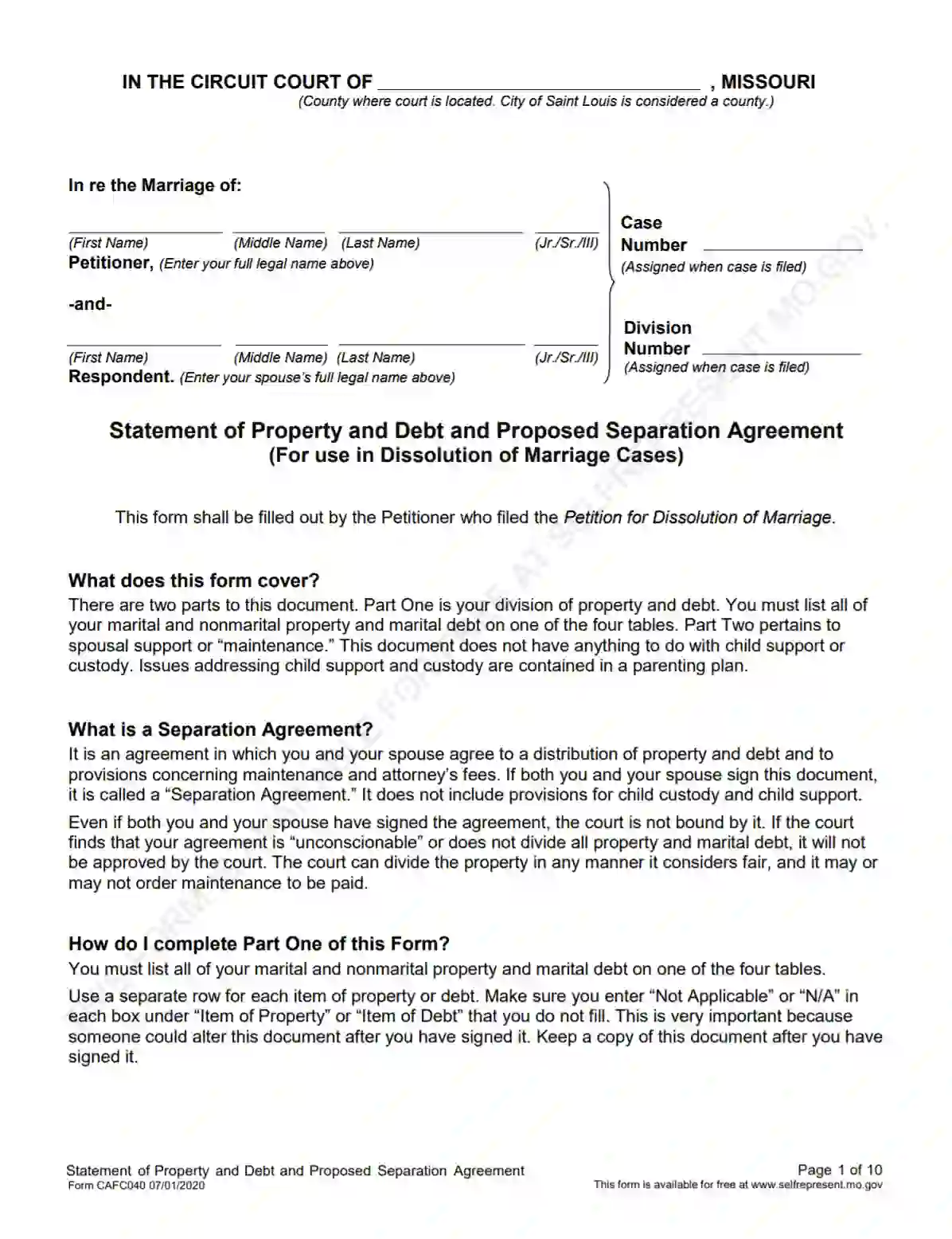
FormsPal helps you prepare the settlement agreement, not the court filings. Court forms, fees, and steps can change, so ask your local court clerk what to file before you go. The steps below cover the agreement itself, from gathering information to signing.
A complete list saves time when you reach the disclosure sections of the template. Collect as many of these records as you can before you start, so that both of you work from the same numbers.
| Information | What to collect |
|---|---|
| Names and addresses | The full legal name and current address of each spouse |
| Children | Each child's full name, date of birth, and Social Security number |
| Income | Recent pay stubs, tax returns, and any other income records |
| Accounts and retirement | Bank, investment, and retirement account statements |
| Home and vehicles | Mortgage or lease papers, deeds, and vehicle titles |
| Debts | Statements for credit cards, loans, and other debts |
| Insurance | Policy numbers and coverage details for health, life, and other insurance |
A divorce often changes who you want to name in your other legal papers. Once your situation is settled, consider reviewing these documents:
Beneficiary forms on insurance and retirement accounts deserve a look too. The account provider or a lawyer can tell you how to change them. If you later move to another state, check the page for that state, such as the Illinois marital settlement agreement.
The court sets apart to each spouse that spouse's nonmarital property. It divides the marital property and marital debts in such proportions as the court deems just after considering all relevant factors.[2] Spouses can also settle it themselves. The terms of a written separation agreement bind the court unless it finds the agreement unconscionable, except for terms on the custody, support, and visitation of children.[1]
Yes. Section 452.325 says the parties may enter into a written separation agreement.[1] It can provide for maintenance of either spouse, the disposition of any property either spouse owns, and the custody, support, and visitation of their children. The FormsPal template gives you a structure to fill in.
When the court divides marital property, it considers several factors. One is the desirability of awarding the family home, or the right to live in it for reasonable periods, to the spouse having custody of any children.[2] If you settle by agreement, put your own terms for the home in section 6 of the template.
The answer depends on how the court divides the marital property. Under Section 452.330, the court sets apart each spouse's nonmarital property. It then divides the marital property and marital debts in such proportions as it deems just after considering all relevant factors.[2] If you and your spouse agree on who keeps the house, record that in section 6 of the template.
Section 452.325 says a separation agreement can cover maintenance, property, and the custody, support, and visitation of the children.[1] The FormsPal template adds more parts, and you can fill in the ones that fit your situation:
Missouri law lets spouses make a written agreement on their own.[1] Many couples still have a lawyer read it before they sign, especially when a child, a family home, or retirement accounts are involved. Section 2.2 of the FormsPal template also says both spouses reviewed the agreement with independent legal counsel, so plan for that review.
In practice, yes. People use the terms marital settlement agreement, divorce settlement agreement, separation agreement, and property settlement agreement for the same kind of document. Missouri's statute uses the term separation agreement and applies it in a dissolution of marriage and in a legal separation.[1] The FormsPal template is titled Missouri Marital Separation Agreement.
Yes. Both spouses sign on page 7, and a notary public completes the acknowledgment on page 8. Ask your local court clerk whether the court wants anything more with your petition for dissolution of marriage.

Other Marital Settlement Agreement Forms by State
General information, not legal or tax advice.
Unless noted otherwise, the sources below are from the Mo. Rev. Stat..
